Current read
Significant local damage, with key questions still open
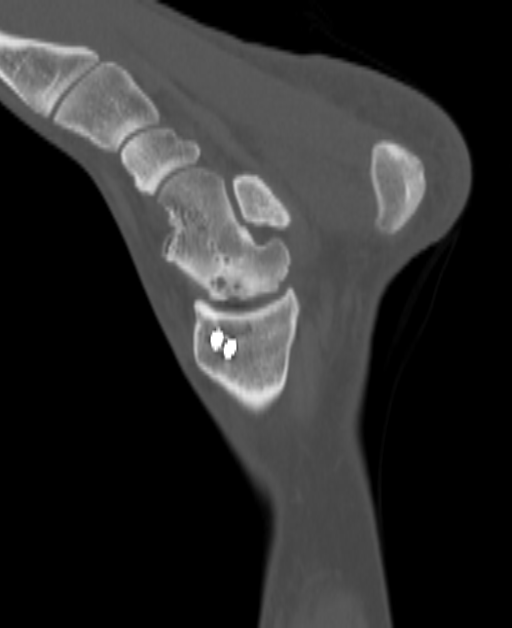
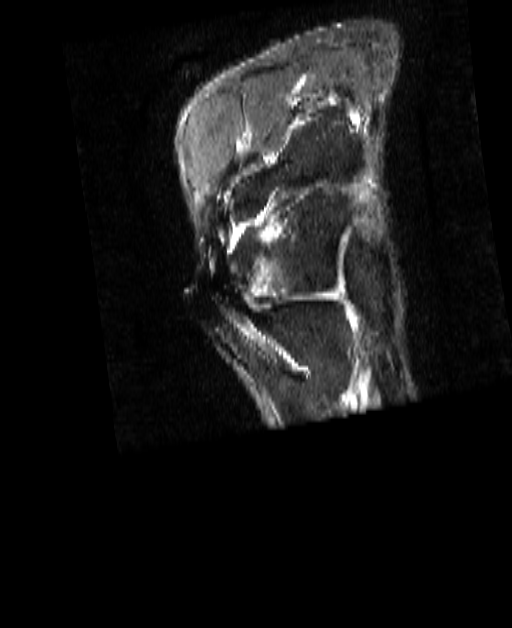
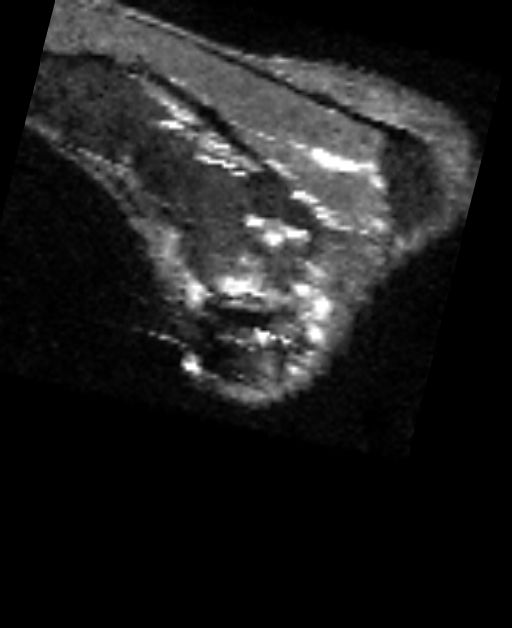
The September 1, 2026 MRI describes a 9 × 14 mm medial talar lesion with extensive cystic bone changes, moderate-to-high-grade cartilage thinning/fissuring, and reactive marrow signal. It reports no subchondral fracture or unstable fragmentation. It also documents a chronic high-grade ATFL tear and flatfoot/heel valgus alignment. Read the report in plain English.
The clinic notes add examination findings: no giving-way or gross instability on September 10, with negative drawer and varus tilt tests on August 20. Donatto documented early changes on the opposing tibial surface, three standing ankle X-rays, and four helpful Supartz injections. Pain with prolonged standing and reduced ankle motion persisted. Read the initial evaluation and follow-up summary.
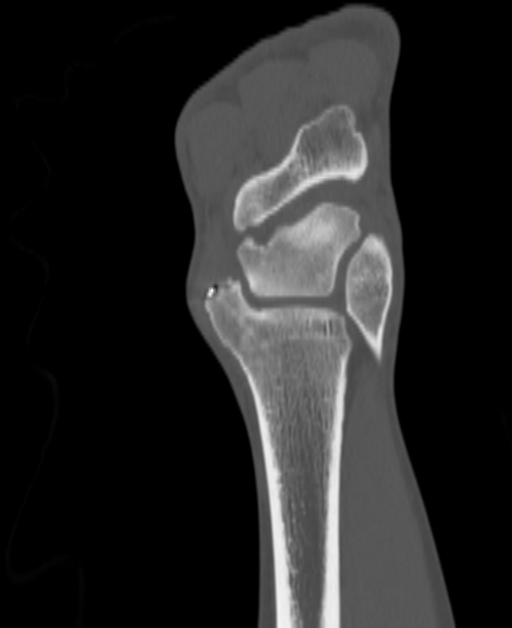
What changes now: the planned CT should define the amount and shape of bone loss and, if a bulk graft is chosen, guide donor matching. Clarify the extent of the early tibial-side changes and whether the existing standing views sufficiently assess alignment. Further stability testing is a decision for the surgeon after the reassuring clinical findings, rather than an automatic next step. Older dated research notes below are historical; their symptom snapshots, injection-date assumptions, and 2025 size estimates should not substitute for the new records.
Documented
Cartilage and bone damage, early tibial-side changes, standing pain, reduced motion, and no gross instability on examination
Not documented
Gross talar collapse, avascular necrosis, or diffuse bone-on-bone arthritis
Still unknown
Bone-defect depth, interval change, tibial cartilage grade, quantified alignment, and duration of injection relief
October 2025 vs. September 2026 MRI
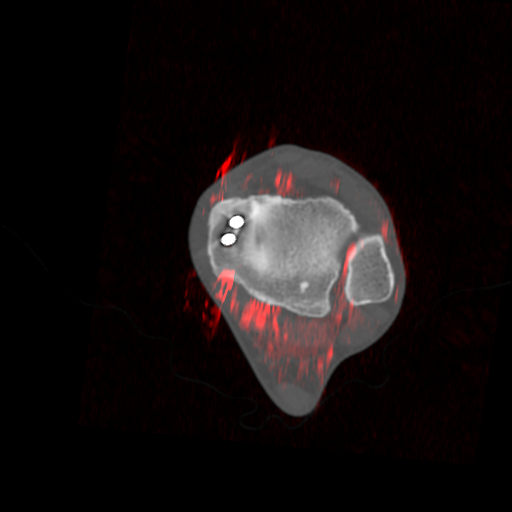
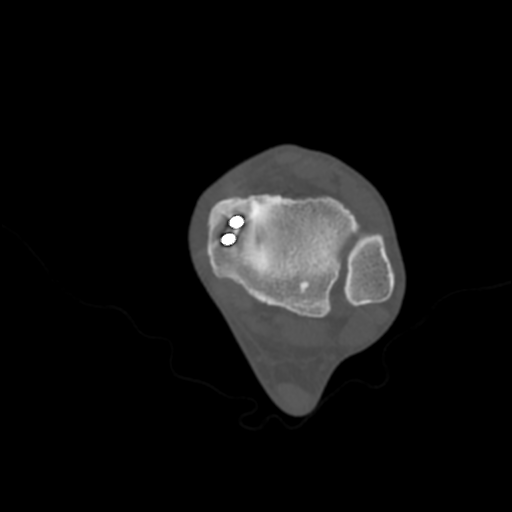
The focal graft-region abnormality is visible in both studies; progression remains unresolved. The new image comparison includes every anatomical series and localizer from both dates. The 2025 study used 1.5 T with metal-artifact-reduction sequences; the 2026 study used 3 T with different sequences and slice spacing. Brightness and image number are not directly comparable. Open the side-by-side MRI comparison and evidence summary →
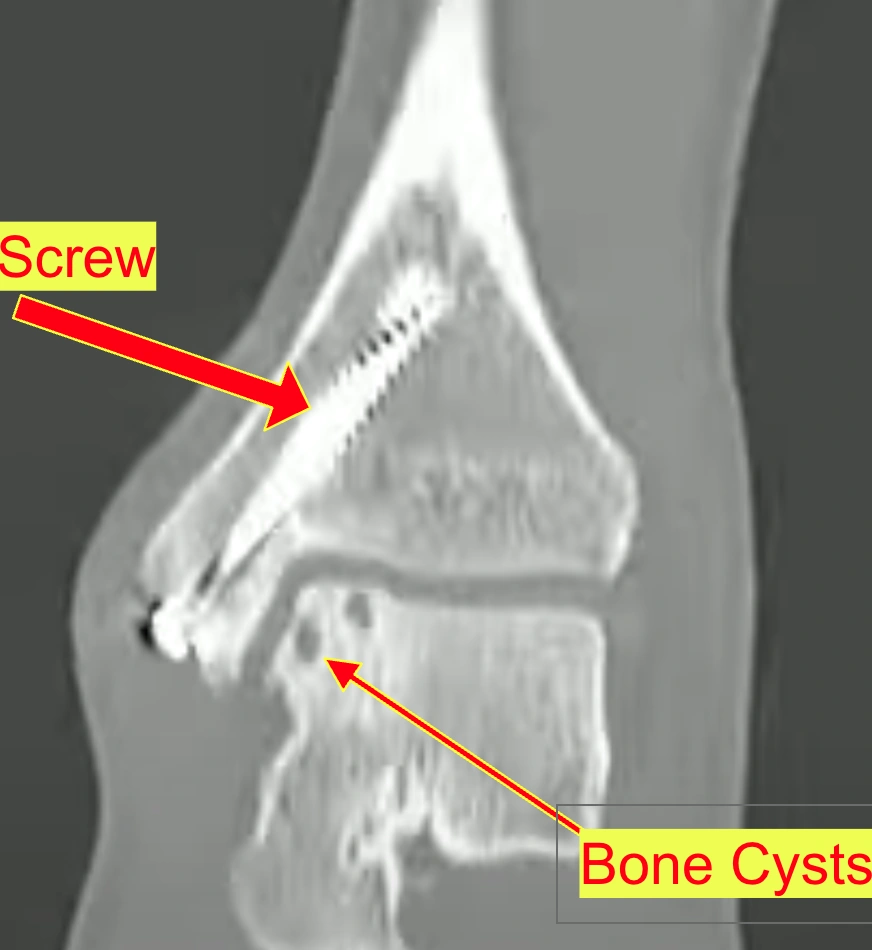
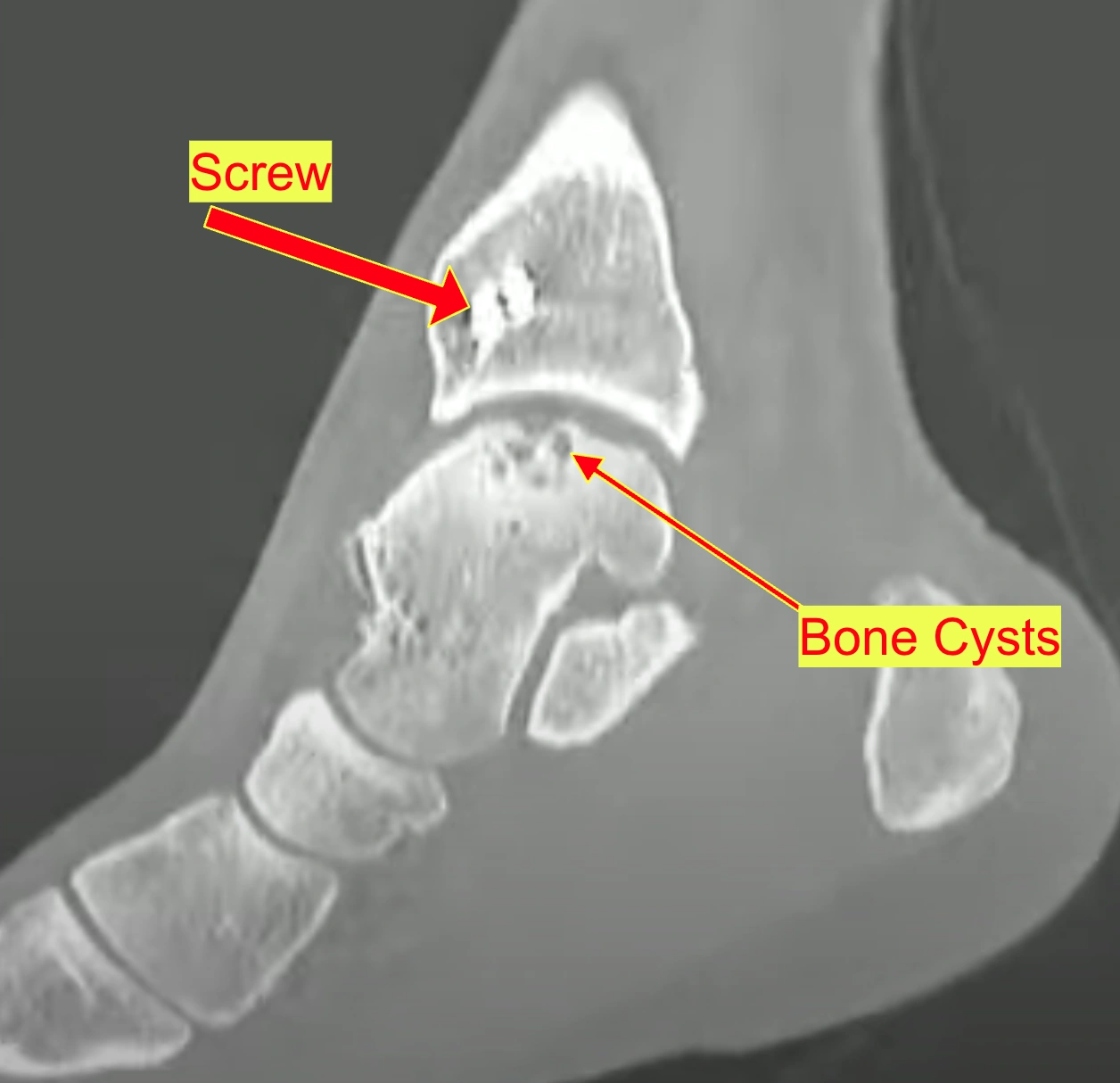
The numbers do not establish growth or shrinkage. The new MRI measures the affected region at 9 × 14 mm. The April 2025 CT described a 15 mm region of denser bone (“sclerosis”) containing individual cysts up to 4 mm. The November 2025 second opinions described roughly 15 × 10 mm cartilage involvement and a 15 × 12 × 10 mm cystic bone region. These describe different features, dimensions, or measurement boundaries.
A clinician needs to compare the actual studies side by side and measure the same structures. The new report gives no depth, individual cyst measurements, or explicit interval-change assessment. Its use of “extensive” does not by itself prove progression from the earlier description of small cysts.
What this means for the planned CT: Donatto’s written September 10 plan specifies measuring the exact bone loss and matching donor-talus size and configuration if a bulk transplant is pursued. This is preparation for a possible option; it does not establish that surgery has been chosen or a donor found.
Study dates need reconciliation: the August evaluation lists prior X-rays from April 11 and August 4, 2025, and a CT attributed to Cleveland Clinic on November 17, 2025. This site separately documents an April 2025 CT and a November second opinion. Preserve those source labels until the original study records establish which CT was actually reviewed; the clinic note alone does not confirm a separate November scan.
AI-Assisted Reaction and Questions for the Surgeon
This supports a meaningful local bone-and-cartilage problem, but it does not settle the operation. The damaged cartilage and underlying reactive bone are plausible contributors to the standing pain. The absence of a fracture or unstable fragment is encouraging. The report does not establish whole-joint, bone-on-bone disease or demonstrate that a repeat allograft, fusion, or talus replacement is necessary.
The examination makes the ligament finding more reassuring. The new notes document no giving-way episodes or gross instability, with negative anterior drawer and varus tilt tests. These findings reduce concern about obvious mechanical looseness despite the chronic ATFL tear on MRI. They do not exclude every form of instability, but the MRI wording alone is not a reason to assume ligament surgery is needed.
The opposing joint surface deserves closer attention. Donatto saw early changes at the tibial plafond, the lower shinbone surface facing the talus. The question is now how extensive those changes are, rather than whether anyone assessed that side. The note does not establish a full-thickness opposing cartilage defect, a definite kissing lesion, or end-stage arthritis. This matters when judging how much a procedure limited to the talar graft could help.
Symptom relief is documented, but incomplete. Four Supartz injections had helped according to Donatto, and avoiding impact substantially reduced pain; prolonged standing remained painful. Salk’s notes identify helpful October and December 2025 injections, confirm administration on May 18, 2026, and record benefit from that May injection at the July follow-up. The July prescription specifies every four months, but the note does not document a new July injection or resolve the date of a fourth administration. These benefits do not demonstrate graft healing. Donatto left observation, injections, and surgery under discussion.
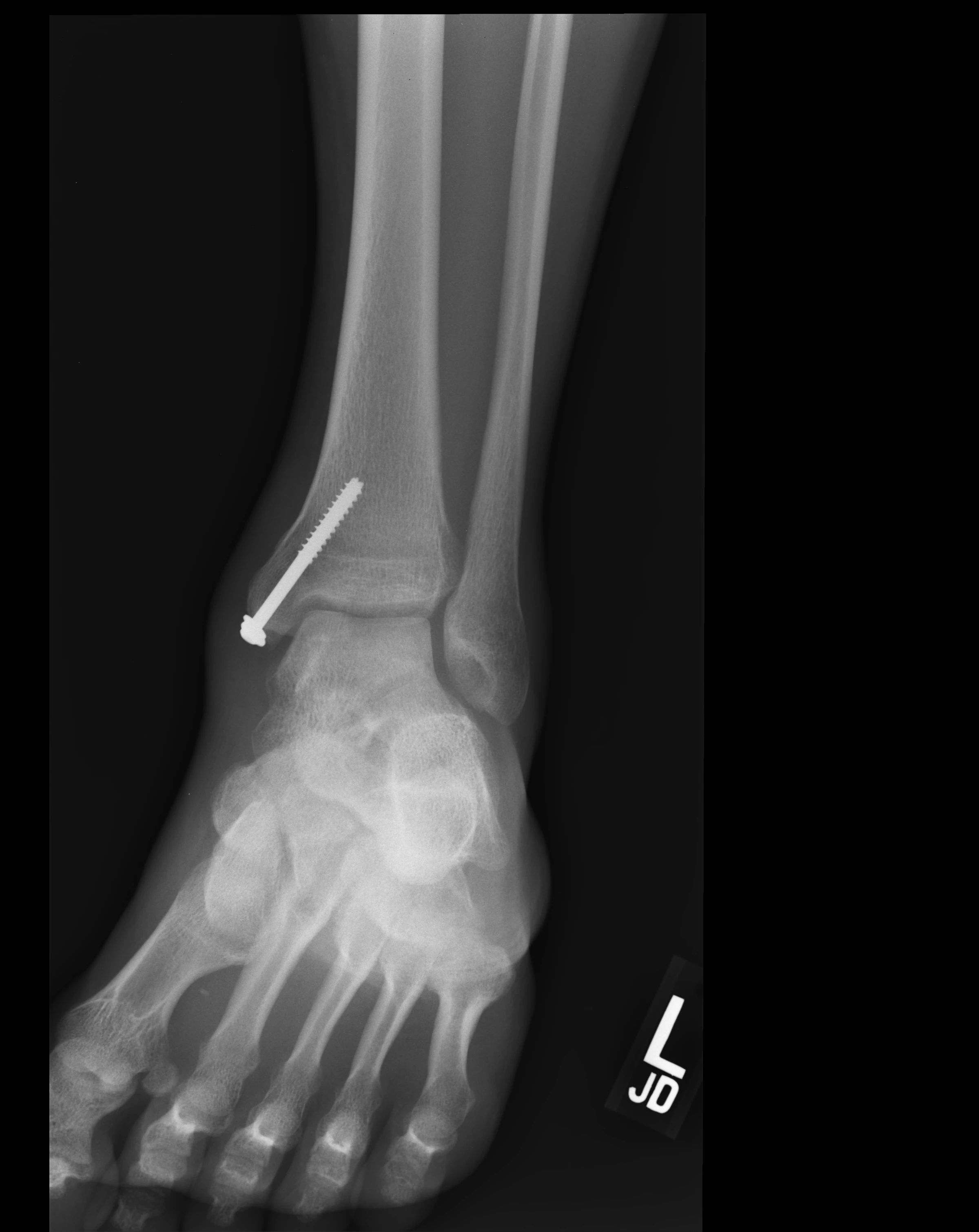
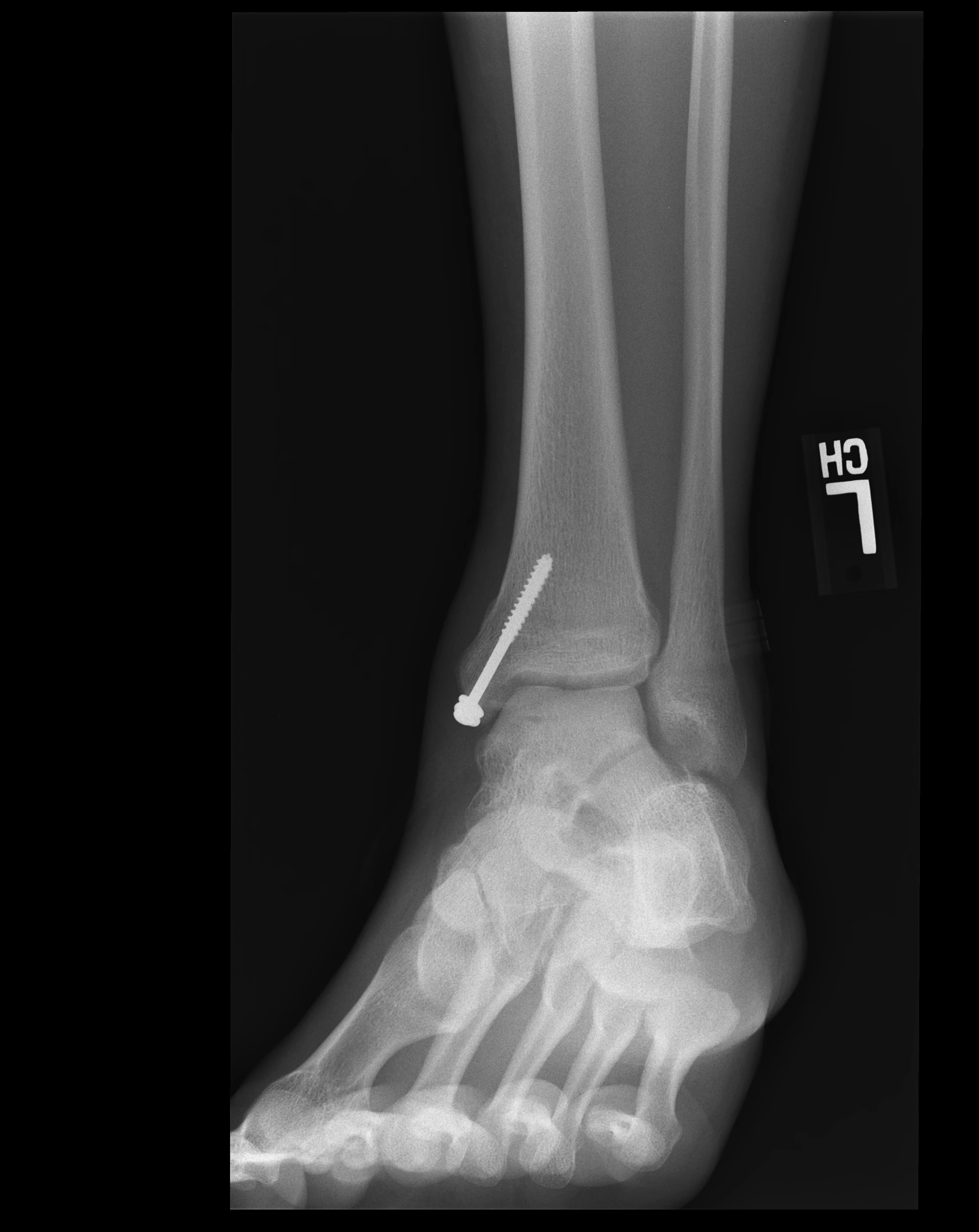
Some standing imaging is already complete. Three weightbearing ankle views were taken on August 20. They are not the same as a documented, quantified hindfoot or whole-leg alignment assessment. Review the existing views before deciding whether any additional study is useful.
This is an educational interpretation of the written report. Treatment depends on present symptoms, function, examination, and a surgeon’s review of the full images.
- Has anything actually changed? Please compare the 2025 scans with this MRI and the new CT, measuring the same lesion boundaries, individual cysts, and bone-defect depth.
- What is left of the cartilage and supporting bone? How much cartilage and supporting graft bone remain, and how extensive are the early tibial-plafond changes already noted? Is there a full-thickness opposing defect or a breach in the supporting bone layer?
- Do the reassuring stability tests settle the ligament question? Given no giving-way, no gross instability, and negative drawer/varus tilt tests, is any further stability assessment needed for surgical planning? The 2012 timeline records planned ATFL tightening; interpret the MRI with the operative report if relevant.
- Does the flatfoot alignment matter under load? Do the August 20 standing ankle views adequately assess alignment, or would quantified hindfoot/whole-leg views or weight-bearing CT add useful information? Does examination reproduce pain in the sinus tarsi?
- Which finding best matches my pain? How do you distinguish the talar lesion from the ligament, tendon, or nearby-joint findings, and what would justify surgery rather than continued symptom-guided care?
Background for the explanations: AOFAS: osteochondral lesions; AOFAS: ankle instability; MRI and CT assessment of talar lesions; AAOS: flatfoot alignment; sinus tarsi review. These sources explain the terms; the patient-specific findings come from the MRI report.
Highest-value unfinished work
What to do now
Before choosing surgery
-
1
Establish the current baseline
The notes now document prolonged-standing pain, reduced motion, and benefit from four Supartz injections. Track pain with standing, walking, stairs, and exercise; maximum standing/walking time; and the amount and duration of relief after each injection. Confirm the date of the most recent injection rather than assuming it was May 18. A dated FAOS score would quantify the function that the notes describe without a numeric score.
-
2
Use the in-person assessment to narrow the plan
Donatto has now completed an initial examination and MRI follow-up. Bring the new CT, full DICOM studies, official reports, and operative history to the next discussion with the surgeon who would perform any revision. Ask how the measured bone loss and tibial-side cartilage condition affect the options.
-
3
Document alignment, stability, and impingement
September 12 clinic-note update: no giving-way/no gross instability on September 10 and negative drawer/varus tilt tests on August 20 are reassuring. Three standing ankle views have already been obtained; quantified hindfoot or whole-leg alignment is not documented. Match any additional examination or imaging to unresolved symptoms and the proposed procedure.
Review the recorded stability and range-of-motion findings alongside hindfoot/whole-leg alignment, gait, and possible impingement. Additional alignment views, stress radiographs, or weight-bearing CT should depend on what remains unresolved after the existing examination and imaging. DGOU diagnostic recommendations
-
4
Complete a structured joint-preservation trial
Document skilled physical therapy, proprioception and stability work, calf/peroneal strength, brace or load-sharing AFO use, footwear or orthotic assessment, and low-impact conditioning. Avoid repeated basketball, running, and jumping while they reliably provoke symptoms, without becoming generally inactive.
-
5
Ask MASCOT how it defines “bony defect depth” — before assuming disqualification
Added July 29, 2026. The trial's exclusion 1 bars an underlying bony defect depth over 5 mm, and the recorded cyst depth here is 10 mm — which this page has read as an automatic no. But inclusion 3 explicitly admits lesions “with or without cysts,” and a Hepple V cystic lesion will commonly exceed 5 mm of subchondral involvement, so the protocol invites a lesion type its own exclusion screens out. “Cyst depth” and “underlying bony defect depth” may not be the same measurement. Ask Leslie Mellor at UC Davis (916-826-8135) and Vericel Clinical Affairs (978-347-2876) one precise question: how is that depth defined and measured for screening, and on which imaging? Every other numeric criterion — age, the 1.2 cm² size floor, the 90-day injection washout, and the prior allograft — has now been checked and clears.
Temper the expectation, though. The hope has been that the 10 mm is an MRI artifact of bone-marrow oedema and that a CT would re-measure it under 5 mm. The best direct evidence says it will not: a study of 48 surgically-treated cystic talar lesions found no significant difference between MRI and CT on depth (p=0.155), length or width, with excellent interobserver agreement [265]. The “MRI overstages” caution in the literature is about cartilage grading and marrow oedema, not about measuring a discrete cyst — and a Hepple V lesion has a discrete cyst. So this is worth a phone call because it is a definitional question about what the protocol means, not because a new scan is likely to produce a smaller number.
Corrected August 1, 2026 — and this is the most consequential thing found this week. The 10 mm is contradicted by this site's own CT report, and the paragraph above was arguing against a hope that the primary documents had already answered. Three numbers have been sitting on this page for months without ever being set side by side:
- The April 2025 CT, as reported by the radiologist who read it: “15 mm area of sclerosis of medial talar dome with several subchondral cysts measuring up to 4 mm.” That is the treating-side measurement, from the modality the trial protocol is most likely to rely on — and it is under the 5 mm cap, not double it
- Dr. Choung, having reviewed both the MRI and the CT: “Cysts seen on CT are confirmed to be small — most of the signal is from reactive bony inflammation versus fluid-filled cysts.” That is a clinician saying, in advance, exactly what the paragraph above says not to hope for
- The 10 mm itself: it comes from Dr. Sagar Chawla's Cleveland Clinic opinion of November 2025 — “bone cyst ~15mm x 12mm x 10mm” — which was a remote records review, not a reading by the radiologist who acquired the study
The honest reading, which is not “he qualifies”: these two measurements are probably describing different structures. A 15 × 12 × 10 mm figure most likely traces the whole bony envelope of the lesion — sclerosis, oedema and cysts together — while “several subchondral cysts up to 4 mm” describes the discrete fluid-filled pockets inside it. Neither is self-evidently what MASCOT means by “underlying bony defect depth,” and no one on this page has read the images. The April 2025 CT is also now sixteen months old.
What changes is the expected answer. This page has been treating the depth gate as a near-certain disqualification and advising him to plan around ineligibility. On his own record that is not supported: there is a documented, unresolved contradiction, and one of the two numbers clears the cap comfortably. The call to Leslie Mellor and Vericel is now worth more, not less, and it should carry a second question for whoever re-reads the imaging: which structure does the depth refer to, and what is the depth of the bony defect as distinct from the surrounding zone of sclerosis? Ask for it in writing.
Three further gates that had not been examined, and one may matter more than the depth. Inclusion 2 requires FAOS Pain and FAOS Sport/Recreation both at or below 50, on a scale where 100 means no symptoms — so it is possible to be too well to enrol. One load-triggered episode in 67 days that resolved in two is not obviously a score below 50. The planned check-in uses VAS and AOFAS, which cannot answer this — add FAOS to it. Second, exclusion 7 (needing an osteotomy for implantation) is determined at the Visit 2 arthroscopy, which means undergoing a procedure and then being excluded, against a recorded 8.4% nerve-injury rate. Ask whether it can be pre-assessed on imaging. Third, the trial randomizes to MACI or bone marrow stimulation — and for a revision lesion that is the arm with the weakest evidence: a 2026 prospective series found non-primary lesions improved a median of only 1 point on walking pain versus 3 for primary lesions (p=0.01) [266]. Ask what happens if he randomizes to that arm and whether he can withdraw before that surgery.
-
6
Ask Dr. Salk about HA with a corticosteroid rather than repeating HA alone
Added July 29, 2026. The AAOS ankle guideline was read in full this week. Its recommendation against intra-articular hyaluronic acid alone is Strong at High quality of evidence — that is the exact intervention currently being paid for in cash — but it contains one carve-out: there “may be a benefit for short term improvement in pain and function when combined with corticosteroid.” Two randomized trials support that, though neither had a placebo arm, so combination therapy is only shown to beat corticosteroid alone over roughly six weeks to three months. Worth asking before another Supartz series is bought: is a combined injection an option here, what would it cost, and what would count as success. Also worth raising that the guideline itself calls routine HA use “poor resource utilization” at $500–2000+ per series — the goal is a decision made on evidence rather than momentum.
-
7
Get coronal alignment actually measured — it may open a different kind of option
Added July 29, 2026. Alignment has been on this list as item 3 for months and has still never been measured. A July 2026 series gives a concrete reason to close that gap: fibula-preserving supramalleolar osteotomy for varus ankle arthritis corrected talar tilt and the medial distal tibial angle, and cartilage grade was stable or improved in every patient at second-look arthroscopy. That is realignment — unloading a medially overloaded ankle rather than resurfacing it — and it sits upstream of every cartilage procedure being considered. It only applies if there is a genuine coronal deformity, which is unknown here. Whatever else is decided, the answer to “is this ankle mechanically overloaded on the medial side” changes which options are even on the table. Level IV, 22 patients, 17-month follow-up — a question to raise, not a plan.
-
8
Request one unified full-image review
September 2026 update: include the new MRI report and images, and the CT Dr. Donatto recommended on September 10 to assess possible lesion expansion. Ask for an explicit comparison with the 2025 studies using the same anatomical boundaries and dimensions.
Ask the surgeon or musculoskeletal radiologist to answer the unresolved questions directly: remaining graft cartilage, tibial-side cartilage, graft congruity, subchondral-plate breach, cyst communication, arthritis grade, and whether there is any true collapse or avascular necrosis. Repeat CT or MRI only for a meaningful clinical change or procedure planning.
-
9
Score the FAOS this week — the link this page gave you is dead
Added July 30, 2026. This plan has said “add a monthly FAOS” for weeks, and the questionnaire URL it pointed at now returns a 404. Working routes: the official scoring guide [282] is still live, and an archived copy of the questionnaire was verified byte-identical to the original. The instrument also has a current official home at ePROVIDE (free registration).
The formulas, because the direction is counter-intuitive — 100 means no symptoms: Pain = 100 − (sum of the 9 pain items × 100 / 36); Sport & Recreation = 100 − (sum of the 5 sport items × 100 / 20). Raw items run 0 = None to 4 = Extreme. To score at or below 50 on Sport/Recreation — the trial's threshold — you would need to average moderate difficulty or worse across squatting, running, jumping, twisting and kneeling.
Do this before booking anything in Sacramento. If the number comes back well above 50, that is the answer, and it saves a trip. Re-score every four weeks and date each one; the series is worth more than any single number.
-
10
Update the function record before drawing eligibility conclusions
September 12 update: the August/September clinic notes now describe persistent standing pain and increasing dysfunction. The older July episode count below is a historical snapshot, not a current severity assessment. These notes supply no FAOS score or precise standing-time limit, so they do not by themselves resolve eligibility.
Added July 30, 2026. This is the finding that reframes the rest of this list. The insurance guideline that governs cartilage surgery was read in full this week, and the binding constraint is not the talus criteria this page has been arguing with — it is the patient-selection requirements that gate every procedure in the document: “disabling localized knee or ankle pain for at least 3 months, which has failed to respond to at least 6 weeks of conservative treatment,” with significant impairment defined as “pain rated at least 3 out of 10 in intensity and associated with inability to perform ADLs and/or IADLs” [280]. The trial's FAOS threshold says the same thing from the other direction.
One load-triggered episode in 67 days that resolved in two days does not meet either. That is genuinely good news about the ankle, and it means the useful work right now is not qualifying — it is documenting, so that the three-month clock and the imaging baseline already exist if things change rather than starting from zero on the day they are needed. Concretely: log every episode contemporaneously with date, trigger, pain score, functional limitation and duration; ask Dr. Salk to chart them rather than keeping them privately; get the baseline alignment film; and keep the dated FAOS series running.
-
11
Clarify bone-defect depth and the opposing cartilage
September 12 update: Donatto has now documented early tibial-plafond changes. Whether these constitute a defined kissing/bipolar lesion, and the current bone-defect depth, remain unresolved; the old statement that the tibial surface has never been assessed is superseded.
Added August 1, 2026, and it is now the highest-value item on this list. This page has spent a month treating a 10 mm cyst depth as the thing that disqualifies him from the trial. His own April 2025 CT report says “several subchondral cysts measuring up to 4 mm,” and Dr. Choung, having reviewed both studies, said the CT cysts are small and that most of the signal is reactive bony inflammation. The 10 mm comes from a remote records review. Those are very probably measurements of two different things — the whole bony envelope versus the discrete cysts inside it — but that is precisely the point: nobody has ever asked which one the trial means. Details and caveats are in item 5 above.
Two questions, one appointment. Ask whoever re-reads the imaging — Dr. Salk can order it, or it can ride along with the in-person assessment in item 2 — to state in writing: (1) the depth of the bony defect as distinct from the surrounding sclerosis, and (2) whether there is a kissing lesion on the tibial plafond. The second question is new this week and it matters twice over: a consensus published July 31 names kissing lesions one of the key prognostic factors in this joint [301], and MASCOT excludes kissing or bipolar lesions outright. The April 2025 CT says nothing about the plafond either way; it records only mild joint-space narrowing and osteophytes.
Why to do this before calling Sacramento. Both of the trial's remaining gates — the depth cap and the kissing-lesion exclusion — turn on a radiologist's answer to a question nobody has put. One reading of existing images could resolve both, and it costs a records request rather than a scan.
-
12
Send one letter this week — it has a 30-day legal clock and it unblocks three other things
Added August 3, 2026. “Is the plan employer self-funded?” has sat on this page as an unresolved document question for four sweeps, and it now gates three separate recommendations: which appeal route applies, whether the second-opinion statute below applies, and whether the free expert-opinion benefit exists. It is not actually unresolvable. Under 29 U.S.C. §1024(b)(4), a plan administrator must, “upon written request of any participant,” furnish the summary plan description, the latest annual report, and the “contract, or other instruments under which the plan is established or operated.” And §1132(c)(1) makes an administrator who fails to do so “within 30 days after such request… personally liable… in the amount of up to $100 a day” [331].
Do it concretely: one dated email to HR or the plan administrator, copied to a certified letter, asking for those three documents by name. It costs nothing and converts a standing unknown into an obligation with a deadline. A quieter parallel route, if contacting the employer is unappealing: the Department of Labor's EFAST2 Form 5500 search, where line 9a distinguishes Insurance from General assets of the sponsor — but treat that as corroboration only, since small plans are exempt from filing and filings lag about a year.
The sixty-second version, which you can do before writing anything. Open the plan booklet to the grievance section. If it prints the Department of Managed Health Care notice in boldface with 1-888-466-2219, the plan is Knox-Keene and item 13 applies. If it names the California Department of Insurance (1-800-927-4357) instead, it is a CDI-regulated policy and no equivalent second-opinion statute was found. If it names neither, the plan is self-funded — and the letter above is the only way to prove it.
-
13
Ask for the second opinion under the statute instead of paying $800 for it
Added August 3, 2026. This page has spent three weeks pricing remote second opinions — Cedars $590, Duke $800, NYU $800, UCSF $900, Stanford $975, Cleveland Clinic $1,690 — and treating the cost as unavoidable. California Health & Safety Code §1383.15 may make it unnecessary. The statute requires a plan to “provide or authorize a second opinion” on request, by a professional who “possesses a clinical background, including training and expertise, related to the particular illness, disease, condition” — and where no such provider exists in network, “the plan shall authorize a second opinion by an appropriately qualified health professional outside of the plan's provider network” [329].
What to say, on the phone and then in writing the same day. Call the member-services number on the back of the card — Anthem publishes no universal California member line — and say: “I am requesting a second opinion under Health and Safety Code section 1383.15. My condition is a revision osteochondral lesion of the talus after a failed fresh talar osteochondral allograft. I do not believe any participating provider in Northern California has a clinical background specific to this condition, so I am requesting authorization under subdivision (g) for a second opinion outside the network.” Name the surgeon you want — Bugbee, Hunt or Murawski — rather than leaving the choice to the plan.
Do item 12's sixty-second test first, because if the plan is self-funded this statute does not apply and the request should be framed as a network-adequacy exception instead. One thing that could not be verified: whether his specific plan bundles a free expert-opinion benefit such as 2nd.MD, Teladoc Medical Experts or The Clinic by Cleveland Clinic. Anthem never states this publicly; it is set per employer contract, and the plan documents from item 12 will list it.
-
14
Book Scripps before September 30 — and know what the date actually protects
Added August 3, 2026. Scripps' own page, updated July 30, confirms the Anthem contract extension “is set to expire on September 30, 2026” with negotiations unresolved and Scripps stating that “Anthem has not agreed to fair payment” [332]. This page has carried that deadline as “see Bugbee before the network lapses.” There is more to it than beating a date.
California continuity of care — Health & Safety Code §1373.96 for DMHC plans, Insurance Code §10133.56 for CDI policies, so one applies under either regulator — protects a “surgery or other procedure… authorized by the plan as part of a documented course of treatment and… recommended and documented by the provider to occur within 180 days” of the termination date, at contracted rates; a serious chronic condition can qualify for up to twelve months [330]. So the visit is worth more than the visit. If Bugbee sees him before September 30 and documents a recommendation with a target date, that protection can run to March 29, 2027. The enrollee has to request it — it is not automatic.
One practical fact: Bugbee's Scripps profile says “In-person visits only” — no video visit, no online scheduling — so the trip to San Diego is unavoidable. 858-554-7993. Worth noticing honestly: his profile lists osteochondral allograft transplantation among his procedures but never uses the word “talus.”
Re-verified August 4, 2026: the Scripps page is unchanged since its July 30 update and still reads “Nothing has changed at this time. You may continue to schedule appointments and receive care at Scripps… as you normally would.” The September 30 expiry stands, with 57 days left.
-
15
Get the alignment film for about thirty-five dollars — both blockers are now solved
Added August 4, 2026. The standing hip-to-ankle alignment film has been an action item since July and has never been taken. Two things were in the way, and this week both were resolved.
Blocker one, who can order it. Dr. Salk cannot — a mechanical-axis study images the femur and hip, outside podiatric scope, and California has no self-referred radiography [340]. Two routes work. The cleanest is to fold the order into the UC Davis Sports Medicine consult (916-734-6805) that this plan already recommends — ask when booking for the order to be placed ahead of the visit so the film can be taken the same day; UC Davis Radiology takes plain films walk-in, Monday to Friday 8–5, scheduling 916-734-0655, order fax 916-703-2254. The second route is a chiropractor: NorthBay's EOSedge page says in its own words to “ask your doctor or chiropractor for a referral” and that there is “no appointment needed, just walk in” [347]. A cash chiropractic visit legally generates the order. One thing to confirm by phone: whether UC Davis accepts an order written by a non-UC-Davis physician.
Blocker two, the price — and this is the good news. Last week's $33.57 figure was flagged as unconfirmed. It has now been confirmed by downloading UC Davis's own machine-readable charge file and reading the line directly: CPT 77073, outpatient, facility billing class, payer Blue Cross, plan “Ucd Hb Blue Cross Ppo”, $33.57 — against a $252.80 cash price and a $632 gross charge [346]. Expect one small extra bill: that line is the hospital's technical charge only, so a separate radiologist read (77073-26) will follow, likely $10–20 but unverified.
The comparison is the whole point. NorthBay — the best-matched machine in the region — charges $2,057 cash for the same code. The same study at UC Davis under this plan should land near $35 plus a small read. Order it by name, not by code: ask for a standing full-length weight-bearing hip-to-ankle alignment radiograph for mechanical-axis assessment, because the code's official descriptor reads “bone length studies” and ordering by number alone can return a leg-length report instead.
Closed this week, so nobody re-chases it: Diagnostic Orders Direct, a $40 telehealth service that issues imaging orders without a doctor's visit, does not serve California [348].
-
16
Ask the one question that reframes this whole file: why did the first graft last twelve years?
Added August 4, 2026. This is not a new study. It is a fact already in the timeline that this site has never put to work, and on review it may be the strongest single argument available.
The 2012 allograft was implanted in October 2012 and the pain returned in March 2025 — roughly twelve and a half good years. Set that against the only published series of revision osteochondral allograft of the ankle, which reports a mean time to failure of 6.7 years [190], and against primary talar allograft survivorship of about 89% at ten years. His first graft did not fail early. It outlasted the average, roughly doubling the mean revision failure interval.
Why this matters more than it sounds. Dr. Salk advised against a second allograft on the grounds that “the results from that are very poor.” That is a fair reading of the published averages — and this patient's own history sits well above them. Those two facts are in tension, and nobody has been asked to resolve it. A durable twelve-year response to a specific operation in a specific joint is exactly the kind of individual evidence that a population average cannot see.
Use it three ways. Lead with it when calling any surgeon's office — “revision case, prior bulk fresh talar allograft that gave twelve pain-free years” is a materially different sentence from “failed allograft.” Put it in any second-opinion submission. And if an authorization is ever needed, it is a patient-specific argument for the procedure that a guideline written on averages does not answer. The honest caveat: one patient's good result does not predict the second graft's, and the Gaul series still reports 50% needing further surgery. It is a question worth forcing, not a conclusion.
-
17
The alignment film is now fully unblocked — one referral request to Dr. Salk starts it
Added August 5, 2026. This has been an action item since July and has never been acted on. Every blocker on it is now down, and the last one turned out to be a misreading of what “Dr. Salk cannot order it” implies.
He cannot order the film. He can still start the chain. UC Davis states its own referral rule plainly: “Most UC Davis Health medical specialists require a referral from either a primary care physician or another specialist, either in the community or at UC Davis” [363]. Dr. Salk is a community specialist. So the sequence is: ask Salk for a referral to UC Davis Foot & Ankle → book on 916-734-6805 → the UC Davis physician writes the hip-to-ankle order → walk in for the film. Nothing here requires a chiropractor or a workaround.
Go to a hospital-based site, or the price does not apply. The $33.57 sits under the plan name “Ucd Hb Blue Cross Ppo” — hospital billing. UC Davis's own billing page lists its hospital-based outpatient clinics as 4868 X St, 4860 Y St (ACC), 2521 Stockton Blvd and 2279 45th St; the Davis, Auburn, Midtown and Point West clinics are not among them [364]. Walk-in X-ray, Mon–Fri: Main Hospital 4301 X St Suite 1776, 8–5, 916-734-0655; 48X Complex 4868 X St Suite 1C, 8–5; ACC 4860 Y St Suite 0500, 8–5:30 (check in at Suite 1800).
The full price is now known, and it is under $65. The radiologist's professional fee could not come from a UC Davis file — the hospital's machine-readable file was parsed in full and all 48,795 charge entries are billing class facility, with zero professional lines, because physician groups are not covered by the price-transparency rule. The anchor instead comes from Medicare's own claims data: HCPCS 77073 in California, place of service F (hospital outpatient, professional component only) averaged $13.87 allowed across 347 providers [365]. So roughly $33.57 + $14–30. Against NorthBay's $2,057 cash and Sutter's $793 — which carries no cash discount at all, gross and discounted both $793 [366] — UC Davis wins by more than an order of magnitude.
Order it by name, not by code. UC Davis's own chargemaster line for 77073 reads “HC BONE LENGTH SCANOGRAM” — so “standing hip-to-ankle scanogram / bone length study” is the phrase that will be recognised at the desk. Ruled out so it is not chased: Shriners Children's on Stockton Blvd has the region's only EOS scanner but serves birth to 18.
-
18
Email the MASCOT depth question to Vericel's own trial inbox — and ask the second half nobody has asked
Added August 5, 2026. Vericel publishes a MASCOT-specific address on its clinical development page — MACIANKLE@vcel.com [367]. It is obfuscated on the page against scrapers, which is why earlier sweeps never surfaced it; it was decoded from the page source and verified August 5. Email rather than phone, because it produces a written answer by construction.
Send it to MACIANKLE@vcel.com and clinicalhotline@vcel.com together, then to Leslie Mellor at UC Davis (ljmellor@health.ucdavis.edu, 916-826-8135) — she physically holds the protocol. The question:
For MASCOT (NCT06915233, protocol 55-2410-01), the exclusion criterion reads “lesions with an underlying bony defect depth of > 5 mm.” From what anatomic reference level is that depth measured — for example, from the original subchondral bone plate level, or from the articular cartilage surface? And is that measurement made on baseline MRI by the site investigator, or adjudicated by a central imaging reader?
The second sentence is the one this site has never thought to ask, and it may matter more than the first. If a central reader adjudicates eligibility, then a friendly site investigator's informal read does not settle anything — and the strategy of getting a sympathetic local measurement collapses. Better to know that before building a plan on it.
-
19
Two surgeons worth calling who are not exposed to the Scripps deadline — and the deadline is 52 days out
Added August 5, 2026. Time-sensitive. Scripps' own page, stamped updated July 30, 2026, still says the Anthem contract extension “is set to expire on September 30, 2026” [368]. Not resolved, not extended. Dr. Bugbee — author of the only published revision-talar-allograft series in the world — is at Scripps, so a Bugbee consult booked after September 30 may fall out of network. Appointments 858-554-7993; Scripps Clinic foot & ankle is 858-554-9300.
The hedge is a surgeon in the same county who is not at Scripps. Ariel A. Palanca, MD, Palomar Health Medical Group, 15611 Pomerado Rd 5th Floor, Poway, 858-485-0050. She is a co-author of “Fresh Osteochondral Allograft for Large Talar Osteochondral Lesions” (Foot Ankle Clin 2024) — the exact operation under discussion — and Palomar's own accepted-insurance page lists “Anthem Blue Cross HMO, PPO, EPO” [369]. Unverified: whether she is accepting new patients.
Also new: Eric Wan Tan, MD, Keck Medicine of USC, 800-872-2273 — his profile states “Accepting New Patients” and lists Anthem Blue Cross Prudent Buyer, which is the actual name of California's Anthem PPO network [370]. Honest caveat: he lists cartilage preservation but has no published talar structural-allograft work, so he is a weaker on-point match than Palanca.
Ask every office the same precise question: “Are you contracted with the Anthem Blue Cross Prudent Buyer PPO network?” — not “do you take Anthem,” which is ambiguous. And check them yourself against Anthem's guest directory at anthem.com/ca/find-care, which needs no login and is the only authority that actually counts; every network claim here comes from the provider's page, not Anthem's.
-
20
Ask for a Good Faith Estimate before the next cash-pay anything — you legally qualify, and this site has never mentioned it
Added August 5, 2026. Federal law defines a “uninsured (or self-pay) individual” to include someone who has coverage “but who does not seek to have a claim for such item or service submitted to such plan or coverage” [371]. Anthem excludes all HA injections class-wide, so no claim is ever submitted for Supartz — which makes him a self-pay individual for it by definition, and equally for any cash-pay imaging.
What that entitles him to: a written, itemised estimate before paying — within 3 business days of simply asking, or 1 business day if the service is scheduled at least 3 business days out. If the final bill exceeds the estimate by $400 or more, he can dispute it, with 120 calendar days from the initial bill to file, and the administrative fee is refunded as a bill reduction if he wins. Help line 1-800-985-3059.
The practical version is one sentence: before the next Supartz cycle and before any cash-pay scan, say “I'm self-pay for this — please send me a Good Faith Estimate.” It costs nothing, it is enforceable, and it turns a verbal quote into a document. Directly relevant given that a $200 Supartz quote and a $240.76 visit balance have already had to be reconciled by hand once.
-
21
If anything is denied, California SB 1120 gives you three questions that are hard to answer badly
Added August 5, 2026. SB 1120 (Chapter 879, in force since January 1, 2025) amended both Health & Safety Code §1367.01 and Insurance Code §10123.135, so it reaches Anthem whichever way the plan is regulated. It requires that no one may deny or modify a request for medical necessity except “a licensed physician or a licensed health care professional who is competent to evaluate the specific clinical issues involved”, and that any AI or algorithmic tool used in utilization review “does not base its determination solely on a group dataset” and “does not supplant health care provider decisionmaking” [372].
Why this fits his case unusually well. Revision talar allograft has a world literature of one series, n=20. A denial written off population averages is close to the exact failure mode the statute was passed to address — a group dataset supplanting an individual clinical judgment. On any denial, ask in writing: (1) the name, licence type and specialty of the reviewer; (2) whether an AI or algorithmic tool was used at any stage; (3) what patient-specific information that tool used. Note this is a route for the surgical and imaging side — it will not move the HA exclusion, which is a benefit-design exclusion rather than a medical-necessity denial.
-
22
Learn the three billing codes this decision actually runs on — this site has never carried them
Added August 5, 2026. The site carries CPT 28446 (talar osteochondral autograft) but has never mentioned the three codes that a revision-allograft authorisation would actually be adjudicated under: 27415 (osteochondral allograft), 27416 (osteochondral autograft), and J7330 (autologous chondrocyte implant — the MACI code) [373].
Why it is worth knowing them by number. A prior authorisation is decided against a code, not against a description — and payer medical policies are written per code. Asking “what is your medical policy for 27415?” gets a specific document; asking about “cartilage surgery” gets a call-back. It also lets him check a quoted price against the Medicare fee schedule before agreeing to anything, and it pairs directly with the Good Faith Estimate right in item 20.
→ Worth pairing with a paper Dr. Bugbee himself published — “Variability in Private Payer Medical Policies for Osteochondral Allograft Transplantation Demonstrates the Absence of Standardization in Medical Criteria Between Payers” (PMID 36579033). The surgeon most likely to do this operation has published on the fact that payers deny it inconsistently, which is useful to have in hand before the first denial rather than after.
-
23
Ask two questions about the MRI you already own — they carry odds ratios of 10 and 17, and they cost nothing
Added August 6, 2026. This is the highest value-per-effort item on the page. A study of 56 people with cystic talar lesions managed without surgery, followed a median of 98 months, found that most cysts essentially do not move — median growth 0.3 mm³/year, about three-quarters flat or shrinking, no correlation between cyst growth and symptoms, and “none of the cases progressed to OA” [389]. But the top quartile grew roughly 450 times faster than the median, at about 137 mm³/year. The entire question is which group he is in.
Three factors predicted progression, and two are readable off imaging that already exists: bone marrow edema (OR 10.19) and wall breakage — loss of subchondral bony integrity — (OR 16.94), alongside initial cyst volume. So the request is one sentence, to Dr. Salk or to whoever next reads the films: “On my most recent MRI, is there bone marrow edema around the cyst, and is the cyst wall broken or intact?”
Why it changes something. Right now the pace of this whole decision is set by how the ankle feels, and this study says symptoms and cyst behaviour are uncorrelated. Two answers he can obtain for free convert “wait and see how it goes” into a stratified estimate. Read with its limits: retrospective, and it studies primary lesions rather than one under a failed allograft — a graft-host interface that has already failed once is not the same mechanical situation. It informs urgency; it does not settle it.
-
24
Before the MASCOT screening call, understand that screening is the operation — and add one more question to the Vericel email
Added August 6, 2026. Every previous sweep read the trial's eligibility criteria. None read its study design, and the design changes what “trying for the trial” means [376].
Eligibility is decided in the operating room. Participants have an index ankle arthroscopy “to further assess clinical trial eligibility… further evaluated against entry criteria,” and the osteotomy exclusion is explicitly determined there. Both of his live risks — the bony depth and whether the lesion needs an osteotomy — are adjudicated after he is under anaesthetic. He can be excluded on the table, having had surgery and received no treatment.
Then: the biopsy comes before the coin flip. “All participants who meet the eligibility criteria… will have a cartilage biopsy taken prior to randomization.” And the marrow-stimulation arm is performed during that same arthroscopy — so if he draws it, he wakes up having had it. That answers the question this page has been telling him to ask the coordinator, and the answer is that there is no practical withdrawal window for that arm. The MACI arm, by contrast, is a second open operation via arthrotomy 5 to 12 weeks later. MACI is two surgeries; marrow stimulation is one.
The new question for MACIANKLE@vcel.com, alongside the depth question in item 18: “Vericel has had FDA approval for arthroscopic MACI delivery — MACI Arthro — since August 2024 for the knee [377]. The MASCOT protocol specifies talar implantation via arthrotomy. Is arthroscopic delivery permitted under this protocol — and if arthrotomy is required, does that make the osteotomy exclusion more likely to apply to a medial dome lesion?” None of this is a reason to skip the trial. It is the difference between agreeing to a phone call and agreeing to an operation.
-
25
Send one email to Bologna — there is a trial whose entry criterion may be the very depth that disqualifies him everywhere else
Added August 6, 2026. The recurring structural problem on this site is that trials exclude people who have already been operated on and exclude deep cystic lesions. NCT07555899, at the Istituto Ortopedico Rizzoli in Bologna, does neither — a scaffold enriched with bone-marrow-derived cells placed at the subchondral level with retrograde drilling, recruiting, n=20. The full criteria were pulled and read: no depth cap, no prior-surgery exclusion, no revision exclusion, no cyst exclusion [378].
Inclusion admits “chronic cystic subchondral lesions of the talus (Grade IIA according to the Giannini classification)” and “large chronic OCLs.” Giannini chronic stage IIA is a damaged articular surface, ≥1.5 cm² and >5 mm deep [386] — close to a description of this lesion, which would make the exact depth that disqualifies him from MASCOT the thing that qualifies him here.
Deliberately not oversold. The trial's own wording is internally muddled — it also says “with intact cartilage” of another admitted category — retrograde drilling is a technique built around preserving a cartilage roof he does not have, and the Giannini definition here rests on a single source's table. It is Italy and n=20. So this is one email, not a plan: Antonio Mazzotti, MD PhD — antonio.mazzotti@ior.it, +39 349 879 8863. Ask whether a Hepple V lesion with roughly 15 × 10 mm of cartilage loss and a 15 × 12 × 10 mm cyst counts as Giannini IIA for their protocol given that the technique is retrograde.
→ One free consequence worth noticing: this trial's only patient-specific gate is coronal alignment — distal tibial articular angle and talar tilt. That is exactly what the ~$65 standing alignment film in item 17 measures. The film that has been deferred since July is now a trial-eligibility document as well as a surgical-planning one.
-
26
The Scripps deadline just got teeth — these two have already let this contract break once, for four months
Added August 6, 2026. Time-sensitive: 55 days. Scripps' page was re-checked today and is unchanged — the Anthem extension “is set to expire on September 30, 2026,” not resolved, not renewed. What this site never knew is where that extension came from. The contract “terminated effective January 1, 2025” and was not restored until May 6, 2025, leaving “over 125,000 Anthem policyholders unable to access in-network care” [380]. The eventual fix was retroactive, so claims were covered — but for four months patients had to find other providers or invoke continuity of care.
Why this changes the priority rather than merely restating it. Until now the September 30 date was a line on a hospital's negotiation page, easy to read as posturing. It is not: these parties have already gone out of network once and needed four months to come back. Dr. Bugbee — who wrote the only published revision-talar-allograft series in the world — is at Scripps.
The concrete move is the one already documented in item 12, and it has a deadline attached. California continuity of care protects a “surgery or other procedure… authorized by the plan as part of a documented course of treatment” recommended to occur within 180 days of the termination date, at contracted rates. So a Bugbee consultation completed before September 30, with a documented recommendation and a target date, can carry protection into late March 2027 — and the enrollee has to request it, because it is not automatic. Appointments 858-554-7993; Scripps Clinic foot & ankle 858-554-9300. The San Diego hedge who is not at Scripps remains Dr. Ariel Palanca, Poway, 858-485-0050.
-
27
You are paying about 2.4× the manufacturer's own price for Supartz — one call may fix that
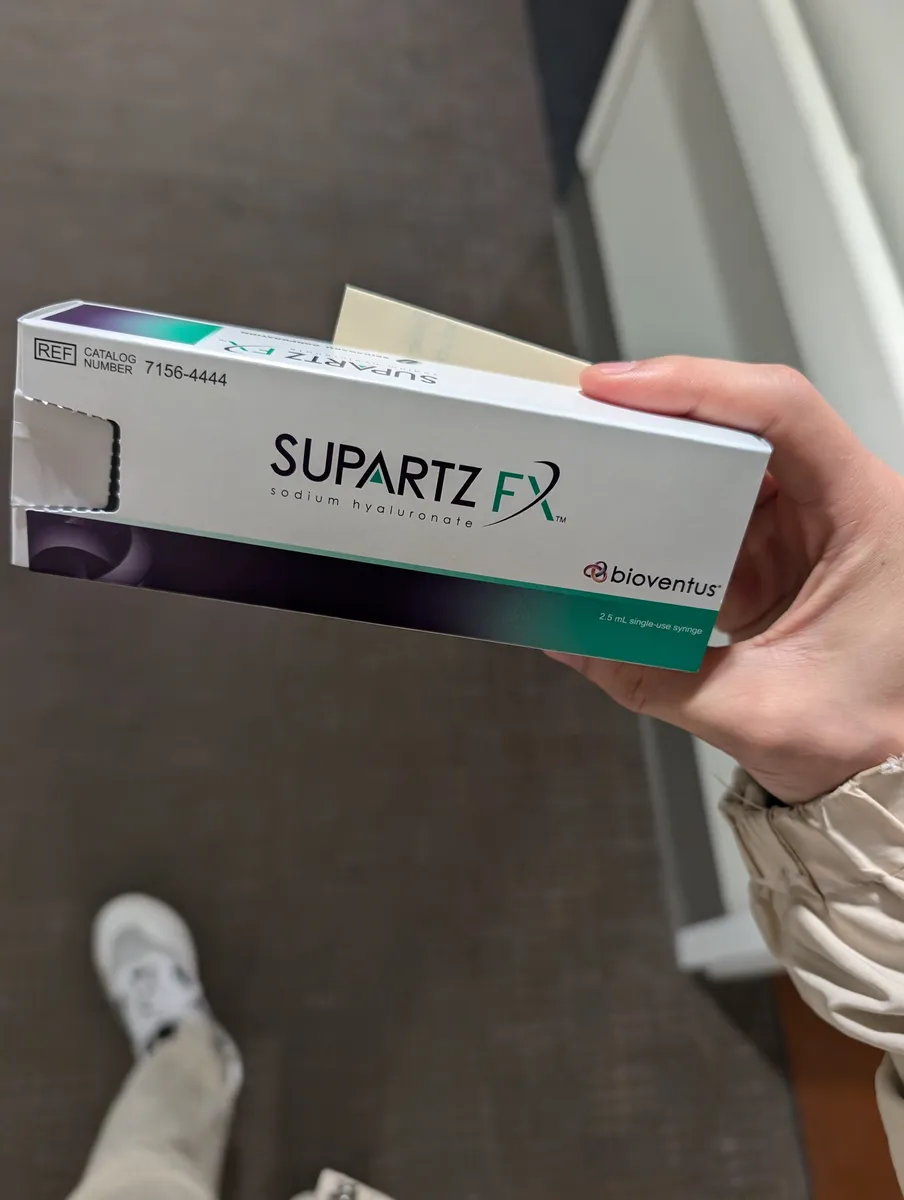
Added August 6, 2026. Bioventus, which makes Supartz FX, runs a direct cash programme whose published price is “SUPARTZ FX five-injection therapy: $85 (per injection)” [400]. The May 7 Amazon Pharmacy purchase was $200. Customer service is 1-800-836-4080.
The catch is real and should be tested rather than assumed: Supartz is FDA-indicated for the knee, and the programme is written around knee osteoarthritis. His ankle use is off-label — legitimate prescribing, but a manufacturer's direct-to-patient programme may or may not fill it. Also verified: Rx-Direct sells GenVisc 850 / TriVisc at “just $97 a syringe”, (866) 553-0112 — likewise knee-framed.
Pair this with the Good Faith Estimate right in item 20. He is a self-pay individual for HA by definition, so he can ask for a written itemised estimate before agreeing to anything — and now he has a manufacturer price to hold it against. Sequencing note: any further HA injection restarts MASCOT's 90-day washout, so the price question and the trial question are not independent.
-
28
Two free calls that turn the September 30 deadline and the HA exclusion from guesses into answers
Added August 6, 2026. Both rest on statutes this site has never carried.
First — ask DMHC whether Anthem has actually filed to terminate Scripps. 1-888-466-2219. Health & Safety Code §1373.65(a) requires that “at least 75 days before the termination date… the health care service plan shall submit an enrollee block transfer filing to the department” [397]. For a September 30 termination that filing was due around July 17 — already past. Whether it exists is the first genuinely two-sided signal available on a date that has been one-sided for weeks. And do not wait for a letter: §1373.65(c) says a PPO enrollee is mailed notice “only if the terminated provider is a general acute care hospital” — if what terminates is the Scripps physician group, which is where Bugbee sits, he may never be told.
Second — if anything HA-related is ever denied in writing, make Anthem cite the contract rather than its own policy. §1374.30(b) requires that a denial based on non-coverage “shall clearly specify the provision in the contract that excludes that coverage” [399]. CG-DRUG-29 is a clinical policy bulletin, not a contract term. And §1374.30(d) makes DMHC, not Anthem, “the final arbiter when there is a question as to whether an enrollee grievance is a disputed health care service or a coverage decision,” with independent review required “if there appears to be any medical necessity issue.” There is “no application or processing fee of any kind.”
Why it might be worth the stamp. The California IMR database was queried directly this week — a task this page has carried as open for weeks. Hyaluronic-acid denials are overturned 458 times against 132 upheld, and there are three ankle-specific overturns, all since 2019 [398]. One of them turns on a fact he shares: “the patient has a history of benefit from a prior viscosupplementation injection to the ankle.” Stated honestly, because it would be easy to oversell: those are medical-necessity denials that reached review, and a genuine contract exclusion is statutorily barred from IMR. This is not “file and win.” It is a free way to force Anthem to say which kind of denial it is actually making — and the site's standing assumption that the answer is “exclusion, end of story” has never once been tested.
-
29
Palanca is accepting new patients — and there is now a second California surgeon with both boxes ticked, plus a $590 second opinion that names him
Added August 6, 2026. One long-standing question closes. Dr. Ariel Palanca is accepting new patients — Palomar Health Medical Group's own profile carries the flag in a JavaScript variable no ordinary fetch renders, acceptingNew = ‘yes’, and her Anthem PPO listing was re-verified on a page modified April 28, 2026 [394]. Published on the exact operation, accepting patients, Anthem PPO, and not exposed to the Scripps cliff. 858-485-0050.
New name: Dr. Timothy P. Charlton, MD, Cedars-Sinai — “Accepting New Patients,” Foot & Ankle, Anthem Blue Cross on his insurance list, HSS fellowship, AOFAS member, reviewer for Foot & Ankle International and JBJS; 310-423-9900 [395]. He is the third California name with both boxes verified institutionally, after Eric Wan Tan [370] and now Palanca — but unlike Tan he is a foot-and-ankle surgeon with an OLT publication and an AOFAS membership rather than a general cartilage-preservation listing. Honest limit: his OLT credential is a 2017 review co-authored with Eric Giza (PMID 28594507), not a talar structural-allograft operative series — so ask what he has actually done, exactly as this page says to ask Hunt.
And the cheapest live remote second opinion found anywhere, which happens to name him: Cedars-Sinai's Virtual Second Opinion costs “$590 if you live in California”, turns around in “four to six business days,” and includes an optional live video session with the doctor rather than a written report only — 310-423-4654 [396]. Enter through the Foot & Ankle path and confirm the assignment before paying — the “Articular Cartilage Injuries” route surfaces knee surgeons. Two corrections while here: Duke's virtual second opinion is confirmed dead (404), and HSS's $800 page is dead with the price now $1,400 — and no live HSS page supports this site's earlier claim that HSS excludes California, which reopens the Drakos option.
Added July 30, 2026
What it actually costs, and how to get seen
First verified prices
→ Every previous sweep recorded that no self-pay price could be verified from any primary source. That gap is now closed. Hospitals are federally required to publish machine-readable charge files; reading those directly, rather than the price-estimator pages built on top of them, produced real numbers — and the spread is much larger than anyone would guess.
Imaging, cash price
- Ankle MRI — $446–525 at freestanding imaging centres, against $1,949 at the cheapest hospital and $6,254 at the most expensive. Cheapest verified: Silicon Valley Medical Imaging (Fremont) $446; Inview Imaging, six East Bay locations, $525, (925) 732-7404
- Ankle CT — $246–336 at freestanding centres, against $986 to $4,403 at hospitals
- SPECT/CT — $1,882 at El Camino Health, against $2,639 at UCSF and $6,242 at the most expensive. Order it under the 78830 code family; the older code does not appear in a single Bay Area hospital file
- The standing full-length alignment radiograph — $202.95 at John Muir Concord, ranging to $736 at Stanford. The single most-recommended missing test on this page costs about two hundred dollars
Two things to know before calling. Several hospitals publish a “discounted cash price” identical to their gross charge — that is, no discount at all — while others discount 55–75%. And only one Bay Area system separates the radiologist's fee from the scan fee in its file, so everywhere else a second bill may land on top of the quoted number. Ask for the all-in price, in writing, by billing code.
Order the alignment film by name, not by code. The billing code's official descriptor reads “bone length studies,” so ordering by code alone can produce a leg-length report instead of the mechanical-axis measurement that is actually needed. Ask for a standing full-length weight-bearing hip-to-ankle alignment radiograph for mechanical-axis assessment. This matters more now that “normal alignment” is confirmed as a mandatory insurance criterion — the film is a prerequisite, not an optional extra.
Who can order it — corrected August 4, 2026. This paragraph previously read “Dr. Salk can order all of it,” and that was wrong for the one test this page most recommends. It is true for foot and ankle imaging: California defines podiatric medicine as diagnosis and treatment of the foot “including the ankle,” and the podiatric board's scope fact sheet states that “any procedure and modality is within the DPM scope if utilized to diagnose and treat foot, ankle or other podiatric conditions.” So the ankle MRI, the ankle CT and the weight-bearing CT are all within his scope, and weight-bearing CT has no special billing code — it bills as an ordinary ankle CT. But the standing hip-to-ankle alignment film is not an ankle study. It images the femur and hip, which Business & Professions Code §2472(b) places outside podiatric scope, and 17 CCR §30441 forbids self-referred radiography in California [340]. That film needs an MD, a DO, or a chiropractor — see the new action item 15 for the two routes that actually work. The Carelon confirming call at 800-252-2021 is still worth making for the studies Dr. Salk can order, since on the insurer's side this is a verified absence of restriction rather than an affirmative permission.
A written second opinion from the most-published surgeon on this exact problem, for $800
This page previously ruled out John G. Kennedy, MD — Chief of Foot & Ankle at NYU Langone, and the most prolific author alive on failed talar osteochondral lesions — because NYU's own page says he does not accept insurance. There is a route around that. NYU Langone runs a written orthopaedic second-opinion service: $800, five business days, California is an eligible state, covering a records and imaging review and a detailed written report. Coordinator 646-878-1888; self-pay, FSA/HSA eligible [288]. Two honest catches: the service promises “an NYU Langone orthopedic surgeon,” not Kennedy specifically, so request him by name in the submission; and it is a records review, not an examination, so it complements rather than replaces the in-person assessment in item 2.
- Cedars-Sinai — $590 for California residents, 4–6 business days, 310-423-4654. The only programme with a published foot-and-ankle category — but its six listed conditions do not include cartilage lesions, so call before paying
- UCSF $900 (7–10 days; orthopaedic scope unpublished — call 917-565-8540, option 5, first). Stanford $975. Cleveland Clinic $1,690, and it explicitly will not issue a billing code, which forecloses any reimbursement attempt
- Mass General Brigham $950 plus $375 per imaging study — but it is physician-to-physician, so Dr. Salk would have to submit it
- HSS does not serve California, and the $800 figure for it circulating in search results is a stale index artifact — both of its links now 404. Mayo could not be verified at all; the price range circulating online traces to a medical-tourism blog, not to Mayo
Added August 1, 2026 — a better-targeted $800 option, and a call that might make all of these free.
- Duke runs its own remote written second opinion, also $800, and California is eligible (every state except Tennessee and Michigan). It is administered through a partner service that contacts you within one business day, gathers the records, and returns a written report addressed to your treating physician. Why it may beat the NYU route: Duke holds the deepest bench in the country for this specific problem — Easley, Adams and Nunley on structural talar allograft, de Cesar Netto on weight-bearing CT, and Murawski on the revision and salvage consensus. One request can reach the consensus author. Two things to settle on the intake call: a 2022 Duke article describes the same programme at $1,500 while current patient-facing material says $800, so confirm the price before paying; and the service says it matches you to “an appropriate Duke specialist,” so ask for Murawski by name and get confirmation in writing [312]
- Make this call before paying for any of the above. Anthem partners with The Clinic by Cleveland Clinic to give members access to Cleveland Clinic expert second opinions, and many employer plans separately bundle 2nd.MD or Teladoc Medical Experts at no member cost. If any of those is included in this plan, the $1,690 Cleveland Clinic price listed above could be $0. Two calls settle it: member services on the Anthem card, asking specifically for “The Clinic by Cleveland Clinic expert second opinion,” and the employer's benefits contact. Stated as a lead, not a fact — whether it applies depends on the specific plan, which is the same unresolved document question this page has flagged before
- Free expert help with the insurance fight, for when there is a surgical plan to fight for. The Patient Advocate Foundation provides no-cost one-on-one case management, explicitly including securing prior authorizations and resolving denials — 1-800-532-5274, weekdays 8:30am–5pm Eastern. Honest caveat: its stated focus is chronic, debilitating and life-threatening illness, and a currently mild ankle may not qualify. Its value arrives at the moment a revision cartilage procedure is submitted and denied as investigational, which this page expects. It is also a genuine alternative to leaning on a friend for insurance calls
Added August 1, 2026 — a much closer option for the alignment film
The standing hip-to-ankle mechanical-axis film is still the cheapest missing test on this page, and last week the nearest verified scanner was in Fairfield. Stanford Health Care has an EOS scanner, and Stanford's own page describes it as capturing “two full body, weight-bearing images of the skeletal system at the same time” at substantially lower dose than conventional radiography — which is exactly the study required, at roughly half the driving distance [313]. What is not verified, and has to be settled by phone: which Stanford site actually houses the unit, whether adults can be scanned on it, what referral it needs, and the cash price — the page publishes none of that. Radiology scheduling: 1-866-742-4811, weekdays 8am–5pm. Candidate locations are Redwood City (450 Broadway), Hoover Pavilion in Palo Alto, and the Sherman Avenue imaging centre.
Two negatives worth recording so they are not re-chased. Burlingame remains the only weight-bearing CT in Northern California, independently re-confirmed. Corrected August 3, 2026: the vendor's own facility locator also lists PACE Podiatry and Ankle Care, 1421 Secret Ravine Pkwy Suite 111, Roseville CA 95661, 916-781-3223 — so Burlingame and Sacramento are not the only options, though that practice's own website is now a parked domain and its cash price is unpublished, so call before driving [337]. What does hold: there is no hip-to-ankle weight-bearing CT unit anywhere in Northern California — the nearest is Los Angeles. And cartilage-sensitive MRI of the ankle — T2 mapping, dGEMRIC or UTE — does not exist as an orderable clinical test in the Bay Area. Both UCSF and Stanford run world-class quantitative cartilage imaging programmes, but their published work is knee, hip and shoulder, and these are research protocols rather than products. The realistic route, if it is ever wanted, is to ask one of those groups whether a revision talar allograft can be scanned under an existing research protocol — a case this unusual is the kind such groups want.
Three surgeons worth adding, and one hard deadline
- Richard D. Ferkel, MD — SCOI / UCLA Health, 6815 Noble Avenue, Van Nuys. 818-901-6600. The only surgeon found anywhere with both “accepting new patients” and “Anthem Blue Cross” verified on the same institutional page. He published Autologous chondrocyte implantation of the ankle: 2- to 10-year results — cell therapy as salvage after failed grafting [286] — and “Which Way Should We Treat an Osteochondral Lesion: Up or Down?”, which is precisely the treat-the-bone-versus-the-cartilage question a 10 mm cyst poses. Confirm the plan type by phone, and ask who actually performs the surgery
- William D. Bugbee, MD — Scripps, La Jolla. 858-554-7993. The leading US osteochondral allograft authority, and therefore the right person to answer the question this page has never had answered: why did the 2012 graft fail, and can another one work? In-person only, no telehealth. ⏰ Hard deadline: Scripps' own page states its Anthem contract extension “is set to expire on September 30, 2026.” An in-network consult has to happen before then
- Duke — Mark Easley, Samuel Adams, James Nunley, Morrisville NC, appointments 919-613-7797; all three accepting new patients. Their structural talar allograft series is the most revision-heavy in the country — 74.2% had prior ankle surgery [287]. Cesar de Cesar Netto, the weight-bearing-CT authority, is also there. And Duke is a MASCOT site, so one trip could serve both purposes. Anthem is not listed — Duke's pages show Blue Cross Blue Shield of North Carolina only, so an out-of-state PPO question needs a phone call
Names to retire from this page's list, so they are not researched again: Alexej Barg died in 2022; Gregory Berlet is retired; James DeOrio's own Duke page states he no longer performs surgeries; Christopher Hyer has moved and is replacement-focused; Norman Waldrop III and Steven Neufeld have no talar OLT publications. Do not call any number found online for Stephen J. Pinney, MD — the practice domain fails to resolve and his status is unverifiable. And a negative worth recording: systematic searches of UCSF, Stanford, UC Davis, Sutter, Dignity and Kaiser NorCal surfaced no additional Northern California surgeon with a talar OLT publication record beyond the nine already named here. The local bench really is that thin.
Two insurance levers this page has never used
- An investigational denial skips the internal appeal entirely. The state's own review application says so verbatim: “If your plan denied your treatment because it was experimental/investigational, you do not have to take part in your plan's complaint or grievance process before you file an IMR application” [281]. Free, decided in 45 days (7 if urgent), six-month filing window — and the form itself states that about 72% of patients receive the requested service through it. Note the state also warns that no additional information is accepted once submitted, so everything goes in at once
- The network-adequacy route is the only realistic way to see an out-of-network expert at in-network cost. The plan documents define an “authorized referral” for where no in-network provider practises in the appropriate specialty, and state that with prior authorization on those grounds “you will not be responsible for the difference” between the out-of-network charge and the allowed amount. That is the mechanism — requested before services, never after — that could reach Kennedy, Duke or Bugbee
And the appeal exhibit list is now materially stronger. The certification must come from an in-network provider who also supplies the supporting evidence — and Andrew Haskell satisfies both at once: in-network at Sutter, would be the operating surgeon, and is the published author of the closest technical match to this lesion [267]. Three new supporting exhibits were identified, all peer-reviewed: a series specifically in Hepple V lesions [283], a meta-analysis of allograft versus autograft in the talus [284], and the classic series on fresh allograft for large-volume cystic talar defects [285]. One more asymmetry worth carrying in: the same guideline's knee cell-therapy criteria set the bony-depth threshold at 10 mm, not 5 mm, and treat that depth as a trigger for concurrent bone grafting rather than a bar to cartilage repair.
Dates in the next sixty days
- ⏰ August 16 — seven days away (re-checked against the registry August 5: exclusion 15 reads “Injection of hyaluronic acid (HA), platelet-rich plasma (PRP), and/or corticosteroids in the target ankle within 90 days prior to Visit 1,” and the injection was May 18, not the May 7 purchase date), the 90-day injection washout clears and the trial's timing gate opens. Nothing needs to be done on that date; what matters is that a repeat Supartz series before it would restart the clock and push the earliest possible screening out by another three months
- August 18 — check-in with Dr. Salk, two days after the washout clears. Add a FAOS score to the planned VAS and AOFAS, which cannot answer the eligibility question on their own. This is the natural appointment at which to settle the injection decision, precisely because the two clocks now sit two days apart
- ⏰ September 30 — Scripps' Anthem contract extension expires. The deadline for an in-network Bugbee consult
- September 18, 1:00–2:15 pm — the IFFAS “Cartilage Lesions” symposium in Seattle, with the MASCOT principal investigator and John Kennedy speaking back to back [289]. Do not register — there is no patient category, the cheapest relevant tier is $750, and virtual costs the same as in person. The abstracts publish open access afterwards, free — and the plan documents count peer-reviewed abstracts from major medical meetings as acceptable appeal evidence
- Before any UC Davis booking — verify the Anthem network status by phone (member services 800-331-1476). UC Davis issued a formal notice in 2024 that Anthem plans would no longer be in-network there; Anthem is listed again now, but the page carries an “as of” disclaimer, and on a year-one-deductible plan a repeat would be expensive. Also note that 916-734-7463 circulates online as the UC Davis orthopaedic appointment line and is actually the Spine Center — use 916-734-6805, or go through the study coordinator directly at 916-826-8135
One structural note: no referral is needed to see an in-network specialist on this kind of plan — the plan documents say “referrals are never needed” — but precertification for advanced imaging is a separate requirement, and the same documents say it is the member's responsibility to start it. Sutter explicitly accepts self-referrals (888-834-1788). Verify all of this against your own plan documents rather than the specimen ones this was read from, and check which entity is named on the card, because that decides which appeal route applies.
Added July 29, 2026
Who to actually call
Revision-capable surgeons
→ Action item 2 has said “see a foot-and-ankle surgeon who treats revision talar cartilage” for months without naming one. These are named, with credentials and phone numbers read off each institution's own site. Being on this list is not an endorsement — it means the person publishes or is institutionally listed in this specific niche.
The two calls worth making first
- Andrew Haskell, MD — Bay Area Orthopedic Surgeons / Sutter Palo Alto Medical Foundation, 301 Industrial Road, San Carlos. 650-596-4040. Roger Mann foot-and-ankle fellowship; Assistant Clinical Professor at UCSF; co-director of the Stanford/PAMF foot-and-ankle fellowship. Why he is first: he published a 32-patient series of structural distal-tibia autograft for large or cystic talar dome lesions, with a mean lesion area of 86.2 mm² and a mean depth of 8.4 ± 3.0 mm — this lesion sits at the upper end of that series, which makes it the closest published technical match found anywhere [267]. Sutter's own provider page lists him as accepting new patients and lists Anthem PPO among accepted plans, and he is 25 minutes from San Francisco
- Eric Giza, MD and Christopher Kreulen, MD — UC Davis Health, Division of Foot & Ankle, 3301 C Street, Sacramento. Clinic 916-734-6805; new patients 800-282-3284. Giza is Chief of Foot & Ankle, directs the fellowship, lists cartilage transplantation as his research, and is the MASCOT principal investigator. Kreulen lists cartilage transplantation and osteochondral defects, and was senior author on a 2025 systematic review of MACI for talar lesions. Why: one Sacramento trip can cover the trial screen, weight-bearing CT and SPECT/CT in the same institution. UC Davis's accepted-plans page lists Anthem Blue Cross PPO as of February 2026 — but this supersedes a 2024 termination notice, so verify with Anthem before booking
Solid local alternatives
- Kirstina Olson, MD — UCSF Foot & Ankle Care, 1500 Owens St, SF. 415-353-2808. Her UCSF Health page explicitly lists osteochondral lesions among conditions treated
- David E. Oji, MD — Stanford, Los Gatos and Redwood City. 650-723-5643. Stanford lists “arthroscopic treatment of talar cartilage defects”; he has published specifically on medial talar lesions
- Daniel Thuillier, MD — UCSF. 415-353-2808. Holds the Roger Mann Endowed Chair in Foot and Ankle Surgery
- Loretta Chou, MD — Stanford Foot & Ankle, Redwood City. 650-723-5643. Lists “chondral/osteochondral defect”; published on autologous osteochondral grafting for talar defects. Listed as Professor Emerita while still practising — confirm she takes new patients
- Jeffrey Mann, MD — Cal Sports & Orthopaedic Institute, Berkeley 510-704-7760. Co-author on talar osteochondral grafting and distal-tibial allograft work; recent output is total ankle replacement, so best kept for the eventual fusion-versus-replacement conversation
- Eric W. Tan, MD — Keck Medicine of USC, Los Angeles. 323-442-5860. Worth a flight only for a second opinion, but notable: Keck lists “cartilage preservation/restoration,” and he has published second-look arthroscopy of talar lesions after failed prior treatment — the exact failure mode in play here
Added August 1, 2026 — one new name, and one long-standing question closed
→ Two additions, and an honest note about a third: this week's research independently “rediscovered” Bugbee and the September 30 Scripps deadline, both of which are already above. That is a confirmation of the existing recommendation, not a new finding — and worth stating, because a sweep that re-finds its own conclusions can look like it found something.
- Christopher D. Murawski, MD — Duke Health; Duke Sports Medicine and Orthopaedics Cary, 100 Duke Health Cary Pl, Cary NC, and Duke Raleigh Hospital, 3400 Wake Forest Rd. 919-385-8120, and his Duke profile states he is accepting new adult patients. Duke was already on this list for Easley, Adams and Nunley; Murawski is the individual there most specific to this question. His profile states a “particular interest in cartilage injuries (osteochondral lesions)” and that he leads an international consensus on cartilage repair of the ankle — he is a named author across the 2018 proceedings this page now leans on heavily, including the revision and salvage paper. State the caveat plainly: he finished his foot-and-ankle fellowship in 2024, so he is early-career. He is the field's literature and consensus specialist for this problem, not a thirty-year operative track record — which makes him unusually valuable for a written opinion and a question worth asking about who would hold the knife. Duke is also a MASCOT site [307]
- Resolved — Simon Görtz is in Boston, is not retired, and is accepting new patients. Last week left this open. His Massachusetts licence was first issued September 12, 2019 and is active through January 2028 with no disciplinary entries, which dates the move from Phoenix and makes the Arizona trail stale rather than current; his Brigham directory page lists him as accepting new patients. Brigham Orthopaedic and Arthritis Center, 60 Fenwood Road, 2nd Floor, Hale Building, Boston. 617-732-4970; new-patient coordinator 1-855-278-8010. The ankle question is still genuinely unresolved — his Brigham profile names knee, shoulder and cartilage transplantation and contains the words “ankle,” “talus” and “talar” zero times, yet he is a co-author on the July 2026 ankle consensus with a Brigham affiliation. Panel membership is not the same as taking ankle patients: one phone call settles it. One trap recorded so no future sweep repeats it: a surgeon directory renders the word “Retired” on his entry inside a hidden conditional block that is not the live label. He is not retired, and any automated read of that page will get this wrong [317]
Added August 4, 2026 — the first name on this list that offers virtual care, and a false alarm about the best one
- Mark C. Drakos, MD — Hospital for Special Surgery, 535 East 70th Street, New York NY 10021. 212-606-1112. Verified from his HSS profile this week. He is listed under Foot and Ankle Surgery and Sports Medicine, his page names “Cartilage Injuries” among the conditions he treats and “Cartilage Repair” among his procedures, and his active research includes “Evaluation of Biocartilage Allograft Matrix for the Treatment of [talar] Osteochondral Lesions” [345]. What makes him different from every other name on this list: the profile states “Offers Virtual Care.” Every other out-of-state expert here requires a flight before anyone has looked at the case. Fellowships 2009 and 2010, so roughly sixteen years out. Two caveats, both worth resolving in the same call: the page does not say whether he is accepting new patients, and HSS's separate written second-opinion programme explicitly excludes California — so “offers virtual care” still has to survive a licensure question. Ask precisely that: can a California resident have a virtual new-patient visit, and if not, can the records be reviewed before travelling?
- A false alarm, recorded because it concerned the best access match on this page. A search aggregator surfaced this week claiming Richard D. Ferkel's California licence expired in 2026. The primary source does not support it. SCOI's own page is live today, gives an active appointment request and 818-901-6600, and states that “Dr. Ferkel is available to see patients at the Van Nuys and Westlake offices” and that he “is currently the director of the sports medicine fellowship program” [351]. He is active, and he remains the only surgeon found anywhere with both “accepting new patients” and “Anthem Blue Cross” verified on one institutional page. One honest qualification this page never made: SCOI markets him as a “Sports Medicine, Reconstructive Knee, and Shoulder Surgeon” who took “additional training in foot and ankle surgery” — so his standing on this problem rests on his published ankle work [286], not on how his practice describes him.
- Two second-opinion routes updated. Mass General Brigham — already priced here at $950 plus $375 per imaging study — now has a direct line: 888-456-5003, consultsinfo@partners.org. It is physician-to-physician, so Dr. Salk would submit it; whether a podiatrist qualifies as the initiating physician is unconfirmed and is worth asking in the same call [355]. Mayo Clinic is closed — it runs no patient-initiated written second opinion, and its virtual care reaches out-of-state patients “only if the provider is licensed in the state where the patient lives.”
Added August 3, 2026 — a name with an operative record rather than a bibliography
→ The last two names added here were consensus authors who are early in their surgical careers. This one is the opposite: seventeen years post-fellowship, and he wrote the review article whose title is literally this problem.
- Kenneth J. Hunt, MD — UCHealth Foot and Ankle Center, Central Park, 3055 Roslyn St Suite 200, Denver CO 80238. 720-848-3668. (Also Highlands Ranch, 720-516-1000, and Steadman Hawkins Englewood, 303-694-3333.) He is the author of “Management of Treatment Failures in Osteochondral Lesions of the Talus” [328] — the title of this situation — plus a series on reconstructing large talar lesions with bony defects, and he is a co-author across the same consensus series this page relies on. He finished fellowship in 2009, roughly seventeen years ago, and appears four times as an author in the AOFAS 2026 program, so he is currently active. Denver is a two-and-a-half hour flight. Three things to check rather than assume, all stated because the page should not oversell him: his signature technique uses Cartiform — a viable allograft membrane over morselised autograft, which is not the bulk fresh talar allograft that failed here, so ask directly whether he performs bulk revision allograft; his profile does not say whether he is accepting new patients; and, exactly like Bugbee's and Görtz's pages, it contains the words talus, talar and allograft zero times — his credentials come from the literature rather than the marketing copy. His licence standing could not be verified because both the Colorado and California lookups are CAPTCHA-gated [327]
- Recorded but not recommended — Michael E. Brage, MD, Sigvard T. Hansen Foot and Ankle Institute, Harborview, 908 Jefferson St, Seattle. 206-744-4830. He is Bugbee's and Görtz's actual co-author on five fresh ankle allograft papers spanning 2002 to 2019 [339], which makes him look like an obvious call. Read the papers and he is not. His allograft work is bipolar tibiotalar shell allograft — resurfacing the whole joint for ankle arthritis, which is the escalation path rather than the focal talar graft under discussion here. His UW faculty page also returns a server error and a PeaceHealth Bellingham listing exists, so confirm where he actually practises before booking travel. And one trap for any future search: Provencher and Clanton at Steadman Philippon publish constantly on “talus allograft” — as donor tissue for shoulder reconstruction. Those papers dominate a naive search of this term and have nothing to do with treating an ankle
- The registry question closes with an address. Re-verified this week: the international cartilage society's patient registry “is currently available for knee problems, but other joints will be added in due time.” The five-minute task flagged on August 1 now has a target — email registry@cartilage.org, copying theodorakys.marin@cartilage.org, the registry manager, to ask when the ankle module opens and whether a revision talar allograft patient can pre-register [333]
Added July 31, 2026 — one registry lead and one long-shot name
- The Missouri BioJoint programme and its lifelong registry. Missouri Orthopaedic Institute, 1100 Virginia Ave, Columbia MO; appointments 573-884-3077. Its allograft preservation system keeps donor cartilage cells viable roughly twice as long as standard storage — which attacks the exact constraint that makes size-matched fresh talar grafts hard to obtain, since the consensus preference is for grafts used within 28 days. Its registry [296] explicitly includes the ankle, sets its floor at an osteochondral defect ≥15 mm, and carries no revision exclusion. Three caveats belong in the same breath: the registry is invitation-only at a single site, so in practice it means having the surgery in Missouri; its size criterion is written in knee-centric language that needs clarifying for an ankle; and the university settled lawsuits over its BioJoint knee surgeries, reported in 2021. Treat this as a lead to evaluate against the local options, not as a recommendation
- Simon Görtz, MD — Brigham and Women's / Harvard, 617-732-4970. He published the talar-dome partial allograft series using an anterior approach that avoids cutting the malleolus, and co-authored the original international allograft consensus. Two unresolved caveats, stated before any effort is spent: his current hospital profile lists cartilage transplantation for knee and shoulder without naming the ankle, and a second source suggests he may have moved to Phoenix. Confirm he still takes ankle cases first
- Closed as negative, so it is not re-chased: all 479 United States expanded-access records were enumerated this week, and there is no expanded-access or compassionate-use programme for any cartilage repair product in the country. A fresh registry query also confirms no ankle-eligible trial exists in California, Washington, Oregon, Arizona or Nevada other than MASCOT
On Dr. Salk. He remains useful for records, the injection log and imaging orders, and Anthem processes him as in-network. But he is a DPM, not an orthopaedic surgeon, and a revision osteochondral graft is conventionally an MD or DO foot-and-ankle subspecialist procedure. The question to put to him is simply: will you refer, and will you release the imaging and the operative history?
Also named and then ruled out, so it is not re-researched later: John G. Kennedy, MD at NYU Langone is the most-published OLT surgeon in the US, but NYU's own page states he does not accept insurance — full cash-pay. And the UCSF Cartilage Repair and Regeneration Center is knee-only by its own description; it is not an ankle route.
Added July 29, 2026
The cheapest missing test, and the coverage problem nobody has looked at
Clarify which alignment information is still missing
September 12 update: three standing ankle X-rays were taken August 20. The full-length alignment study discussed below is a different examination and is not documented in the new notes. The surgeon should decide whether it adds useful information to the existing views.
A standing full-length lower-extremity alignment radiograph (CPT 77073) is the least expensive and highest-yield study on this whole page, and it has never been done. Three separate trial protocols gate eligibility on more than 5° of varus or valgus measured on a standing film. More importantly, two 2025 studies tie alignment directly to outcome: varus alignment was significantly associated with medial lesions specifically (odds ratio 2.63) [268], and in 44 mosaicplasties for medial talar lesions the varus group ended up at VAS 4.4 versus 1.5 post-operatively (p<0.001), with mechanical-axis deviation correlating with post-operative pain at ρ = 0.804 [269]. Translation: a cartilage procedure done on an uncorrected varus ankle is predicted to leave pain behind. Small retrospective series, but the effect size is large and the test is a single standing X-ray.
Order sequence matters for coverage. Anthem delegates these decisions to Carelon, whose imaging pathway for an osteochondral lesion requires “nondiagnostic radiographs” before advanced imaging, and whose SPECT/CT pathway requires “postoperative joint… pain when other imaging (radiographs, CT, or MRI) is nondiagnostic.” So the order is films first, then MRI, then SPECT/CT — requesting SPECT/CT first will be denied. The 2012 surgery makes the post-operative pathway a clean fit once the earlier studies are on record.
Added July 31, 2026 — where that film can and cannot actually be taken. UCSF's orthopaedic imaging centre at 1500 Owens Street cannot do it: its published service list is DXA, MRI and fluoroscopy only, with no CT, no EOS and no weight-bearing radiography. Recorded so the most obvious local attempt is not wasted. The best-matched machine found is an EOSedge scanner at NorthBay Health in Fairfield — 707-646-4646, 1101 B. Gale Wilson Blvd — which captures the whole standing hip-to-ankle mechanical axis in one low-dose pass, at roughly the same driving distance as the Concord facility already priced here. And weight-bearing CT in San Francisco proper is confirmed not to exist; Burlingame or Sacramento remain the only options.
Weight-bearing CT is genuinely scarce locally: the only Northern California site on the vendor's own locator is San Mateo Podiatry Group, Burlingame, 650-342-2420, and UC Davis states it has the first weight-bearing scanner in Northern California (confirm by phone). SPECT/CT is widely available — UC Davis 916-734-0655, UCSF 415-353-3900, Stanford 650-723-6855, John Muir Walnut Creek 925-947-5320.
The coverage finding that should be known before any surgical consult
Anthem has no branded policy for cartilage surgery; it delegates to Carelon. Comparing Carelon's current joint-surgery guideline against its 2022 predecessor shows a regression: the 2022 version contained an explicit talus osteochondral allograft pathway covering large or cystic lesions where autografting would be inadequate. That talus allograft pathway has been deleted, and the talus autograft criterion now reads “large or cystic… lesions of the talus without prior treatment,” with a second prong for “revision surgery after failed marrow stimulation.”
Read literally, this lesion fails every prong. Size passes — roughly 1.2–1.5 cm² against a 1.0 cm² floor. But “without prior treatment” is defeated by the 2012 allograft, and a failed allograft is not failed marrow stimulation. Do not lean on “cystic” either: the volume threshold is 3.0 cm³ and this lesion is roughly 0.8–1.5 cm³ — though it is worth noting that the published clinical definition of a large cystic lesion is >300 mm³, making the policy threshold about ten times stricter than the literature. Expect a denial on the criteria as written, and ask the surgeon's office to run a predetermination rather than discovering it after surgery is scheduled.
Three exhibits to build any appeal on, all verified: the AOFAS position statement (board-approved July 29, 2022), which endorses osteochondral transplantation “especially large diameter lesions, cystic lesions, and those that have failed previous surgical treatment” and states AOFAS does not consider it experimental; the 2022 Carelon/AIM version itself, showing the talus allograft pathway existed and was removed; and a 2021 study in which autologous osteochondral transfer beat marrow stimulation for large cystic lesions on both outcome (p=0.001) and 118-month survival (p=0.042), with 14 of 32 marrow-stimulation cases failing versus 2 of 18.
Two other coverage facts worth having. PRP and bone marrow aspirate concentrate are “investigational and not medically necessary for all indications” under Anthem policy TRANS.00035 — so neither is a covered route regardless of what a clinic offers. And MACI outside the trial is doubly closed: its FDA label is knee-only with an explicit limitation of use, and Carelon separately excludes “autologous chondrocyte implantation in joints other than the knee.”
A correction worth propagating: clinical-trial routine-care coverage does not apply here. Both the federal mandate and California's are limited to cancer or another life-threatening disease or condition. A symptomatic talar lesion is not life-threatening, so neither protects MASCOT's routine care. The sponsor supplies the study product and trial-specific procedures, but the arthroscopy, facility fee, anaesthesia, imaging, physical therapy and travel are not shielded by any mandate. Ask, line by line, which items the sponsor pays and which get billed to Anthem.
There is an appeal route, and it is not the one you would guess
→ The clinical-trial coverage law does not help here. But California has a separate, broader review for “experimental or investigational” denials, and its threshold is one this lesion can plausibly meet.
California Health & Safety Code §1370.4 requires every health plan to provide an external, independent review of coverage decisions on experimental or investigational therapies — and its eligibility threshold is broader than the trial mandate. Read verbatim from the statute: the enrollee must have “a life-threatening or seriously debilitating condition,” and “seriously debilitating means diseases or conditions that cause major irreversible morbidity.”
That phrase — not “life-threatening” — is the one to build on. A Hepple V cystic talar lesion after a failed allograft, on a trajectory toward tibiotalar arthritis and fusion, is a credible major-irreversible-morbidity case. This is the route for any denial framed as investigational — PRP, bone marrow concentrate, or MACI used off-label — rather than as not medically necessary. It requires a physician certification that standard therapies have not worked or are not appropriate, plus either a plan-contracted physician's statement or two qualifying pieces of medical or scientific evidence (the statute lists acceptable sources, and peer-reviewed abstracts accepted at major medical meetings count). The plan must notify you of this right within five business days of an investigational denial — if its letter omits that, flag it. There is also an expedited track with a seven-day expert analysis.
Do not build an appeal on the clinical-trial statute. Both the federal provision and California's own version define an approved trial as one for “cancer or another life-threatening disease or condition,” where life-threatening means the likelihood of death is probable unless interrupted. A talar lesion does not qualify, so that argument loses. The investigational-review route above does not share that limitation.
Three procedural rights worth knowing before a denial arrives
- The denial letter must hand you a direct line to the doctor who denied it. H&SC §1367.01 requires that any written denial to a provider include “the name and telephone number of the health care professional responsible for the denial… The telephone number provided shall be a direct number or an extension, to allow the physician or health care provider easily to contact the professional responsible.” That is how a peer-to-peer actually gets scheduled — and if the number is missing, that is itself a violation
- The clock is five business days, not two weeks. Standard pre-service decisions must be made “not to exceed five business days” from receipt of the information needed; urgent cases where delay “could jeopardize the enrollee's ability to regain maximum function” are capped at 72 hours. Denials must come from a physician or comparably qualified professional — not an administrator
- Independent Medical Review is free, fast, and binding. You cannot be held in the plan's own grievance process for more than 30 days (three days if expedited), the filing window is six months, there is no fee of any kind, a tie among reviewers goes in favour of providing the service, and the plan faces a penalty of not less than $10,000 per day for failing to implement. Your surgeon may join and advocate. California also publishes a searchable database of past IMR decisions — worth looking for prior talar cartilage cases before writing anything
One thing to determine first, because it changes all of the above: whether this plan is state-regulated as a health care service plan, regulated as a disability insurer, or self-funded through an employer. If it is self-funded, the California routes do not apply at all and only the federal external-review process remains. The fastest test is to open the plan documents and see which regulator's notice appears in the grievance section.
Two ways to improve the odds before submitting anything
- Make sure the imaging request is coded to the lesion, not to “ankle pain.” For an established osteochondral lesion, the reviewer's own criteria require only nondiagnostic radiographs — there is no conservative-treatment duration requirement. The generic “lower extremity pain, not otherwise specified” pathway does require six weeks of failed conservative management. Same scan, different bar, decided by how the request is worded. The guideline also states that CT was substantially more sensitive than MRI for detecting subchondral fracture, and acknowledges that implanted material causes artifact — both are quotable when requesting CT after a graft
- Bone grafting may make the 10 mm argument disappear. The same guideline's cell-therapy criteria permit treatment where a bony defect is 10 mm or less in depth, and state that lesions with a bony defect deeper than 10 mm must also undergo corrective bone grafting. So a plan that already includes grafting the subchondral defect satisfies the criterion on its own terms rather than fighting over a borderline measurement. Two practical consequences: get the depth reported to the tenth of a millimetre, and have the operative plan state the bone grafting explicitly
One sharper reading of the coverage gap. The reviewer's guideline has a talus autograft criterion but no talus allograft criterion at all — and it states that indications it does not address are considered not medically necessary. There is also no talus-specific billing code for an osteochondral allograft, so one would go through as an unlisted procedure and force manual review. Net effect: a revision autograft has a narrow written path; a revision allograft of the talus has none. That is worth knowing before a surgeon proposes one over the other.
Two expectations worth resetting before any consult
- A cyst coming back after grafting is the norm, not a failure. Across 13 studies and 382 ankles, post-operative cysts appeared in 42% after autograft, 58% after allograft and 34% after osteoperiosteal grafting — and no relationship was found between cyst presence and clinical outcome [270]. A follow-up scan showing a cyst is not by itself bad news
- There may be a lower-risk way to answer the containment question. Second-look needle arthroscopy after prior cartilage surgery has been reported in 16 patients with no complications observed [271]. Worth asking about as an alternative to a full diagnostic scope, given the 8.4% nerve-injury figure
Two honest gaps. No Bay Area self-pay price for ankle MRI, CT or SPECT/CT could be verified from any primary source, so none is quoted here — ask each facility's billing line for the prompt-pay rate by CPT code, in writing. And whether an in-network amount applied to an unmet deductible accrues toward the deductible and out-of-pocket maximum while a cash-pay transaction accrues toward neither is unverified — it is the pivotal question in a year-one deductible year, and it is a question for Anthem member services.
Decision threshold
Let function determine the pace
If symptoms are manageable
Stay in joint-preservation mode
- Continue low-impact exercise, PT, bracing, and load management.
- Use injections only when they produce a clear, measured benefit worth the cost and burden.
- Monitor function; structural damage alone does not create an automatic surgery deadline.
If daily life becomes limiting
Compare reconstructive options
- Confirm the joint is still reconstructible: preserved space, no collapse, and no major tibial-side damage.
- Correct meaningful malalignment or instability as part of the plan.
- Choose the procedure from the anatomy and surgeon experience, not from a fixed online ranking.
No proven one-size-fits-all winner
Revision options to compare
The revision literature is mostly small, heterogeneous case series. These are conversations to have, not a ranked treatment ladder. 2024 non-primary OLT systematic review
Bone graft + matrix/scaffold
Addresses the bone void and surface together. It may be a lower-morbidity reconstructive option, but evidence specifically after a prior talar allograft is limited.
OATS / autograft
Has the strongest biologic revision signal overall, but can require a malleolar osteotomy and creates a knee donor site. Reoperation and donor-site risks belong in the discussion.
TOPIC / osteoperiosteal graft
Promising five-year single-center results for large medial lesions, but no direct series was found for TOPIC after a failed talar allograft.
Repeat fresh allograft
The first graft's 12 pain-free years are a favorable personal result. Repeat-allograft evidence is much thinner and less favorable than primary-allograft survivorship data.
Arthroscopy alone
May treat a proven impingement source or help stage the joint, but debridement or microfracture alone is not a strong definitive repair for a large cystic revision lesion.
Fusion or total talus replacement
These are irreversible salvage branches. On the current record, preserved joint space and no documented collapse make the reason for using either now something that must be explained explicitly.
Bring this list to the appointment
Questions the next specialist should answer
- What is the dominant pain generator: subchondral graft bone, worn cartilage, anterior impingement, instability, or arthritis?
- Is the joint still reconstructible, and what do the tibial plafond, subtalar joint, and talonavicular joint look like?
- Was alignment and ligament stability measured under load, and does either need correction?
- For this exact anatomy, why choose bone graft + scaffold, OATS, TOPIC, or repeat allograft?
- Added August 8, 2026: If an allograft is done, would it be augmented with autologous BMAC at implantation — and if not, why not? Two knee RCTs now back the question: faster early osseous integration in one [404], and reoperation of 5.3% vs 35.3% in the other [405]
- Added August 11, 2026: If a fresh allograft is done, what donor-age criteria does the graft bank apply, and is young-donor tissue requested for a young recipient? Bugbee's own registry published this week: grafts from donors over 20 failed at 11.7% vs 3.7% for donors 20 and under — and grafts released in the back half of the 28-day storage window did better, not worse, so scheduling inside the window is not the thing to optimize [409] [410]
- How many revision cases after a prior talar allograft has the surgeon personally treated, with what reoperation and failure rates?
- What pain relief, activity level, recovery time, reoperation risk, and salvage path should realistically be expected?
- If recommending total talus replacement or fusion now, what specific finding makes joint-preserving reconstruction inappropriate?
Research guardrails
Important evidence updates
- New, October 10, 2026 — two carries on the Saturday window, and a watched paper landed its PubMed record. First carry: the field’s leading OLT surgeons published a single contemporary treatment algorithm in JBJS. Rubin, Murawski, Ferkel, and Kennedy (NYU/Duke/SCOI) assembled the entire option ladder — fragment fixation, lift-drill-fill-fix, marrow stimulation, autograft and allograft transplantation, ACI/MACI/AMIC, emerging scaffolds and biologics, and the salvage tier — into one stated decision frame whose inputs are lesion size and morphology, cartilage integrity, subchondral bone involvement, and ankle stability [499]. No new data, but it is the map a revision consult will be navigated with; carried to the OLT overview with its limits stated (narrative review, heavy author-bloc self-citation, and for this ankle’s central revision-allograft question it offers a box, not an answer). Second carry: if the malleolar access cut cannot be skipped, a 61-patient comparative series found a triplanar osteotomy beat the standard medial cut on recovery — full weight-bearing at 5.0 vs 6.8 weeks, less pain, equal three-year function and complications [500]; carried to topic 18, where “which cut, if any” is now a three-paper consult question. Also: the occult-syndesmotic-instability study [492] — one in five OLT surgical patients harbors syndesmotic instability only visible under intraoperative stress — landed its PubMed record, verified against the cohort facts; that indexing watch closes (eight remain). The weekly Scripps–Anthem page read ran on schedule: the agreement text is unchanged — PPO in-network, HMO out, and still no effective date, duration, or surgery-center statement, so those stay open questions. Elsewhere the window was quiet and proven quiet: day 3 of the ICRS Summit in Porto produced no podium data or ankle series (the wake watch runs through next week), all sixteen trial-registry watches unchanged (restor3d now ten days past its own start estimate, suzetrigine nine), FDA adverse-event anchors reproduced exactly with the fourth total-talus narrative still unposted at day 31, preprints walked clean (305 + 102 + 50 records, counted-verified), and the EU registry canary moved +11 with its term family exact.
- New, October 9, 2026 — one carry on the Friday window: the marrow-concentrate (BMAC) rung for talus lesions gains an 84-patient cohort — published to ask whether poverty predicts worse results, and finding it predicts worse arrivals instead. The Oswestry specialist centre (the UK cartilage program behind the ACTIVE knee trial) reviewed 84 patients given single-step BMAC for osteochondral lesions of the talus between 2015 and 2020: foot-and-ankle scores improved from 66.0 to 40.9 at 12 months, beyond the clinically important threshold — one of the largest outcome datasets this treatment has in this joint — and patients from more deprived areas presented significantly sicker but improved just as much once treated [498]. Carried to topic 10 with the weights stated: retrospective, no comparator arm (the cells cannot be separated from the procedure that delivered them), 12-month horizon, and the equity null is power-limited by the authors’ own wording. Elsewhere the window was quiet and proven quiet: day 2 of the ICRS Summit in Porto produced no podium data or ankle series (the wake watch stays open), all sixteen trial-registry watches unchanged (the restor3d registry now nine days past its own start estimate, the suzetrigine trial eight), FDA adverse-event anchors reproduced exactly with the fourth total-talus narrative still unposted at day 30, preprints walked clean (387 + 69 + 62 records, counted-verified), nine journal-indexing watches driven with none landing, and the one new preprint keyword row was a mouse bone-microscopy method — a collision.
- New, October 7, 2026 — Agili-C, the aragonite cartilage-repair scaffold on this site’s option list, launched commercially across Europe. Smith+Nephew announced full availability in twelve countries (Austria, Belgium, France, Germany, Ireland, Italy, Luxembourg, Netherlands, Portugal, Spain, Switzerland, UK), with the implant featured at the cartilage field’s own congress — the ICRS Summit in Porto, October 8–10 [497]. The honest weights, unchanged from the August first-cases filing: commercial expansion is not clinical evidence, the cited data remain the knee pivotal trial (KOOS superiority over microfracture to five years), the release never mentions the ankle, and the US label stays knee-only. Why it still matters here: a twelve-country rollout widens the implant’s real-world surgical base ahead of any future ankle indication, and the Porto congress makes this week a named watch — podium data or any ankle series surfacing there is an automatic carry. Elsewhere the Wednesday window was quiet and proven quiet: all sixteen trial-registry watches unchanged, the FDA adverse-event anchors reproduced exactly, preprints walked clean (457 + 93 records, counted-verified), nine journal-indexing watches driven with none landing — and the one new EU clinical-trial row behind a moved canary count was enumerated and proved to be a homeopathic knee-cream study, a collision. The international OLT author group (Amsterdam, NYU, MGH, Yonsei) also published a JBJS perspective arguing the field under-treats the window between first sprain and end-stage arthritis — a position piece, no new data, logged as color.
- New, October 6, 2026 — the alignment work-up this site keeps recommending now has a published score to aim at: a prospective 80-patient cohort built a five-measurement “Composite Deformity Score” from standard standing X-rays and showed it tracks talar-lesion severity — with medial-dome lesions, this ankle’s kind, carrying by far the worst deformity burden. The five inputs — whole-leg mechanical axis, hindfoot alignment, Meary’s angle, calcaneal pitch, and the distal tibial angle — are each graded 0–2 and summed to 0–10; the score was reliable between observers, correlated with lesion size (r = +0.74), independently predicted large lesions after BMI adjustment (AUROC 0.87), and ran inverse to function scores [496]. Medial lesions averaged 6.1 of 10 against 3.4 for lateral, and a score above 6 was 100% specific for a large lesion. Why it matters here: these are exactly the measurements the standing alignment order already names — the August 20 standing views plus the sub-$65 whole-leg film now feed a single, checkable number instead of a loose set of angles. The honest weights: cross-sectional (deformity travels with severity; nothing yet shows correcting it shrinks lesions), a single-center cohort scored by its own designers, and the authors themselves demand multicenter validation before clinical use. Elsewhere the Tuesday window was quiet and proven quiet: the Monday CT.gov batch posted on schedule with all sixteen registry watches unchanged, an FDA July adverse-event anchor ticked up by one late-arriving report of the known replacement-hardware family (all 24 rows re-read — nothing cartilage-relevant), preprints walked clean except an ETH Zurich bench benchmark finding stem-cell sources outperform adult chondrocytes at matching native cartilage, nine journal-indexing watches driven with none landing, and the international ankle-cartilage society published a medico-legal statement defending arthroscopy at fracture fixation — color, not evidence.
- New, October 4, 2026 — a treatment paper aimed at exactly this ankle’s situation: the Stone Clinic published its first five ankle patients treated with the autologous cartilage paste graft — all five had failed prior ankle surgery, all had been offered fusion or replacement, and at two years none had converted. The technique, adapted from the knee procedure Kevin Stone has run for three decades: a single arthroscopic surgery — debride the defect, morselize the bed to bleeding bone, then pack in a paste crushed from small osteochondral plugs taken from the patient’s own knee [495]. The series speaks this site’s language: one patient had a prior bone allograft of the tibia and talus — the closest published analogue to this ankle anywhere in 495 sources — and four of five had bipolar talus-plus-tibia loss. At two years, activity pain fell 7.8 → 2.4 of 10, grinding 7.4 → 1.4, and no patient went on to fusion or replacement. The honest weights: five hand-picked patients of 24 treated (the five with complete surveys), the inventor’s own clinic, non-validated outcome measures, descriptive statistics, and a 2-year horizon — exactly where marrow-stimulation-family repairs historically start to fail. Carried to topic 4 as the adjunct family’s first revision-terrain member; the practical edge is that the clinic is in San Francisco, the paper is open access, and “does a single-stage autologous option belong on the menu before the irreversible rungs” is now a sourced question for any revision consult. Elsewhere the Sunday window was quiet and proven quiet: both PubMed uniques dispositioned (an EV-engineering review, a knee MACI slope study), sixteen registry watches unchanged (restor3d four days past its own start estimate, suzetrigine three), FDA adverse-event anchors exact, preprints walked clean, nine journal-indexing watches driven with none landing, and the Scripps–Anthem page watch now on its weekly cadence after the settlement.
- New, October 2, 2026 — the watch caught the settlement: Scripps and Anthem reached a new multi-year agreement, one day after the contract lapsed. The daily anchor check found the negotiations page rewritten overnight — the transition-period fine print gone, replaced by an announcement titled “Scripps Health and Anthem Blue Cross Reach New Multi-Year Agreement” — and the matching press release, dated October 1, confirms it [494]: PPO and EPO members keep in-network access to Scripps hospitals, clinics and physicians “in the years ahead”; HMO members stay out permanently, already reassigned by Anthem. For this ankle that dissolves the forcing function the site has tracked for two months: the December 31 transition deadline and the January 1, 2027 cost cliff no longer apply — the Donatto CT and any Scripps consult or authorized procedure are back to ordinary in-network status. The honest caveats: neither source states the agreement’s effective date, duration beyond “multi-year,” retroactivity for the one-day gap, or whether the four-surgery-center exclusion survives — so the CT order keeps its this-quarter plan on clinical grounds (the [467] ICM classification ask, the [483] reporting standard, the two-study alignment order, and the [492] syndesmosis question all unchanged), just without an insurance deadline behind it. The 2025 precedent held: these lapses settle — that one took four months, this one a day. Elsewhere the window was quiet and proven quiet: every literature channel verified against live controls (PubMed’s two new in-window uniques were a podiatric segmental-bone-defect review and a knee-paper retraction notice, both read and set aside; the preprint servers walked clean at 352 and 71 records), all sixteen registry watches unchanged with the restor3d start estimate now two days overdue and the suzetrigine trial still not recruiting a day past its own start date, the FDA adverse-event anchors reproduced exactly with September closed as the watch’s first zero-report month, and the eight journal-indexing watches all driven with none landing.
- New, October 1, 2026 — three carries on a two-day window, and the Anthem contract expired with no deal: the transition regime is now live. The Scripps–Anthem agreement lapsed September 30 exactly as the fine print anticipated — the negotiations page sat byte-stable through its own deadline with no agreement announcement, the press never covered it, and as of October 1 the documented fallback governs [490]: a PPO member keeps in-network benefit levels at Scripps hospitals, clinics and physicians through December 31, four named surgery centers are out regardless, and an authorized procedure scheduled within 180 days can still be finished at Scripps under the continuity-of-care clause. The Donatto CT rides on those transition terms now — still fully usable, with a December 31 horizon and a January 1 cost cliff behind it. The window’s literature was the richest in weeks: the international consensus series on ankle cartilage repair published its fragment-fixation installment — fifteen statements from seventy-five experts, all at ≥82% agreement, the treatment-side companion to the imaging and terminology standards already carried [491]; a Bone & Joint Journal series found occult syndesmotic instability in 20.6% of 175 ankles operated for talar lesions — hidden looseness only a stress exam under direct vision caught, with BMI above 25.6 the one independent preoperative flag — extending this site’s stability-before-revision rule to a third ligament column [492]; and the Chondrograft 3D-printed implant this site has watched since August published its first peer-reviewed evidence — a six-goat pilot where the scaffold beat microfracture on repair histology at 16 weeks, at the cost of a permanently non-resorbable polymer whose remnants sat wrapped in a chronic foreign-body response [493]. Registry bookkeeping: both watched trial start-estimates came due and neither converted — the restor3d ankle-replacement registry (September 30) and the suzetrigine total-ankle-replacement pain trial (October 1) both remain not-yet-recruiting, the latter after a September re-verification that left its start date unchanged on its own start day.
- New, September 27, 2026 — zero carries on the Sunday window: a genuinely quiet day, proven quiet against live controls on every channel. Nothing new for the ankle surfaced anywhere — and the two genuinely new papers the window did produce are both knee-side reading, examined in full and set aside: a Hokkaido comparison showing that in atelocollagen-based cartilage cell implants, covering the repair with a collagen membrane instead of periosteum produced equal two-year outcomes but structurally better-looking repair tissue — relevant background for the injectable-collagen family this site tracks in the talus, but a knee series — and a Chinese finite-element study of how osteochondral allograft plug sizing changes stress on the repaired surface (bigger plugs concentrate more stress; a computer model, no patients). Channel bookkeeping: ClinicalTrials.gov posted its normal weekend zero-batch; all sixteen registry watches unchanged, with the restor3d ankle-replacement registry’s estimated start now 3 days out and the suzetrigine trial’s 4; the European registry’s counts reproduced exactly (after a malformed-query incident the sweep caught and re-proved before believing any zero — now a standing rule); MAUDE’s anchors reproduced a twelfth time with the total-talus report still narrative-less on day 18; the bioRxiv API outage reached day 4 and the website scrape — now routine — verified the negative directly on both preprint servers; the TAME ankle-embolization abstract watch is day 7, still empty; and all seven PubMed indexing watches were driven with none landing. The Scripps–Anthem page settled into byte-jitter with every transition-period anchor intact: 3 days to the contract expiry, and the rewrite is still invisible to the press — the page itself remains the only primary source. The Donatto CT keeps its September preference with the [490] transition terms as the documented fallback.
- New, September 26, 2026 — one carry on the Saturday window, and it is the insurance page, not a paper: four days before the contract expires, Scripps published the actual terms of the Anthem transition period — and a PPO member keeps in-network access through December 31. The Scripps–Anthem negotiations page, byte-stable for eleven days, grew by three thousand bytes overnight and the new text answers every question the 09-15 announcement left open [490]: if no deal is reached by Tuesday, most Anthem commercial members — including PPO plans like this one — keep in-network benefit levels at all Scripps hospitals, clinics and physicians from October 1 through December 31, 2026; Anthem HMO members assigned to Scripps medical groups are excluded (Anthem has already reassigned them elsewhere); four named Scripps Clinic surgery centers go out-of-network October 1 regardless (Carmel Valley, Jefferson, La Jolla/Anderson, Rancho Bernardo — three others remain available); continuity-of-care categories are now enumerated, including “a surgery or other procedure… authorized by the health plan and scheduled to occur within 180 days” of the lapse — the named mechanism for finishing an authorized ankle operation at Scripps even out-of-network; and a new cliff date appears: no agreement by December 31 means higher out-of-pocket costs from January 1, 2027. Read it as the slope getting guardrails: the Donatto CT no longer dies on October 1 — but September certainty still beats transition-period fine print, and the page is still one negotiating party’s word. The window’s second event is a watch landing: the Regenexx/Hernigou intraosseous marrow-concentrate study — 88 patients, both ankles arthritic, treated ankle reaching fusion or replacement at a third the rate of the untreated one over 15 years — is now MEDLINE-official, its abstract verbatim-confirmed 22 days after the Crossref-first carry [458]. Channel bookkeeping: PubMed’s Saturday window produced five uniques, all read and dispositioned (a cadaveric total-talus stability study, two stem-cell reviews, a microfluidic bench platform, a fracture-triage validation); the bioRxiv API outage reached day 3 and the sweep escalated to scraping the website itself — both preprint servers’ newest osteochondral and talus listings read directly, zero ankle-topical items in the backlog window; MAUDE’s anchors reproduced an eleventh time (with a query-form gotcha caught and recorded); all sixteen registry watches unchanged; the TAME watch is day 6, still abstract-less. 4 days to the Anthem expiry — and for the first time, a documented safety net on the other side of it.
- New, September 25, 2026 — one carry on the Friday window: the first survey of what US foot-and-ankle surgeons actually do with biologics — and a long-silent cell-therapy trial quietly marks itself complete. A Hospital for Special Surgery / Cedars-Sinai survey of 129 AOFAS surgeons found 92% use at least one orthobiologic, with marrow concentrate (BMAC) the most common — and two-thirds of its users put it into osteochondral procedures, the exact class of surgery this ankle has had, on what the survey itself calls surgeon preference rather than evidence [489]. Carried to topic 10, where it becomes the denominator beside the ledger’s eleven ankle studies and zero randomized trials; the surgeons who abstain cite the same two reasons — evidence and cost — this site keeps meeting from the payer side. Registry event: the allogeneic Cartibeads first-in-human trial — the off-the-shelf sibling of the donor-cell mini-graft program — updated its record for the first time in eighteen months to mark itself COMPLETED (n = 10, finished June 2025, no results posted); both Cartibeads trials are now finished with zero results published between them, so the publication watch is the whole game [418]. Channel bookkeeping: a Cureus case report of a conservatively watched cystic talar lesion read and held at case-report tier; the ten-year marrow-stimulation age study [482] got its first lay-press coverage; the TAME watch is day 5, still abstract-less; MAUDE’s anchors reproduced a tenth time; the bioRxiv API outage entered day 2 in a new shape — the host answers again but returns empty bodies. The Scripps–Anthem page held word-for-word stable at 5 days from contract expiry: the Donatto CT belongs inside September, and the clock is now inside a week.
- New, September 24, 2026 — zero carries on the Thursday window, and the day’s real event is a watch landing: the bone-grafting meta-analysis is now MEDLINE-official. The systematic review arguing that autologous bone grafting should be first-line for talar lesions larger than 150 mm² — carried from Crossref twenty-nine days ago, when it had no PubMed record — landed on PubMed today with its abstract verbatim (AOFAS 56→89, pain 6.5→1.7 of 10, pooled complications 3.8% across eleven studies), closing the longest-running of the eight PMID watches [442]. Its indexing surfaced alongside four same-issue and same-window neighbors, every one read and dispositioned: a flatfoot-implant renaming proposal, a calcaneal stress-fracture case report, a BMP7-fragment peptide that steers stem cells toward cartilage in a dish, and a biomaterials editorial. Channel bookkeeping: Crossref’s “talus” term returned to silence the day after its genuine fire, with yesterday’s 2011 backfile row the only in-window entry; all sixteen registry watches unchanged with the restor3d registry’s estimated start six days out; MAUDE’s anchors reproduced a ninth time; the TAME abstract watch is day 4, still empty on all four mirrors; and the bioRxiv/medRxiv API went fully unreachable — the channel’s first host-level outage, unverified today, retry tomorrow. The Scripps–Anthem page held stable at 6 days from contract expiry: the Donatto CT still belongs inside September.
- New, September 23, 2026 — two carries on the Wednesday window, both from the Rizzoli orbit: the first model of a flatfoot correction unloading a medial talar dome lesion, and the injectable cousin of AMIC gets its first talus-specific meta-analysis. A Bologna–Basel–Duke modelling study took a severe flatfoot with a coexisting medial talar dome lesion — this ankle’s deformity family and lesion location — and virtually performed the lateral calcaneal lengthening that corrects it: the joint space over the medial lesion measurably opened, and opened more with each larger wedge [487]. One virtual patient and zero outcomes, but it is the valgus realignment thread’s first entry that points the right direction, carried to topic 28. Meanwhile the Rizzoli group itself pooled everything published on ACIC — microfracture plus an injectable collagen gel — in the talus: five studies, 97 patients, function up ~27 AOFAS points, pain down 3.7 of 10, and the authors’ own honest verdict that with almost no controlled cohorts, the gel’s benefit over microfracture alone is unproven [488]. Carried to topic 4 — with the footnote that the review’s middle author is the named contact of the one recruiting trial whose entry criterion matches this ankle’s cyst. Channel bookkeeping: the Crossref “talus” term fired genuinely one day after its four-day silence was proven real; all sixteen registry watches unchanged; MAUDE’s anchors reproduced an eighth time; the TAME abstract watch is day 3, still empty. The Scripps–Anthem page held stable at 7 days from contract expiry: the Donatto CT still belongs inside September.
- New, September 22, 2026 — one carry on the Tuesday window: twelve years of watching early ankle arthritis go untreated — and more than half of it never got worse. A Seoul academic center followed 89 ankles with early-stage arthritis (Takakura I–IIIA) managed entirely without surgery for a mean of 12.1 years — the longest natural-history ledger this site has recorded: 56.2% showed no radiographic progression at all, 39.3% moved one stage, and only 4.5% moved two — with next-stage progression concentrated in malaligned hindfeet, while age, sex, and body weight predicted nothing [486]. Carried to topic 1 as the decade-scale answer to “what does the observation arm actually look like” in the observe/inject/operate triad — and as one more independent voice for quantifying this ankle’s alignment, since hindfoot alignment was the only baseline factor that tracked progression (varus in that cohort, the mirror of this ankle’s documented valgus; the variable transfers, the direction does not). Channel bookkeeping: the Crossref “talus” four-day-zero escalation fired and resolved as genuine quiet — the term’s newest works anywhere turn out to be last Thursday’s own carries; ClinicalTrials.gov’s Monday batch posted on schedule, ending its two-day zero exactly as predicted; the restor3d outcomes registry moved for the first time since July — enrollment target raised to 2,250 and start now estimated September 30, still not recruiting [456]; the TAME abstract watch is spreading through the indexes (Europe PMC, Semantic Scholar, OpenAlex now list it) though none yet carries the abstract; and MAUDE’s anchors reproduced a seventh time. The Scripps–Anthem page held content-stable at 8 days from contract expiry: the Donatto CT still belongs inside September.
- New, September 20, 2026 — zero carries on the Sunday window, the regime’s second genuinely empty day — and its quietest verified one, with every negative control-proven. Every candidate the window produced was dispositioned: an ankle-fusion plate evaluated mostly in a computer stress model with a four-patient clinical tail (hardware/bench tier), a knee-study review of weight-bearing CT lessons from a well-known imaging group (watched in case its full text speaks to the ankle), a meta-analysis of brain-stimulation and stroboscopic-glasses adjuncts to balance training in unstable ankles (rehab-performance evidence, not cartilage evidence), and the usual bench scaffolds and market reports. The structural notes are procedural: ClinicalTrials.gov posted its first fully-empty window day of the daily regime — and the control bracket reproduced yesterday’s 935 exactly, which is what licenses calling it a quiet Sunday rather than a broken filter; a silent failure mode in the ISRCTN registry’s date filter was caught and its canonical query form recorded; and Crossref’s narrowest search term posted a second consecutive zero day, sanity-proven live before being read as weekend quiet. All seventeen registry watches unchanged, MAUDE’s anchors reproduced a fifth time with the fourth total-talus narrative still unposted, and the preprint servers logged a third consecutive fully-verified day. The Scripps–Anthem page held content-stable at 10 days from contract expiry: the Donatto CT still belongs inside September.
- New, September 19, 2026 — one carry on the Saturday window, and the replacement rung gets its longest number yet. The through-the-fibula ankle replacement whose thread this site has tracked through revision salvage, deformity correction and an independent Tokyo mid-term read posts its first decade-scale result, from the Baltimore designer-orbit group: 71 primary transfibular trabecular-metal replacements at minimum 10-year follow-up (mean 11.0 years) — 98.6% implant survivorship, exactly one metal-component revision (a deep infection ending in below-knee amputation), and outcomes, alignment and motion statistically stable between year five and year ten [485]. The honest counterweight travels with it: 40.8% of ankles needed a reoperation (most often gutter debridement) — the survivorship headline counts only implant removal, not the operations along the way. End-stage-arthritis evidence, not OLT evidence — carried for the optionality map, not the near-term plan. Channel bookkeeping: the cleanest sweep day yet — every literature channel verified first pass (bioRxiv 376/376, medRxiv 20/20, arXiv frontier unchanged), all seventeen registry watches unchanged, MAUDE’s anchors reproduced a fourth time with the fourth total-talus narrative still unposted, and AOFAS 2026 meeting week closed with five industry press releases and zero podium data. The Scripps–Anthem page held content-stable at 11 days from expiry: the Donatto CT still belongs inside September.
- New, September 18, 2026 — one carry on the Friday window, and it lands on the page about the one treatment this ankle is actually paying cash for. A Level-I systematic review and component network meta-analysis in the Journal of Cartilage & Joint Preservation pooled 66 randomized trials and 9,822 patients to ask what a hyaluronic-acid buyer is actually paying for: higher-molecular-weight formulations trended best for pain without proving superiority, an exploratory model tied molecular weight itself to greater pain relief (P=.030, hypothesis-generating by the authors’ own grading) — and cross-linking, concentration, cumulative dose, and injection schedule showed no independent effect at all, an explicit null on most of what differentiates premium products; milder radiographic disease also trended toward better response, the camp this early-stage ankle sits in [484]. All knee data — the joint discount applies in full — but for the cash-pay Supartz ledger it sharpens the “if it wanes” contingency: molecular weight is the only dial with even a weak signal, and nothing here argues for preemptively upgrading away from a mid-MW product that is measurably helping. Channel bookkeeping: every literature channel verified first pass (bioRxiv 349/349, medRxiv 79/79, arXiv frontier unchanged); all seventeen registry watches unchanged; MAUDE’s August anchors reproduced a third time with the fourth total-talus narrative still unposted; AOFAS meeting-week news was all industry PR (Treace bunion data, a fibula-nail launch) with no OLT podium coverage yet. The Scripps–Anthem page held content-stable at 12 days from expiry: the Donatto CT still belongs inside September.
- New, September 17, 2026 — four carries on the Thursday window, the sweep’s densest day in weeks — and three of the four land directly on this ankle’s phenotype or its open questions. The lead: the Beijing group that developed the bone-plus-periosteum transplant (AOPT) — this site’s leading revision-alternative conversation — published a comparison of computer-simulated, 3D-printed-guide-plate AOPT against the conventional technique in exactly this lesion type, large cystic medial talar lesions: cyst recurrence 7.7% with the guided workflow versus 47.4% conventional, less pain, better daily function, 45 minutes less surgery [480] — encouraging about where AOPT is going, and quietly the most honest number yet published on how often the standard version lets the cyst return. Second, the site’s single open abstract watch closed: the Bern anterior-arthrotomy paper landed on PubMed with its data — lesions confined to the anterior three-quarters of the talar dome were generally reachable without a malleolar osteotomy (cut-off 73.3% of dome length, AUC 0.821) [481], which turns “will the revision need another access osteotomy?” into a question with a number measurable on the existing MRI. Third, the first ten-year, age-stratified outcomes of marrow stimulation: durable in the young with small lesions, graded down by age, and — in older patients — predicted to fail by symptom duration over ~2 years and marrow-edema depth over ~10.5 mm [482]; the duration clock and the edema-depth number are both live questions for this ankle’s imaging review. Fourth, the international consensus series continued with its terminology-and-examination installment, whose headline clinical feature — deep, activity-related ankle pain — describes this ankle’s presentation nearly verbatim, and whose reporting standard independently endorses the cyst-geometry-and-depth ask attached to the planned CT [483]. Channel bookkeeping: every literature channel verified (bioRxiv needed a resumed walk after mid-window timeouts); all seventeen registry watches unchanged; MAUDE’s anchors reproduced with the fourth total-talus narrative still unposted; news quiet against a live control except industry color — Stryker’s foot-and-ankle showcase at the AOFAS 2026 annual meeting, happening this week, a reminder that meeting-season abstracts are about to start surfacing. The Scripps–Anthem page held stable at 13 days from expiry: the Donatto CT still belongs inside September.
- New, September 16, 2026 — one carry on the Wednesday window: five years after a knee is realigned, the ankle’s alignment has measurably moved — and its arthritis almost never has. A Yokohama City University comparison, published today and open access [479], followed 72 knees after opening-wedge high tibial osteotomy and 74 after total knee replacement for at least five years, staging every ankle on the same modified Takakura–Tanaka scale this site uses: the ankle’s joint-line obliquity changed measurably in both groups, yet ankle arthritis progressed in only 5.6% and 4.1% of ankles respectively — no difference between a joint-line-tilting osteotomy and a joint-line-leveling replacement. Carried to topic 28 as the mid-term anchor of its knee-to-ankle coupling thread: proximal realignment demonstrably reaches the ankle’s numbers, and at five years it almost never reaches its staging — the coupling is real, slow, and exactly why quantifying this ankle’s own alignment before any revision decision is cheap insurance rather than alarm. Channel news is recovery news: bioRxiv/medRxiv returned from yesterday’s empty-response outage and both servers verified clean, and arXiv’s export API unblocked after three throttled days with a clean keyword frontier — every literature channel verified for the first time since September 11. MAUDE’s re-anchored August baseline reproduced on first check with the fourth total-talus narrative still unposted, all seventeen registry watches held unchanged, news stayed quiet against a live control — and the Scripps–Anthem page kept its new transition-period language, byte-stable, 14 days from the September 30 expiry: the Donatto CT still belongs inside September.
- New, September 15, 2026 — the Scripps–Anthem page changed for the first time in 46 days, and the change is the news: a mutually-agreed transition period through December 31 if the contract lapses. The negotiations page grew overnight and the new language, quoted directly, says that if no agreement is reached before October 1, “Scripps and Anthem have agreed to a temporary transition period from October 1, 2026 through December 31, 2026,” available “to most Scripps patients” — alongside new framing that there has been “measurable progress in narrowing unresolved gaps” and an agreement “remains within reach” [478]. Read it as a slope where there was a cliff — and read “most” as the reason the plan does not change: the Donatto CT and any Scripps consult still belong inside September, when in-network status is certain rather than transitional; 15 days remain. The window itself produced three more carries. The four August total-talus adverse-event reports finally posted their narratives — three of four, read in full [475]: a below-knee amputation attributed to post-surgical cryotherapy skin necrosis rather than the implant, a routine-sounding exchange of a custom talus after six and a half years, and a nerve injury deemed unrelated to the device — the four-reports-in-one-month scare softens on contact with the text, and no new implant-failure mechanism joins the end-stage page’s ledger. And topic 28’s alignment thread gained both of its missing pieces at once: a 90-ankle Korean comparison showing the cheap whole-leg scanogram misstages ankle arthritis exactly in early-stage disease — this ankle’s stage — so the leg film and the standing ankle films must both be ordered and neither substituted for the other [476]; and a Duke-led 153-scan standing-CT model of valgus collapse showing internal talar rotation initiates the slide while sinus tarsi impingement — the structure this ankle’s MRI flagged as “mild changes” — marks the turning point where collapse accelerates [477]. Channel bookkeeping: CT.gov returned to its daily rhythm on schedule with all seventeen watches unchanged; bioRxiv/medRxiv went dark serving empty responses (a first) and arXiv’s API stayed blocked a third day with its RSS fallback clean — both logged as unverified rather than assumed quiet.
- New, September 14, 2026 — zero carries on the Monday window, the sweep’s first genuinely empty day — and an honest zero, proven against live controls on every channel. Every candidate the window produced was dispositioned: a cartilage-vitrification lab protocol (interesting for topic 21’s cryopreservation thread only if it ever reaches a clinical series), an infection-prevention implant coating that surfaced on a hyaluronic-acid keyword collision, a 3D-printing parameters study that used a talus as its demo shape, a knee case report of the injectable hydrogel class the Southampton registry watch [465] is tracking for ankles, and a paywalled Wall Street Journal opinion piece on osteoarthritis imaging and biomarkers — commentary, not evidence. The structural news is procedural and good: CT.gov’s week-long retroactive backlog reproduced cleanly a second consecutive day (≥09-05 held at 4,413, every topic-term count identical twice), which formally ends the wide-window regime — the registry channel returns to its normal daily rhythm with all seventeen watches unchanged. A search-integrity catch worth recording: MAUDE’s anchored baselines briefly “collapsed” under a mis-scoped query form before the canonical form reproduced every month exactly — the kind of false zero the control discipline exists to catch. arXiv’s API stayed blocked a second day but its RSS listings work and were keyword-clean. The Scripps–Anthem page is 16 days from contract expiry, byte-identical to Saturday — and the Donatto CT remains the standing action: ordering it at Scripps inside September, with the weight-bearing alignment film at the same visit, keeps it inside certain in-network status.
- New, September 13, 2026 — two carries on the Sunday window, both PubMed-first, and both landing on questions this site already had open. First, the donor-knee bill for autograft got its first technique comparison: a Tehran cohort [473] compared the two common ways of harvesting knee cartilage plugs for talar mosaicplasty — arthroscopic from the medial femoral condyle versus mini-open from the lateral — in 40 patients: knee scores statistically indistinguishable, complications 12.5% overall regardless of technique. Carried to topic 5, where donor-site morbidity is the standing objection to autograft for this ankle: the cost appears to be a property of harvesting itself, not of any one method — though at forty patients the authors themselves disclaim proof of equivalence. Second, the ankle-replacement thread got its first sizing-versus-survivorship ledger: a 173-ankle California cohort [474] found talar-component downsizing did not predict revision, but ankles starting with the thinnest polyethylene insert (≤7 mm) reoperated three times as often — carried to topic 28, where a thin first poly reads as a fingerprint of the bone cuts, tentatively closing that page’s chain: measure, aim, cut, survive. Channel news: CT.gov’s week-long retroactive backlog produced its first clean reproduction (≥09-05 held at 4,413 with every topic-term count identical) — one more clean day ends the wide-window regime; MAUDE’s August baseline reproduced a third time and the four total-talus narratives are still empty; all seventeen registry watches unchanged; arXiv rate-limited all day (429/503) and goes unverified — a first for the channel; news quiet against a live control. The Scripps–Anthem page is 17 days from the contract expiry, its content static — though its short URL now redirects, the first structural change in 45 days.
- New, September 12, 2026 — one carry on the Saturday window: the talar tilt that bony realignment leaves behind moved when a tendon was transferred. A Beijing Jishuitan matched cohort [472] compared 23 supramalleolar osteotomies done with an adjunctive posterior tibial tendon transfer against 23 matched osteotomies without one: talar tilt corrected 7.4° versus 4.3°, the transfer group finished in better arthritis stages — and patient-reported outcomes did not differ. Carried to topic 28 as the direct sequel to last month’s [420] finding that the bony cut reorients the plafond while the talus stays tilted: tilt is evidently a soft-tissue-balance parameter, and for an ankle whose September MRI just described flatfoot and hindfoot valgus qualitatively, it highlights the remaining gap in quantified alignment. The clinic notes added September 12 document three standing ankle views on August 20; a dedicated hindfoot/whole-leg alignment measurement remains undocumented. Everything else held: all seventeen registry watches unchanged, the four August total-talus MAUDE narratives still empty (but August’s device-report baseline reproduced cleanly and is now anchored), news quiet against a live control, and the Scripps–Anthem page static with 18 days to the contract expiry.
- New, September 11, 2026 — one carry on the Friday window, and yesterday’s heaviest paper is now on PubMed. First, the bookkeeping that matters: the combined ankle-replacement-plus-3D-printed-talus series [469] was indexed by PubMed one day after its Crossref-first carry (PMID 42720036) — the third one-day conversion in a week — so its link now points at the permanent record. Second, the carry: a committee of the Korean Foot and Ankle Society published a reassessment of Korea’s national coverage rule for marrow-concentrate (BMAC) treatment of talus lesions [471], and its finding travels well beyond Korea — the 2 cm² lesion-size floor that gatekeeps the therapy was never tested against outcomes, and the size cutoffs circulating in this field were originally derived to predict when microfracture fails, not as thresholds for any other treatment — carried to topic 10 as the clearest statement yet on this site that the size numbers in coverage rules are administrative history, not measured biology. Everything else held: all seventeen registry watches unchanged, the four August total-talus MAUDE reports still have no narratives, the news channel produced only known recirculations against a live control, and the Scripps–Anthem page is static with 19 days to the contract expiry.
- New, September 10, 2026 — three carries on the Thursday window — the busiest day since September 7 — and two watches resolve themselves inside 24 hours. First, yesterday’s abstract-watch paper landed on PubMed with its abstract: the HSS group’s weight-bearing-CT audit of patient-specific instrumentation in ankle replacement [468] — 54 INBONE II replacements with Prophecy guides, planned-versus-achieved position compared on standing CT: distances mostly within 1 mm, but the talar cut off by 2.91° on average and one ankle in five more than 2 mm off a distance target — carried to topic 28 as the calibration number for the workflow US operating rooms actually use: the guides narrow the execution problem, they do not close it. Second, the heaviest motion-preserving construct on the end-stage page got its first dedicated series: combined ankle replacement plus custom 3D-printed total talus for failed TAA or talar AVN in Foot & Ankle International [469] — 18 patients, fast recovery when it went well (regular shoes at 10.7 weeks, every talus osseointegrated), complications in a third, and one below-knee amputation — carried to the end-stage page as optionality evidence with the heaviest tail-risk caveat on the site. Third, the 15-PGDH program finally got a translation-engineering paper: a Journal of Controlled Release hypothesis review [470] arguing that the enzyme may concentrate in deep cartilage where injected drugs penetrate worst, that joints clear drug faster than it can diffuse to target (a “clearance-diffusion mismatch”), and that only “cartilage-competent” joints may respond at all — carried to topic 23 as the published list of reasons the mouse miracle stays years from a human ankle, single-author hypothesis tier stated plainly. Watch bookkeeping was equally busy: [467]’s PMID landed one day after its Crossref-first carry (42711866; watch closed, the [464] pattern repeating), and the long-open MOPS abstract watch resolved after three weeks — not carried: the Missouri 60-day-allograft-preservation outcomes paper turned out to be a knee-only cohort, exactly the deciding question recorded at watch-open on August 20, answered mechanically. Channel events: the MAUDE reporting frontier finally advanced after a month stuck at July 31 — the August batch holds 7 talus and 22 talar whole-record hits, including four new total-talus injury reports (two 4WEB, two Paragon 28) whose narratives have not yet posted — logged on the end-stage page’s adverse-event thread for follow-up; and CT.gov’s consolidated batch kept growing retroactively (≥ 09-05 up 1,135 → 2,330 overnight, confirming yesterday’s drift-check suspicion), so the full window re-ran — the only new non-collision, a Swiss nanofracture pilot, is knee-only; all sixteen NCT watches unchanged. Elsewhere provably quiet: PubMed control 6,195; Crossref control 62,965 with [462]’s version-of-record DOI recirculating (collision) and an os trigonum return-to-sport series dispositioned (wrong condition); ISRCTN’s lone in-window ankle hit a vascular-graft registry (ankle-brachial-index collision), iPAAG watch [465] unchanged; CTIS 12,392 (+8); bioRxiv/medRxiv walked clean 247/67 with two bench-tier hits logged; AAOS Now September 404 a tenth time; news quiet against a live control of ten, both ankle-term hits known recirculations. Scripps–Anthem is 20 days out, the page static 42 days.
- New, September 9, 2026 — one carry on the Wednesday window, and it is the field formally changing its mind about how this exact lesion should be measured: the international consensus on OLT imaging and classification has published, and it ranks CT above the MRI staging this ankle’s label came from. The imaging-and-classification installment of the International Consensus Meetings on Cartilage Repair of the Ankle — 75 experts from over 25 countries across the Pittsburgh 2017, Dublin 2019, and New York 2025 meetings, 19 Delphi consensus statements [467] — reached strong consensus for weight-bearing X-rays first-line with MRI and CT complementary, three-plane lesion sizing on the standardized 9-zone grid, diagnostic arthroscopy demoted to limited routine value, CT-based classification judged more useful for treatment decisions than the radiographic or MRI-based systems, and the explicit caveat that imaging findings correlate only weakly with clinical function; carried to the background page’s staging section, because this lesion is staged Hepple V on MRI and there are two CT datasets on file — a consensus-backed reason to ask the next surgeon to characterize the lesion on the CT, cyst geometry and subchondral plate first. It is the sequel to [216], the same series’ injectable-orthobiologics installment, and it is consensus tier — graded agreement, not new outcomes data. Sixth PMID watch opened. Also today, a third entry joins the abstract watch: an HSS group (Demetracopoulos, Ellis) deposited “Accuracy of Implant Positioning in Total Ankle Arthroplasty Using Patient-Specific Instrumentation: A Weightbearing CT Analysis” in Foot and Ankle Surgery — squarely the topic 28 alignment thread, Elsevier bot-walled with no abstract yet, destination topic 28 if it carries. And CT.gov’s four-day batch silence broke on the day the method note said to treat it as a platform incident: a consolidated batch stamped 09-08 posted overnight (control ≥ 09-05 now 1,135 after four straight zeros; ≥ 09-04 = 2,013 against Friday’s long-frozen 983), the four-day window re-ran in full, and all eleven topic terms plus the first-posted intersection returned only collisions — the sixteen NCT watches, fetched directly throughout the silence, were never blind. The rest of the day provably quiet: PubMed control 5,054 with fourteen terms yielding only yesterday’s two known dispositions; Crossref control 52,892 with [467] Crossref-first under the “talus” term and a Utah weight-bearing-CT shape-model taxonomy of ankle-and-hindfoot arthritis logged but not carried (morphology, no treatment content); ISRCTN’s two in-window “ankle” hits both collisions (a heart-failure drug trial and a leg-wound study), the iPAAG watch [465] unchanged; CTIS 12,384 (+13) with all five terms unchanged; bioRxiv/medRxiv walked clean 284/109 with one bench-tier synovial-fibroblast preprint logged; MAUDE frontier still July 31 with both whole-record baselines exact (20/27); AAOS Now September still 404 (ninth check); and the news channel’s only fresh items dispositioned against a live control of ten — an inkl piece recirculating a June 2025 Aspetar study (14% cartilage-lesion prevalence on 3T MRI after acute ankle sprains — the date check is what kept a year-old paper off this page) and restor3d launching “MyFit,” a patient-engagement portal for its patient-specific implants — workflow, not evidence; logged as color on the [456] watch. Scripps–Anthem is 21 days out, the page static 41 days.
- New, September 8, 2026 — one carry on the Tuesday window, and it is the first robot on this site: the alignment thesis, automated. A Xi’an Honghui Hospital technique paper puts robotic navigation on the Infinity ankle replacement — an intraoperative O-arm 3D scan, guide pins planned perpendicular to the tibial mechanical axis and placed rigidly by a TiRobot arm, then a comparative review of 42 robotic against 71 conventional cases: about half the fluoroscopy radiation and delayed wound healing of 5% [466]; carried to topic 28, whose premise — coronal alignment decides survivorship — is this paper’s literal first sentence, now aimed by a machine rather than an eye. The caveats carry as much weight as the numbers: a technique-tip article with a retrospective non-randomized comparison, no alignment-accuracy or patient-reported outcomes in the abstract, no survivorship data by the authors’ own admission, and a Chinese-market robot that no US operating room offers — directional, not decisional, but the robotic-TAA thread now exists to be watched. Also today: [464], the NYU allograft scoping review, gained its PMID one day after being carried Crossref-first (42704057; watch closed, link moved to PubMed), repeating the [425] pattern and leaving four PMID watches open. The rest of the day provably quiet, with two channel anomalies worth recording: CT.gov has now posted no batch in four consecutive days (control ≥ 09-05 still 0, Friday’s 983 reproduced exactly on the drift-check; all sixteen NCT watches fetched directly and unchanged — Wednesday’s window is four days deep), and ISRCTN’s edit-date buckets drained retroactively (≥ 09-05, ≥ 09-06, and ≥ 09-07 all read 58 while a ≥ 09-01 control reads 182 and ≥ 09-08 reads 17 — the filter works; the weekend’s edits were re-stamped forward, and the only in-window ankle hits are the two known records, with the iPAAG watch [465] unchanged). Elsewhere: PubMed control 4,493 with fourteen terms yielding only [464]’s indexing, a footwear-anthropology talus paper, and a Nature Reviews Drug Discovery sarcopenia review from the Blau lab that names 15-PGDH inhibition among ageing-muscle therapies — logged, not carried: topic 23 already records the sarcopenia program, and there is still no joint indication anywhere in it; Crossref control 62,847 with the robot paper the only new topical DOI; CTIS recovered to 12,371 (+13) after yesterday’s first negative delta; bioRxiv/medRxiv walked clean 236/110; MAUDE frontier still July 31 with both whole-record baselines exact (20/27); AAOS Now September still 404 (eighth check); news quiet on all three ankle terms against a live control of ten, the only hits the two known recirculations; and Scripps–Anthem is 22 days out, the page static 40 days.
- New, September 7, 2026 — three carries on the Monday window, and each lands on a different rung of the ladder: an independent country checks the transfibular implant’s math, an independent review board-scores the cartilage-from-a-vial class, and a new injectable class enters a registry with the ankle finally named. A Tokyo Women’s Medical University cohort published the first mid-term transfibular ankle-replacement series from outside the implant designer’s orbit: 51 ankles at mean 4.3 years, every patient-reported domain improving past the clinically-noticeable threshold, and 95.5% implant survival at four years — a point away from the incumbent-approach benchmark [450] — at the honest cost of 15.7% delayed wound healing and 9.8% medial malleolar fractures, all healed without reoperation [463]; carried to the end-stage page’s transfibular thread beside the designer-orbit papers [455]/[462]. An NYU Langone scoping review of cartilaginous non-structural allografts — BioCartilage, DeNovo NT, CartiMax — independently reached the verdicts topics 4 and 7 already hold: no consistent functional advantage over marrow stimulation for BioCartilage, “relatively high complication and failure rates” for DeNovo NT, and for CartiMax zero published human outcome studies at all [464]; carried to topic 7 with a cross-note on topic 4 — a Level V verdict, not new data, but a citable one-sentence clinic response if any of these products is ever proposed. And a Southampton NHS registry record put polyacrylamide hydrogel — the permanent single-injection gel with multi-year randomized knee data, sold in Europe as Arthrosamid — into a 100-patient observational study whose population explicitly includes the ankle [465]; carried to topic 2 as a fourth injectable class to watch (no ankle efficacy data, no US approval, results 2029 — but the HA rung it might someday replace is insurance-excluded, consensus-omitted, and trial-negative). The rest of the day provably quiet: CT.gov still has not posted since Friday (control ≥ 09-05 and ≥ 09-06 both 0; Friday’s 983 reproduced exactly on the drift-check), all sixteen watches fetched directly and unchanged; PubMed control 5,324 with fourteen terms yielding [463] plus recirculations of both September 6 carries; Crossref 46,055 with [463] dual-surfacing same-day and [464] Crossref-first; ISRCTN control 39 — live — with the iPAAG record and a lateral-ankle-sprain rehab trial (wrong disease) the only in-window hits; CTIS logged its first negative delta, 12,360 → 12,358; bioRxiv/medRxiv walked clean 144/26; MAUDE frontier still July 31, both baselines exact on the whole-record query form; AAOS Now September still 404 (seventh check); the news channel’s only near-topical items were recirculated AMPLANK coverage [444], a Charcot-reconstruction case report, and a first-TAA-in-Jordan milestone, against a live control of ten; and Scripps–Anthem is now 23 days out, the page static 39 days.
- New, September 6, 2026 — two carries on a Sunday, both metal, both pushing back the point where this site’s ladder ends in fusion. A Cangzhou (Hebei) group published the first three-digit comparative dataset for partial talus replacement: 105 patients with extensive talar avascular necrosis — 49 with a digitally customized 3D-printed partial talus implant versus 53 with ankle fusion — and the implant group did better on every reported endpoint (AOFAS 85.9 vs 78.5, pain 1.7 vs 2.6, 48° of motion vs a fused joint, all p < 0.001) with similar complications and zero reoperations [461] — carried to the end-stage page’s partial-talus section, which until today rested on under 40 published patients; the discounts are written out (retrospective, surgeon-chosen arms, “early” follow-up, whole-bone AVN rather than a focal OLT). And the Schon group published 209 transfibular ankle replacements at minimum five years: 69 ankles with ≥10° of coronal deformity — historically the “too crooked to replace” zone — were corrected to neutral, held it, and matched the straight ankles on every outcome score, with no implant revisions in any group (though roughly a third of all patients needed some reoperation) [462] — carried to topic 28: fifteen degrees of tilt is a correction problem, not an eligibility wall, in specialist hands. The rest of the day provably quiet, and quiet in the cleanest way yet: CT.gov posted no weekend batch (registry-wide control 0; yesterday’s 983 reproduced exactly on a drift-check, proving absence rather than a missed sweep), all sixteen watches fetched directly and unchanged; PubMed control 3,992 with fourteen terms yielding the two carries plus dispositioned items (a midfoot swivel-injury case series, an industry-sponsored cellular-bone-matrix fusion series); Crossref 17,756 with only known DOIs topical; ISRCTN window zero proven real by two backdated controls (17 and 45); CTIS flat a second time at 12,360; bioRxiv/medRxiv walked clean 72/17; MAUDE frontier still July 31 with both free-text baselines exact; AAOS Now September still 404 (sixth check); the news channel returned zero on all three ankle terms against a live control of ten — the first triple-zero proven quiet; and Scripps–Anthem is now 24 days out, the page static 38 days.
- New, September 5, 2026 — two carries: the mystery Italian Episealer study gets pinned, and Oslo delivers the hopeful half of the mental-health story. A record-verification update pushed NCT06522139 through the registry window: IRCCS Rizzoli (Bologna) prospectively implanted the Episealer Talus in 20 patients between October 2021 and September 2023 and is following them to August 2027 for FAOS and implant survival [459] — this is the “Italy enrolled” study the July availability audit knew only as an EUDAMED phrase, now the largest known prospective cohort for the only patient-specific focal talar resurfacing implant on any market, and its primary completion passed in September 2023, so the 1-year readout is publishable at any time — carried to topic 19 with a registry watch opened (the sixteenth). And in Foot & Ankle International, an Oslo registry study of 300 ankle replacements found the 30% of patients reporting preoperative anxiety or depression improved exactly as much as everyone else (ΔMOxFQ 41.3 vs 43.9, p = .40) — and two-thirds of them no longer reported anxiety or depression a year after surgery [460] — carried to topic 24 as the counterweight to the Amsterdam finding that the untreated lesion carries a mood-disorder-sized load: distress before ankle surgery is common, does not blunt the benefit, and often lifts with the ankle. The rest of the day provably quiet: PubMed control 5,309 (a Rizzoli 100%-heterotopic-ossification-after-TAA natural-history paper and a joint-agnostic biologics review dispositioned); Crossref 52,894 (bench TGF-β3 microspheres and knee/hip collisions); CT.gov 983, all fifteen standing watches unchanged; ISRCTN 17; CTIS 12,360 (+8) — growth resumed after yesterday’s first flat day, closing that question; bioRxiv/medRxiv walked clean 231/78; MAUDE frontier still July 31 with both free-text baselines reproduced exactly; AAOS Now September still 404 (fifth check); the news channel’s only near-topical item was a custom 3D-printed navicular implant case report (logged, wrong bone); and Scripps–Anthem is now 25 days out, the page static 37 days.
- New, September 4, 2026 — one carry, and it rewrites this site’s weakest evidence rung: an 88-patient, 15-year, within-patient-controlled study of standalone marrow cells in ankle arthritis — from the field’s pioneer, with Regenexx’s name on it. Philippe Hernigou and the Regenexx group published a contralateral-controlled series of 88 patients with osteoarthritis in both ankles: the worse ankle received intraosseous bone marrow concentrate — into the bone under the joint surface, not the joint space — and over 15 years reached fusion or replacement in 18.2% of treated ankles versus 50.0% of the untreated opposite ankles (adjusted HR 0.24, +3.5 procedure-free years), with an exploratory dose-response — more CFU-F cells, longer survival [458]. Carried to topic 10, which until today rated standalone-injection evidence in degenerative ankle OA at one case report. The discounts are written out in full: not randomized, treated-ankle-by-indication, non-traumatic OA (not this ankle’s post-traumatic disease), and four of five authors are the company selling the procedure — the authors themselves concede no causal effect is established. Also today: a Bern group posted a Foot and Ankle Surgery paper on reaching talar lesions through an anterior arthrotomy for AMIC — the malleolar-osteotomy-avoidance question topic 18 tracks — but its abstract is not yet readable anywhere (Elsevier bot-wall, not yet on PubMed); it joins the abstract watch rather than the pages. The rest of the day provably quiet: PubMed control 9,919 (fourteen terms; a gene-therapy-for-OA review, a Milan EV-plus-PRP bench study and a hydrogel-microsphere review dispositioned); Crossref 73,120 (a Kaohsiung patellofemoral ESWT mechanism paper and a 3D-printed biphasic scaffold dispositioned); CT.gov 1,112 (a diabetic-foot talar-ultrasound study and a knee CARTISTEM Phase 3 dispositioned; a Brazilian calcaneal marrow-quality registration noted as context for [458]’s dose finding); all fifteen watched trials unchanged; bioRxiv/medRxiv walked clean 466/70; ISRCTN 32; CTIS 12,352; MAUDE frontier still July 31; AAOS Now September still 404 (fourth check); the news channel’s only ankle hit was recirculated AMPLANK coverage, already carried as [444]; and Scripps–Anthem is now 26 days out, the page static 36 days.
- New, September 3, 2026 — three carries: the watched Schon revision paper posts its numbers, the first monthly deep registry pass finds restor3d’s 2,000-patient registry, and an mRNA rebuilds cartilage matrix in rats before symptoms. The abstract watch open since August 26 closed: the Schon group’s series of eleven failed total ankle replacements revised to a transfibular trabecular-metal prosthesis — all four infected ankles salvaged two-stage, significant pain improvement, one re-revision and four reoperations at minimum two years [455] — carried to the end-stage page as the first off-the-shelf numbers for the revision-of-a-failed-replacement rung (Level IV, eleven ankles, Zimmer Biomet consultancy on the senior author). The sweep’s first monthly full-depth RECRUITING pass — searching standing trials by topic rather than update date — surfaced NCT07563803, the restor3d Outcomes Registry: 2,000 patients self-enrolling online after any restor3d patient-specific implant, foot-&-ankle cohort included, not yet recruiting [456] — carried to the end-stage page as the first denominator-shaped evidence vehicle for the US custom-talus class, whose FDA post-approval study has sat at 2 patients since April; the twelfth registry watch. And Science Advances published the Itaka lab’s Col9 mRNA result: rat cartilage in a defined “pre-osteoarthritis” state — mechanically softened but histologically normal — rebuilt a native collagen network after intra-articular mRNA nanomicelles, and arthritis never progressed [457] — carried to topic 16 (rats, not ankle work, no human data; the concept, not the joint, is the point). Registry housekeeping: Nanochon’s Canadian Chondrograft arm walked its status back from recruiting to not-yet-recruiting, now showing an estimated October 2026 start at UBC Vancouver and Toronto. The rest of the day provably quiet: PubMed control 7,124 (fifteen terms; the pilon-fracture WBCT shape study, a deltoid-ligament expert opinion and a cadaveric syndesmosis study dispositioned); CT.gov’s missed September 2 batch re-run and clean (control 1,111; an Assiut SPECT/CT diagnostic study and a Bonn knee/hip cohort dispositioned); the other thirteen watched trials unchanged; Crossref 89,164; bioRxiv/medRxiv walked clean 177/83; ISRCTN 43 (one knee ACL collision); CTIS 12,352 (+8); MAUDE frontier still July 31; Scripps–Anthem still stamped July 30 at 27 days out; AAOS Now September still 404; the WJO abstract watch stays open; and the Serper news channel ran with a live control for the first time — ten results on a known-live topic against zero on all three ankle shapes, making today’s news quiet a proven quiet, not an empty return.
- New, September 2, 2026 — the PRF page loses its “no ankle evidence” thesis: a Brazilian group published the largest clinical series yet of arthroscopic OLT treatment augmented with an autologous platelet-rich fibrin scaffold — 36 patients, mean 3.8 years’ follow-up, AOFAS 54.1→82.6, pain 7.6→2.7 out of 10, more than 80% back to sports [454] — carried to topic 25, which until today led with a 15-patient series and the line “the ankle evidence does not exist yet.” The evidence now exists at mid-term scale; what still doesn’t exist is a control arm — the lesions were debrided and marrow-stimulated before the PRF went in, so the series cannot say what the scaffold added, and the authors themselves call for comparative trials. The rest of the day provably quiet: PubMed control 7,332 across the window with fourteen terms yielding only this carry plus dispositioned items (a Mayo/Exactech sawbones navigation-accuracy study, a Bone Joint Res finite-element annotation without abstract, two sarcopenia reviews colliding with the 15-PGDH term); CT.gov’s September 2 batch not yet posted (registry-wide control 0) with all fourteen watched trials checked unchanged; Crossref control 91,853 with only known DOIs topical; bioRxiv/medRxiv walked clean same-day; ISRCTN control 73, five terms zero; CTIS live at 12,344 (+13) after its GET endpoint died — the sweep migrated to the POST search form; MAUDE frontier still July 31 (talus 20 / talar 27 reproduced exactly); Scripps–Anthem still stamped July 30 at 28 days out; AAOS Now September still 404; both abstract watches (Schon transfibular, WJO Missouri-system) still empty.
- New, September 1, 2026 (midday addendum) — the fusion rung’s graft question turns out to have a running randomized trial: a midday registry pass surfaced NCT07225751, Kuros Biosurgery’s Phase IV randomized trial of MagnetOs synthetic bone putty standalone versus the patient’s own harvested bone across 126 ankle and hindfoot fusions — CT-confirmed fusion at 24 weeks as the primary endpoint, recruiting at seven US sites including UC Davis and Rothman [453]. First posted November 2025, it had never crossed the sweep’s registry update window until today; carried to the end-stage fusion rung as its first graft-side entry (pairing with [436]’s fixation data — the two things a fusion surgeon chooses on the day are now both on the page) and as the eleventh registry watch. The rest of the eleven-hour midday window provably quiet: PubMed control 3,365 with ten terms returning only morning-dispositioned items now bearing PMIDs (the supramalleolar-congruity and open-vs-arthroscopic-fusion papers); CT.gov 1,246 updated / the day’s two first-posted trials non-topical; Crossref control 50,982 with only known DOIs in the top reads; Scripps–Anthem still stamped July 30 at 29 days out; the Schon transfibular abstract watch still empty (the adjacent new FAS DOI is hallux valgus).
- New, September 1, 2026 — the September journals land with four carries, and the biggest one is about the patient, not the ankle: the Amsterdam UMC ankle group measured mental health prospectively in 358 symptomatic OLT patients — 87% scored in the poor-mental-health range, as low on average as people with diagnosed mood or anxiety disorders, and two years after treatment 78% still did [449] — carried to topic 24, whose thread (cohort → meta-analysis → database) now has its first prospective, OLT-specific, population-benchmarked measurement: the lesion itself carries a mood-disorder-sized load, and fixing the ankle alone doesn’t lift it. The replacement rung gets its contemporary benchmark: an eleven-centre UK cohort — matching the registered UK INFINITY post-market study (NCT03063593) the registry watch saw touched on 08-28 — found 98.2% five-year survivorship across 502 Infinity replacements, with COFAS grade predicting nothing: how bad the ankle looks going in moved neither survival nor outcome scores [450]. The fourth Rothman paper in a week: obesity carried a 2.27-fold adjusted hazard of mechanical failure across 699 replacements — and stem or keel augmentation did not protect [451], completing the week’s pair of patient-workable risk factors (nutrition labs, body weight). And a registry first mention: NCT07795827, a Vertex-collaborated Phase 4 cohort of suzetrigine (Journavx), the 2025-approved non-opioid NaV1.8 painkiller, specifically after ankle replacement [452] — carried to the end-stage page as its first opioid-sparing watch item. Housekeeping: the Nanochon Chondrograft registration watch closed three days after opening — the trials were registered all along (NCT07542184 Panama, NCT07249489 Canada, both recruiting, knee-only; the 08-29 “no registry entry” line was a search failure, corrected in [448]); the WJO abstract watch repointed to a restructured DOI (10.5312/wjo.114039 — the journal dropped its volume-issue pattern; abstract still absent); the JOT micro-drilling RCT [318] and its companion editorial now have free PMC full texts (letters still undeposited); and the [447] Rizzoli entry was corrected pre-commit — the pilot has been enrolling since February 2022 and was only registered in May 2026. Everything else provably quiet — PubMed 9,413/9,132 blank controls over the three-day window (14 terms, all 34 bare-ankle titles read, twelve abstracts in full, the paired FAI revision-TAA reviews and the Mayo MACI-biopsy-conversion pair dispositioned with reasons); Crossref 101,688 with the Monday SAGE batch read through; CT.gov 1,186/186 with all ten trial watches unchanged; ISRCTN control 1 (parser-verified against 08-01/08-25 baselines); CTIS live at 12,331; bioRxiv/medRxiv back up after the outage — the entire 08-26→09-01 gap walked in full (1,173 + 357 titles), closing the only open coverage gap, one preclinical ECM-scaffold preprint the sole topical hit; arXiv live (cartilage newest still 08-16); MAUDE frontier still July 31 (talus 20 / talar 27); Scripps–Anthem unchanged at 29 days out; AAOS Now August and September both 404. Provenance: the 08-28 and 08-29 sweeps’ page edits were found uncommitted (both sessions ended before logging); they were re-verified against primary sources and committed today with reconstructed log stubs.
- New, August 29, 2026 — two out-of-window first mentions on a quiet Friday, and both are hardware reaching the clinic: a news-shaped registry search surfaced NCT07569848 — the Istituto Ortopedico Rizzoli (Bologna) has been quietly running (enrolling since 2022, registered only this May) a 26-patient prospective pilot of a patient-specific device combining a FAR-type tibial component with a 3D-printed total talus replacement, for ankles with severe bone loss [447] — carried to the end-stage page beside [446]: the custom construct class that until yesterday existed only as retrospective series and MAUDE failure reports now has a registered prospective study. And an August 14 announcement, dedup zero: Nanochon received Panamanian (plus Health Canada) clearance for the first-in-human trial of Chondrograft, a 3D-printed off-the-shelf load-bearing synthetic cartilage implant — no cell harvest, single surgery, knee-first [448] — carried to topic 22 as the first of its class to reach a human trial. Housekeeping: [443] gained PMID 42662097 (the FAO eCollection cadence, right on the five-day schedule); the UK INFINITY PMCF record was touched again 08-28 (status unchanged); [411]/[436]/[442] PMIDs and both abstract watches (wjo.114039, Schon transfibular) stay open. Everything else provably quiet — PubMed 6,709/5,242 blank controls (14 terms, all 27 bare-ankle titles read, the Front Med ankle-OA phenotyping mini-review dispositioned as review-not-carried); Crossref 57,602; CT.gov 1,336/178 with all eight trial watches checked unchanged; ISRCTN control 15, every in-window record read, zero topical; CTIS live a fifth day at 12,316; arXiv live (cartilage newest still 08-16); MAUDE frontier still July 31 (talus 20 / talar 27, baselines reproduced exactly); Scripps–Anthem unchanged at 32 days out; AAOS Now August still 404. The known gap stays a gap: the bioRxiv/medRxiv API is down a third day (hung connections) — the preprint window 08-26→08-29 remains unobserved. Provenance note: the 08-28 sweep’s page edits were found uncommitted (its session ended before logging); they are committed today with a reconstructed log stub.
- New, August 28, 2026 — two carries on a combined two-day window (the Thursday sweep covered Wednesday too), and both are the same institution filling in the replacement ledger: a second Rothman Institute study — same group as Tuesday’s [441] infection series — matched 1,542 total ankle replacements and found laboratory malnutrition (low transferrin, albumin or leukocytes in the 3 months before surgery) predicted readmission, wound disruption, sepsis and clots at 90 days, and infection, periprosthetic fracture, revision-to-fusion and below-knee amputation at 5 years [445] — carried to the end-stage page as the infection thread’s first checkable and correctable preoperative risk factor. And the same group’s seven-ankle series of failed replacements rebuilt with 3D-printed custom stemmed tibial trays on total talus replacements held at 21 months — no reoperations, no subsidence, alignment unchanged [446] — carried to the end-stage page as the first outcome-side series for the custom total-talus construct class the MAUDE thread tracks from the failure side. Housekeeping: the [420] varus-osteotomy series resurfaced on PubMed two weeks after its Crossref carry and was dedup-caught; Stryker’s UK INFINITY post-market study joined the registry watch (its third PMCF alongside ITAR2 and Incompass); watches on the Schon transfibular-revision abstract, the WJO abstract, the JOT letter pair (rechecked on schedule, still no PMC deposit) and the [411]/[436]/[442]/[443] PMIDs all stay open. Everything else provably quiet — PubMed 16,824 blank control over the two-day window (14 terms, all 53 bare-ankle titles read, six abstracts in full); Crossref 92,481; CT.gov 3,180/569; ISRCTN 55; CTIS live a fourth day at 12,312; arXiv live (cartilage newest still 08-16); MAUDE frontier still July 31 (talus 20 / talar 27); Scripps–Anthem unchanged at 33 days out; AAOS Now August still 404. One coverage gap, stated as a gap: the bioRxiv/medRxiv API was down (HTTP 500) all sweep — the preprint window 08-26→08-28 is unobserved, not clean, and gets re-covered tomorrow.
- New, August 26, 2026 — four carries again on the Wednesday batch, and the family of bone-first repairs gets its first pooled numbers: a PRISMA systematic review pooled eleven studies of autologous bone grafting for talar osteochondral lesions — AOFAS 56→89, pain 6.5→1.7, complications 3.82% — and proposes it as first-line treatment for lesions over 150 mm² [442], carried to topic 26 with the [439] retrospective-inflation caveat attached. A Rothman Institute series of 1,008 ankle replacements found deep infection in 2.7%, with a same-sitting calcaneal osteotomy carrying 9.75-fold adjusted odds — and 96% limb salvage with 69% implant retention when infection does strike [441], carried to the end-stage page as an argument for staging realignment and replacement. A Kagoshima quantitative-CT study found unstable ankles already show elevated subchondral bone density in the anterior medial gutter before any arthritis, tracking with talar shape [443] — carried to topic 28 as mechanism for the stability-first rule. And a late-surfaced Dutch announcement: AMPLANK, a second patient-specific 3D-printed titanium focal implant for ankle cartilage damage, is in preclinical development at Twente/Radboudumc/Sint Maartenskliniek [444] — carried to topic 19, where the only existing such implant is single-size, Europe-only and corporately orphaned. Housekeeping: [434] gained its PMID; the Schon-group transfibular trabecular-metal revision paper joined the abstract watch; Stryker’s INFINITY ITAR2 post-market study surfaced alongside Incompass on the registry watch; and an Australian Phase IIb of intra-articular growth hormone + PRP for treatment-resistant ankle OA (NCT06907121, not yet recruiting) joined the trial watches. Everything else provably quiet — PubMed 5,522/5,164 blank controls (14 terms, all 42 bare-ankle titles read); Crossref 68,721; CT.gov controls 1,803/405; ISRCTN 53; CTIS live at 12,302; bioRxiv/medRxiv walked in full (415+99, zero topical); arXiv live; MAUDE frontier still July 31; Scripps–Anthem unchanged at 35 days out; [411]/[436] still await PMIDs; the WJO abstract watch stays open.
- New, August 25, 2026 — four carries on the Tuesday batch, and three of them are about how to read evidence rather than new treatments: the Monday-evening journal deposits produced the busiest carry day since early August. The Vancouver total-ankle registry published a validated model of who feels a meaningful difference after ankle replacement — and instability-caused arthritis, this ankle’s etiology if it ever gets there, carries five-fold odds of a good result [437], carried to the end-stage page along with the first site mention of Stryker’s recruiting Incompass post-market study (NCT07118501). A Beijing group ran the first RNA-therapy experiment in an actual ankle — weekly intra-articular microRNA injections in a rat post-traumatic ankle model reduced cartilage breakdown [438], topic 16’s first entry whose disease model matches the joint. A USC systematic review found MACI graft failure reported at 4.30% in prospective studies vs 0.06% in retrospective ones — a seventy-fold gap produced by study design alone [439], carried to topic 9 as a reading instruction for its own success rates. And a UK diagnostic series found MRI catches chronic lateral ligament incompetence only 59% of the time against 98% for examination under anaesthesia, because lax and elongated ligaments look intact on a static scan [440] — carried to topic 28: a reassuring MRI is not a stability work-up. Not carried, with reasons in the log: a varus-ankle SPECT/CT staging series (imaging-only), a celecoxib-hydrogel delivery study and a BMP-14 hydrogel (preclinical biomaterials), and the day’s knee-OA mechanism papers. Everything else provably quiet — PubMed 4,589/4,493 blank controls (14 terms, all candidates read); Crossref 80,859; CT.gov controls 1,213/214 with the promised 08-22→08-25 window swept; ISRCTN control 27; CTIS live, control 12,288; bioRxiv/medRxiv walked in full (290+54); arXiv live; MAUDE frontier still July 31; Scripps–Anthem unchanged at 36 days out; [434]/[436] still await PMIDs; the WJO abstract watch stays open.
- New, August 24, 2026 — two carries on the Monday fold, one for each end of the treatment ladder, and the CTIS channel reopens after three dark days: the weekend fold (08-22→08-24 on registries, 08-23→08-24 on PubMed) produced two carries. A 29,705-patient Nationwide Readmissions Database analysis found a coded mental-health disorder independently predicts infection (OR 1.76), extended stay, and adverse discharge after total ankle replacement [435] — carried to topic 24, whose psych-factors thread now runs from OLT cohort to database scale. And a 40-ankle arthroscopic-fusion series found four-screw constructs cut delayed union/nonunion from 42.9% to 7.7%, with screw coverage of the talar cross-section (not screw count) the best predictor of healing [436] — carried to the end-stage page’s fusion rung as its first construct-level entry. Also today: CTIS answered again after three consecutive 403 days (control 12,279, up 24 from 08-20; the one new cartilage trial it surfaced — the German minced-cartilage-vs-MACI knee RCT — has been on this site since August 4), and the [406] stem-cell meta-analysis entry gained its PMID. Not carried, with reasons in the log: a transarterial-embolisation proof-of-concept in inflammatory monoarthritis (ankles treated, wrong disease); an all-knee military MACI-progression series; the CLOAK colchicine knee-OA trial; a shark-cartilage evolution preprint. Everything else provably quiet — PubMed 2,096/2,022 blank controls (14 terms, 12 candidates read); Crossref 25,859; CT.gov and ISRCTN Monday-morning zeros parser-verified against the 08-21/08-20 baselines (1,087 / 2,072 / 44); bioRxiv/medRxiv walked in full (133+52); arXiv live; MAUDE frontier still July 31; Scripps–Anthem unchanged at 37 days out.
- New, August 23, 2026 — a quiet Sunday window, one refinement for the stability page, and two of this week’s papers get their PMIDs: the window (08-22→08-23, with PubMed re-covered back to 08-21 after yesterday’s thin load) produced one carry. A Northwestern/Duke series of 43 patients with “global” chronic ankle instability — lateral plus deltoid and/or syndesmotic — found the stability score moved 16–18 points when the deltoid was reconstructed alongside the Broström, but only 8 when the syndesmosis alone was [434]; carried to topic 28 as a refinement of its standing rule that instability has to be sorted before any cartilage revision (Level III, 43 patients, no cartilage content, borderline P=.05). Also today: [431] the military PJCA series and [433] the Medicare fusion-setting analysis both landed in PubMed (42630594, 42632999), and the Frontiers stem-cell meta-analysis [406] re-surfaced on PubMed as “new” — caught by the DOI grep, already on the site since August 8. Not carried, with reasons in the log: an FAO scoping review of chronic syndesmotic instability surgery; a staged limb-salvage-to-fusion case for tibial osteomyelitis; two knee CPAK-alignment papers; a Neanderthal calcaneus; a rat TENS sprain model. Everything else provably quiet — PubMed properly loaded this time (8,647/8,559 in-window, 14 terms, 20 candidates read); Crossref 20,168 control; CT.gov and ISRCTN both zero on the blank control (weekend — a Sunday null, not a clean window, logged as such; MASCOT, Rizzoli and Cartibeads unchanged); bioRxiv/medRxiv walked 142+65 with no cartilage hit; arXiv live, newest cartilage hit still 08-16; MAUDE frontier still 07-31, July counts 20/27; CTIS 403 a third day; Scripps–Anthem page unchanged, 38 days to expiry; AAOS Now August page 404. The Salk appointment outcome (08-18) is still not recorded anywhere in the repo — five days on, it remains the top action item.
- New, August 22, 2026 — the only prospective fusion-vs-replacement cohort posts its eight-year results, and the gap narrows with time: the window (08-21→08-22) produced two carries, both to the end-stage page. NCT01620541 — the VA Puget Sound / University of Washington five-site prospective cohort of 517 end-stage ankle arthritis patients (103 fusions, 414 replacements) — posted its results to ClinicalTrials.gov for the first time on August 21, including eight-year outcomes that were never published [432]. Replacement led on function at every visit, but the FAAM daily-living gap shrank from ten points at one year (72 vs 81) to about eight at eight years (67 vs 76), the sports gap from fourteen points to three (46 vs 49), and SF-36 physical health was indistinguishable by year eight (42.6 vs 43.2); first-year ankle complications ran 16.5% for fusion vs 8.0% for replacement. Discounts: preference allocation with the fusion arm nine years younger, unadjusted per-arm means, adverse events collected to one year only, and only 17 + 93 patients completing year eight. Same day, a Medicare-claims analysis of 7,104 ankle fusions found the inpatient setting carried the highest infection rate and 90-day cost after matching [433]. Not carried, with reasons in the log: a 32-patient Turkish comparison of tibiotalar, triple and tibiotalocalcaneal fusion (small, mixed indications); a lateral-process talar-fracture case; a CFL-tortuosity MRI sign for instability; a bioRxiv piezoelectric-hydrogel cartilage preprint (preclinical); a not-yet-recruiting Egyptian nerve-ablation trial for chronic ligamentous ankle pain. Everything else provably quiet — PubMed was early-loaded today (79 in-window, 0 on all 13 topic terms and on bare “ankle”, “cartilage”, “osteoarthritis”) and is logged as thin, not clean; Crossref 46,791 control; CT.gov 1,087/217 with MASCOT, Rizzoli and Cartibeads unchanged; ISRCTN 16-control clean; bioRxiv/medRxiv walked 893+144; arXiv live, newest cartilage hit still 08-16; MAUDE frontier still 07-31, July counts 20/27; CTIS 403 a second day (now treated as a UA/endpoint change, not an outage); Scripps–Anthem page unchanged, 39 days to expiry; AAOS Now August page 404. The Salk appointment outcome (08-18) is still not recorded anywhere in the repo — four days on, it remains the top action item.
- New, August 21, 2026 — the DeNovo page gets its first new talar series in two years, and two watched abstracts finally open: the window (08-20→08-21) produced one carry. A military-hospital series of ten active-duty service members treated arthroscopically with particulated juvenile cartilage allograft (DeNovo NT) for talar osteochondral defects reports, at a median 15 months, MRI lesion volume 0.77→0.02 cm³, MOCART 25→75, pain 6→1, FAAM sports 15%→85%, nine of ten back on full duty, no complications [431]. It is the most positive PJCA result on the site and it does not change the page’s standing line: Level IV, ten young men, follow-up that ends before the two-year mark where the 2024 systematic review [46] saw its failures cluster, and no lesion-size stratification to test the 125 mm² threshold — read alongside [46], not instead of it. Also today: two of the three watched Foot & Ankle Surgery abstracts became readable on PubMed and both were closed without a carry — the Finnish talar-fracture register (985 operated fractures, nearly a quarter needing secondary surgery) is a fracture-only population with no lesion morphology and no OLT subgroup, and the needle-vs-standard anterior ankle arthroscopy costing study found needle scopes faster but no cheaper — while the third, a Level 5 narrative review of ancillary procedures in total ankle arthroplasty, was read and excluded. [426] gained its PMID (42621182), leaving only [411] on the PMID watch; the MOPS 24-to-60-month outcomes paper remains the sole abstract watch (still not in PMC). Everything else provably quiet (PubMed 7,060/6,958 in-window with 21 candidates read; Crossref 48,125 control; CT.gov 1,098/224 with zero topic hits; ISRCTN 24-control clean; bioRxiv/medRxiv walked 30+6 clean; arXiv live, newest cartilage hit still 08-16; MAUDE frontier still 07-31, July counts steady 20/27; CTIS returned 403 today and is logged as unobserved; AAOS Now August page still unreachable). The Salk appointment outcome (08-18) is still not recorded anywhere in the repo — three days on, writing it down remains the top action item; the Scripps–Anthem extension expires in 40 days.
- New, August 20, 2026 — the injection question gets its third verdict in thirteen months, and this one ranks HA first: the window (08-19→08-20) produced two carries. The one that bears directly on this ankle: a Manchester systematic review restricted to randomized trials only — the entire world RCT literature on injections for ankle osteoarthritis turns out to be eight trials — concluding “HA seems to be the most effective” injectable (alone as multiple small doses, the Supartz pattern, or combined with corticosteroid or exercise), while PRP and corticosteroid alone “do not have any evidence of being effective” [429]. Three readings of the same tiny evidence base now stand side by side — AAOS: strongly against HA alone; Kennedy [422]: adjunct, heterogeneous; Manchester: best of the injectables — and the reconciliation is that AAOS graded HA against nothing while Manchester graded it against the other needles. For a cash-pay Supartz ankle the practical line holds: HA-as-adjunct with pre-set failure thresholds, and the case for PRP got weaker. The second carry: a five-patient series of custom 3D-printed titanium cages salvaging failed foot-and-ankle fusions with bone loss [430] — the failed-fusion counterpart to yesterday’s talectomy rung [428]: alignment mostly held (4/5) but only 2/5 met the pain-relief threshold. Also today: the abstract watch grew to three — a World Journal of Orthopedics paper reporting 24-to-60-month outcomes of the Missouri Osteochondral Preservation System deposited with no readable abstract (publisher behind a firewall, not yet in PMC); it matters because the site’s trial ledger already carries the MOPS lifelong registry [296], which explicitly includes ankles. arXiv recovered — yesterday’s half-outage resolved, cartilage queries answer again, newest hit out-of-window. Everything else provably quiet (PubMed 6,227/6,203 in-window with 16 candidates read; Crossref 56,167 control; CT.gov 1,167/241 with one off-topic flatfoot-orthosis trial; CTIS 12,255, ISRCTN 36-control clean, bioRxiv/medRxiv walked 230+65 clean; MAUDE frontier still 07-31, July counts steady 20/27; [411]/[426] PMIDs and the two FAS abstracts still pending; [402] still not in PMC; AAOS Now August page 404 for the tenth sweep). The Salk appointment outcome (08-18) is still not recorded anywhere in the repo — writing it down remains the top action item; the Scripps–Anthem extension expires in 41 days.
- New, August 19, 2026 — the day after the appointment, the sweep found the operation that waits at the bottom of the ladder — and it holds: the window (08-18→08-19) produced one carry, and it fills a gap this site has been circling since the MAUDE reports opened. Every failed-implant report on the end-stage page ends the same way — “converted to tibiotalocalcaneal fusion” — and until today that conversion was a fate with no outcome data. A Madrid series (Hospital 12 de Octubre, published 08-17) reports 13 talectomy + tibiocalcaneal-fusion salvages held by a computer-assisted hexapod frame: 85% fused with the frame alone, both nonunions rescued by nail, AOFAS 39→74, and every fused patient ending with a stable, plantigrade, brace-free foot — no amputations [428]; indications included aseptic loosening of total ankle replacement, i.e. exactly the pathway the adverse-event ladder documents. Salvage patients, Level IV, nothing about this ankle’s decisions — but the terminal rung is now a described operation with numbers rather than a synonym for amputation. Also today: [425], the GLP-1 ankle paper, gained its PMID (42609010) a day after being carried, leaving [411] and [426] on the watch; and two Foot & Ankle Surgery papers deposited yesterday — a nationwide register study of secondary surgery after talar fractures and a needle-vs-standard-arthroscope cost comparison — have no readable abstracts yet anywhere (publisher page behind a robot wall) and sit on the abstract watch rather than being carried blind. Everything else provably quiet (PubMed 4,899/4,849 in-window, 14 candidates read; Crossref 63,113 control with talus zero again but talar catching the fracture-register paper; CT.gov 1,119/193 with only an off-topic Peking ATFL-repair trial completing; CTIS 12,251, ISRCTN 49, bioRxiv/medRxiv walked 260+84 clean). Two channel notes: arXiv is half-down in a new way — its control query answers while every cartilage-term query returns an empty body, so today is logged as unobserved-not-zero there; MAUDE unchanged (frontier July 31, July counts steady at 20/27). The appointment happened yesterday — its outcome is not yet recorded in this file, and writing it down is now the top action item; the Scripps–Anthem extension expires in 42 days.
- New, August 18, 2026 — four carries on the morning of the appointment, and the biggest is a warning about mistaken identity: the day’s window (08-17→08-18) produced the busiest carry-slate since the roadmap week. First, a Münster case report of exactly the trap a revision workup must avoid: persistent nocturnal ankle pain after arthroscopic OLT treatment that was never the lesion at all — it was an osteoid osteoma of the talar dome, invisible on initial imaging, unmasked by an aspirin trial, and cured outright by CT-guided radiofrequency ablation in four weeks; “is it worse at night, and do NSAIDs help disproportionately?” is now a standing two-question screen on topic 27 [424]. Second, the GLP-1 drugs reached the ankle literature: a TriNetX cohort in which obese GLP-1 users had half the risk of progressing to total ankle replacement (HR 0.5) and fewer injections, while diabetic users saw more arthroscopy (HR 1.9) — the first ankle-specific signal from the drug class reshaping obesity medicine, carried to topic 14 with its claims-data caveats stated [425]. Third and fourth, two same-morning databases scored fusion-vs-replacement the same direction: a 2,105-per-arm matched claims cohort found subtalar fusion three times as often after ankle fusion as after replacement (4.2% vs 1.4% at 5 years, OR 1.90) [426], and an unmatched HCA cohort found replacement ahead on every short-term endpoint (SSI 3.1% vs 21.6% — a number to distrust — readmission 4.0% vs 16.1%, zero vs 1.7% amputation) [427] — both on the end-stage page with their discounts written out. Channel news: bioRxiv/medRxiv recovered after three days down, and the outage window back-fill was walked in full — 882 papers, zero missed carries; MAUDE’s
last_updated finally moved (08-05 → 08-11) but the receive frontier held at July 31 — three routine TAA reports back-filled, nothing new in the total-talus class. Everything else provably quiet (PubMed 3,507/3,404 in-window, all candidates read; Crossref 50,240 with talus/talar zero a fifth time; CT.gov 1,203/200 with only noise; CTIS 12,240, ISRCTN 41, both live). The Dr. Salk check-in is TODAY — the queue stands: standing alignment film ([420]), HA-as-adjunct with a pre-agreed failure threshold ([422]), the carbon-fiber orthosis question ([414]), and the FAOS/VAS/AOFAS scores; the Scripps–Anthem extension expires in 43 days.
- New, August 17, 2026 — the roadmap’s full text opened on the eve of the appointment, and it reads differently from its abstract: the Sunday sweep did not run, so today’s covered the whole weekend window — and its biggest find was not a new paper but a door opening on a known one. The [414] Think Tank roadmap’s PMC deposit appeared (PMID 42602148, PMCID PMC13473791), firing the full-text trigger set on August 13, and the therapeutic-strategies session contains three things the abstract never hinted at: in aged animal models, VEGF inhibition + CCN3 restored cartilage formation after microfracture (marrow stimulation as a delivery event for biologics, not a standalone); intra-articular IL-1Ra gene therapy already has early-phase clinical data with pain relief sustained to 104 weeks; and custom dynamic carbon-fiber orthoses cut pain up to 60% and peak contact stress ~20%, framed by the panel as possibly disease-modifying — the strongest institutional statement ever recorded on topic 32’s subject, and a concrete non-surgical question for tomorrow [414]. The window’s one new carry is from HSS: retrograde osteochondral autograft for tibial plafond lesions (Drakos group, 9 patients) — the indication triad (>10 mm, cystic, failed prior treatment) is this lesion’s profile on the other side of the joint, delivered through a bone tunnel so intact cartilage is never violated, with an ECM-BMAC gap-filler adjunct [423]. Everything else was provably quiet (PubMed 4,251/3,961 in-window, 15 candidates read; Crossref 29,948 with talus/talar zero; CT.gov 954/182 with only known noise; CTIS 12,228 and ISRCTN 8 both live and clean); arXiv recovered (the outage was the http endpoint — https works and its control passes) while bioRxiv/medRxiv remain down a third day, and MAUDE’s stall reached 12 days. The countdowns, now at their ends: the HA washout cleared yesterday (August 16), the Dr. Salk check-in is TOMORROW (August 18) — the queue for it: standing alignment film ([420]), HA-as-adjunct with a pre-agreed failure threshold ([422]), and now the carbon-fiber orthosis question ([414]) — and the Scripps–Anthem extension expires in 44 days (page re-checked today, still stamped July 30).
- New, August 15, 2026 — a quiet Saturday with one paper on it, and it lands on the decision that is four days away: the sweep produced a single carry, and it is unusually well-timed — a scoping review of hyaluronic acid across foot and ankle pathology from the NYU Langone group, senior author John G. Kennedy, published August 14 [422]. It is Level V and it adds no new patients, but it is the first HA synthesis to appear after July’s AAOS guideline, and it splits the evidence by indication rather than by joint: the most consistent support is for soft-tissue problems (Achilles tendinopathy, plantar fasciitis, acute sprain), while for talar osteochondral lesions and selected OA HA is “an adjunct” with outcomes “heterogeneous across studies.” That does not contradict AAOS — AAOS graded HA alone for ankle OA — and neither statement is data about a post-allograft Hepple V lesion. What it changes is the framing to carry into the August 18 appointment: not “HA or nothing,” but HA as an adjunct with a failure threshold agreed in advance. Everything else was provably empty against live controls (PubMed 6,242/6,165 in-window with 18 candidates all read and excluded; Crossref 44,534 with talus and talar simultaneously zero; CT.gov 1,987 updated / 373 first-posted with no topic hits; CTIS 12,229 and ISRCTN 29 both clean). Two sources were down, not quiet — bioRxiv/medRxiv returned empty bodies even for a control window known to hold 196 papers, and the arXiv API failed its own control query for a second day. MAUDE has now stalled 10 days (still 08-05, receive frontier still 07-31), overshooting the predicted refresh. The countdowns: the HA washout clears tomorrow (August 16), the Dr. Salk check-in is 3 days out (August 18), and the Scripps–Anthem extension expires in 46 days (page re-checked today, still stamped July 30).
- New, August 14, 2026 — the roadmap got its first working paper within a day, and a realignment osteotomy kept working past the stage where the textbooks stop it: one day after the [414] Think Tank roadmap, a Frontiers in Medicine review proposed the ankle-specific phenotyping framework its diagnostics session called for — four named subtypes (inflammatory-, malalignment-, post-traumatic/instability-dominant, and structural collapse), measured with exactly the weight-bearing CT and alignment instruments topic 28 has argued for from the patient side [419]. And a Taiwanese series published the morning of the sweep pushed distal tibial oblique osteotomy + strut allograft into Takakura IIIa/IIIb varus ankle OA — the tilt-inside-the-mortise stage traditionally handed to fusion — and got MOXFQ 57.7 → 10.6, AOFAS 63.8 → 85.5, VAS 4.3 → 1.0 with union in all 20, even though the talar tilt itself never corrected: changing the load environment alone moved the outcomes [420]. Also today: a Bone Research review put the other half of the PGE2 story on record — the same molecule the 15-PGDH regeneration program wants more of is, in the skeletal-interoception literature, a driver of ankle-OA pain via sensory nerves in bone; different compartments, real design constraint for any future trial [421]; and [409] gained its PMID (42591544), leaving [411] and [414] as the last missing. The registries were provably quiet (CT.gov 08-12–08-14 controls 2,158/409 with zero topic hits; CTIS, ISRCTN clean; MAUDE unrefreshed since 08-05). The countdowns: HA washout clears in 2 days (August 16), the Dr. Salk check-in is 4 days out (August 18) — [420] adds a concrete question for it: has standing alignment ever actually been measured, and if not, why not before any revision decision? — and the Scripps–Anthem extension expires in 47 days (page re-checked today, still stamped July 30).
- New, August 13, 2026 — the field published its own roadmap this morning, and the FDA’s adverse-event channel reopened with the two worst total-talus outcomes yet reported: the 2026 AOFAS/Arthritis Foundation Ankle Arthritis Think Tank — Schon, Amendola, Demetracopoulos, Ellis, de Cesar Netto and colleagues, convened in January — published its translational roadmap in Foot & Ankle Orthopaedics, opening with the admission this site has been documenting from the patient side: ankle OA treatment “remain[s] largely reactive and centered on end-stage reconstruction,” and the meeting existed “to solve patient frustration of limited treatment options” [414]. Meanwhile MAUDE refreshed for the first time since late June, and its July batch carries two new 4WEB custom total-talus reports: a subsiding implant explanted and converted to tibiotalocalcaneal fusion, and a patient with an unstable, painful subtalar fusion who elected below-knee amputation — the escalation ladder on the end-stage page now has documented terminal rungs [417]. Also today: betaine — the supplement-aisle molecule — joins 15-PGDH and HRX-215 as a third preclinical route at the fibrocartilage problem [415]; the MOCART group validated routine follow-up-MRI sequences against micro-CT and histology (some ordinary readings really do track subchondral healing; T1 contrast alone does not) [416]; the Cartibeads program turns out to have a sponsor (Vanarix SA) and an off-the-shelf allogeneic sibling trial [418]; and [410] gained its PMID. The countdowns: HA washout clears in 3 days (August 16), the Dr. Salk check-in is 5 days out (August 18) — the roadmap authorship list doubles as the surgical-consult shortlist for that conversation — and the Scripps–Anthem extension expires in 48 days (page re-checked today, still stamped July 30).
- New, August 12, 2026 — the graft-source debate at the heart of the revision decision just got its first three-way data point, published this morning: the Shanghai Sixth People’s foot-and-ankle group — the program behind the rib-cartilage technique already on topic 23 — published the first head-to-head comparison of autologous costochondral transplantation against osteoperiosteal transplantation in Hepple V cystic talar lesions: 53 ankles, 27 vs 26, and the rib graft led at every postoperative timepoint, with MOCART 2.0 repair-tissue scores still improving after 12 months in the costochondral arm only — the pattern you’d expect from a graft that brings real cartilage rather than periosteum-derived repair tissue [411]. Retrospective, single-center, from the technique’s own inventors, and likely the same 27 rib-graft patients already carried as [176] — but it converts the rib graft from a case series into a compared option, and it hands the consult list a new question: why periosteum, if a graft can bring cartilage with it? Also today: the first published quantified rehab protocol after total ankle + total talus replacement (n=1, Berg Balance 30→56 at five months) joins the end-stage page as the missing recovery-side counterweight to its adverse-event ladder [412], and the Geneva Cartibeads phase 1 — engineered hyaline mini-grafts from the patient’s own cells, one of the only cell-therapy trials that names the ankle — was marked completed in the registry, starting the clock on its results publication [413]. The countdowns: HA washout clears in 4 days (August 16), the Dr. Salk check-in is 6 days out (August 18), and the Scripps–Anthem extension expires in 49 days (page re-checked today, still stamped July 30). [409]/[410] still await PMIDs; [402] still has no PMC deposit.
- Verified, August 10, 2026 — the first provably-empty window since these updates began, and one thing learned about the registry clock: the Monday sweep found nothing to add — and every zero was checked against a live control rather than assumed. PubMed returned twelve new records across the topic terms (blank-window controls 3,781 / 1,905); all twelve were read and all twelve are other joints or other fields — knee, elbow, spine, even a dental “microfracture.” Crossref’s talus, talar and osteochondral terms all returned zero simultaneously for the first time (control 22,991), the preprint servers walked clean (146 + 3 postings, zero keyword hits), and CTIS, ISRCTN and the direct MASCOT/Rizzoli pulls are unchanged. The operational finding: ClinicalTrials.gov’s Monday batch had not yet posted at sweep time — the whole weekend-plus-Monday window is a registry-wide zero against a prior-window control of 2,135 — so the weekend stays blind one more day and Tuesday’s sweep carries the full August 8–11 range. Otherwise the countdowns simply advanced: HA washout clears in 6 days (August 16), the Dr. Salk check-in is 8 days out (August 18), and the Scripps–Anthem extension expires in 51 days (page re-checked, still stamped July 30, “nothing has changed at this time”).
- New, August 9, 2026 — a drug that has already passed a human safety trial was just aimed at the exact reason microfracture fails: the week's one genuinely in-window paper is preclinical, but it is not the usual mouse-only entry. A Peking University sports-medicine group showed that HRX-215, an oral MKK4 inhibitor, reduced cartilage fibrosis in a rat microfracture model — fibrocartilage being, in the authors' words, “the direct cause of repair failure… after microfracture surgery” — and slowed matrix breakdown in human chondrocytes [407]. The reason it earns this list: HRX-215 is HepaRegeniX's clinical-stage liver-regeneration drug, through a first-in-human safety trial (Cell, 2024 — well tolerated at all doses) and a completed Phase Ib — a shorter repurposing distance to the fibrocartilage problem than anything else on topic 23, though still rats-and-cells-only for cartilage, with no joint trial registered. Also today: the first head-to-head test of the two device classes on the bracing page — a 10-person cross-over pilot of rocker-bottom shoes vs AFO in ankle OA found no overall pain or function differences, but the younger half preferred the AFO and the AFO-preferring group had significantly lower maximum pain [408] — thin evidence, but it runs in the same direction as Dr. Salk's bracing recommendation. The weekend window was otherwise structurally quiet: PubMed and Crossref controls live (4,789 / 18,193), ClinicalTrials.gov posted zero updates in-window because it doesn't post on weekends (prior-window control 2,135 — a true zero, not a broken query), preprint servers walked clean, MASCOT unchanged, Scripps–Anthem page still stamped July 30 with the September 30 expiry now 52 days out, and the HA washout clears in 7 days.
- New, August 8, 2026 — the question of what goes under a second graft turns out to have Level I evidence, and this site had none of it: an evidence-summary DOI deposited August 7 led to a pair of randomized trials this site had never carried, on the one intervention aimed at exactly the step where the Williams histopathology says allografts fail — osseous incorporation. A Barcelona RCT found BMAC-augmented fresh allografts integrate faster at 3 months (difference gone by 6 and 12; PROMs flat) [404], and a double-blind Rush RCT with a sham incision found BMAC grafts needed reoperation at 5.3% versus 35.3% (P = .02) — while showing more small cystic changes, which lands squarely on topic 27's thesis that a small cyst on a follow-up scan is not by itself bad news [405]. Both trials are knee and primary transplants — mechanism, not prognosis — and neither moves the central revision-vs-fusion question one inch. What they produce is a new question for the specialist list: would a revision graft be BMAC-augmented, and if not, why not? Also today: an in-window 24-RCT stem-cell meta-analysis (all knee — autologous beat allogeneic, marrow beat fat) [406], and yesterday's backfill review [402] got a PMID within a day of its Crossref deposit, though its full text stays walled. The registries and preprint servers were clean with live controls; MASCOT is unchanged and the HA washout clears in 8 days.
- New, August 7, 2026 — the company said it out loud, with a date attached: on the Q2 2026 earnings call, Vericel’s CEO stated verbatim that the company “began enrolling patients in its MACI ankle MASCOT study during the second quarter” [403]. This site’s “MASCOT is actually enrolling” line had rested on an inference from research-spend attribution in the 10-Q [309]; it is now a direct company statement, and it carries a date the registry never has — first patients entered by the end of June, so seats in the 309-patient, seven-site trial have been filling for a month or more. The registry record itself did not move (re-verified today: recruiting, seven sites, UC Davis still the only West Coast site). Otherwise the literature window is nearly empty for the third consecutive day: the only in-window talus publication anywhere is a French narrative review from the Nancy group [401], and the only other addition is a three-month-old open-access review that surfaced through a late Crossref deposit [402] — neither changes any conclusion on this site.
- New, August 6, 2026 — somebody followed 56 people with exactly this lesion and deliberately did nothing, for eight years, and this site was arguing about the paper without having read it: the reference list already carried a letter criticising a study of untreated cystic talar lesions [221] and the authors' response [222] — but not the study. It is now here [389], and it is the best long-term natural-history evidence that exists for the branch he is in right now. 56 patients with cystic OLT managed non-operatively, median follow-up 98 months. The median annual cyst volume change was 0.3 mm³/year, about three-quarters grew by under 8 mm³/year or shrank, cyst progression had “no correlation with clinical symptoms,” and “none of the cases progressed to OA.” The catch, and it is the whole point: the top quartile grew at about 137 mm³/year. Three factors separate the groups — initial cyst volume (OR 1.002), bone marrow edema (OR 10.19) and wall breakage (OR 16.94). Two of those are readable off MRI he already owns, which turns “how urgent is this?” into a specific question for a radiologist instead of a guess. Honest limits: retrospective observational, abstract read but not full text, and these are primary lesions rather than one sitting under a failed allograft — a previously failed graft-host interface is not the same mechanical situation.
- New, August 6, 2026 — entering the trial is not a screening visit that may lead to surgery; it is surgery that decides the screening: every sweep so far read MASCOT's eligibility criteria and none read its study design. The design says the index ankle arthroscopy is where eligibility is settled — “all participants will have an index ankle arthroscopy within 8 weeks to further assess clinical trial eligibility… participants will be further evaluated against entry criteria” — and the osteotomy exclusion is explicitly decided there [376]. So both of his live risks, the depth question and the osteotomy question, are adjudicated after he is already under anaesthetic. Three further facts follow, none previously on this site: a cartilage biopsy is taken before randomization, so tissue is harvested before he knows his arm; the marrow-stimulation arm is performed during that same arthroscopy, so if he draws it he wakes up having had it — which answers the question this page has been telling him to ask the coordinator, and answers it unfavourably; and the MACI arm is a second, open operation via arthrotomy, 5 to 12 weeks later. MACI means two surgeries; marrow stimulation means one. None of this argues against the trial — it remains the best-matched option and the only one on the West Coast. It does mean the decision to screen is a decision to have an operation.
- Corrected, August 6, 2026 — this site has been overstating the penalty for being a revision case by roughly half, in the direction that argues against the option he is most curious about: the central research page carried, with no citation attached, the line “primary talar OCA shows 89% 10-year survival — revision is roughly 24 percentage points worse.” The 89% is the five-year figure, mislabelled as ten. Bugbee's own primary talar series — same institution, same registry, same era as the revision series this page is built on — reports “survivorship was 88.7% at 5 years and 81.3% at 10 years” [374]. Against revision's 84% and 65%, the real gap is about 5 points at five years and about 16 at ten — not 24. Revision allograft is still clearly worse than primary and this does not make it a good bet; it makes the published bet less bad than this page has been saying. Also corrected: reference [192], one of the three head-to-head numbers on that page, was credited to “Shah” in two places; there is no such author on it — it is Juels CA et al.
- New, August 6, 2026 — the September 30 deadline is not a bureaucratic date, because these two have already broken this contract once: Scripps' own page, re-checked today and still stamped July 30, 2026, says the Anthem extension “is set to expire on September 30, 2026” — now 55 days out, unresolved. What this site never recorded is how that extension came about. The contract “terminated effective January 1, 2025” and was not restored until May 6, 2025, leaving “over 125,000 Anthem policyholders unable to access in-network care” for four months [380]. The fix was made retroactive, so claims were eventually covered — but during the gap patients had to find alternatives or invoke continuity of care. Dr. Bugbee, author of the only published revision-talar-allograft series in the world, is at Scripps. This is the missing argument for using the continuity-of-care route in action item 12 before the deadline rather than after: it converts a hypothetical into something these parties have demonstrably already done.
- New, August 6, 2026 — Medicare has written no coverage rule of any kind for talar cartilage repair, which is why payer behaviour here is unpredictable: the CMS Medicare Coverage Database had been recorded as unreachable for three sweeps because its web app is gated behind a licence click and its data API returns 401. A different endpoint is open. Across 972 final local coverage determinations and 345 national coverage determinations (plus 95 proposed and 2,173 coverage articles), the terms
osteochondral, cartilage, chondrocyte, MACI, talus, talar and subchondral return zero — against live controls of knee 8, allograft 10 and hyaluron 2 in the same payload [381]. Commercial payers anchor their policies to Medicare's; where Medicare is silent, each payer invents its own rule. That is the mechanism behind the paper Bugbee himself published on payers denying this operation inconsistently (PMID 36579033), and it is worth understanding before the first denial rather than after.
- New, August 5, 2026 — the international consensus was asked whether HA belongs in conservative management, and its answer left HA out: the 2017 International Consensus Meeting on Cartilage Repair of the Ankle produced eleven working-group papers; this site held ten. The missing one is the only paper in the series about conservative and biological management — the branch he is in right now — and it was found by checking the series for completeness rather than by any date search [360]. 75 experts, 25 countries, Delphi method. The working group asked its question with HA named explicitly — “Can the injection of a biological product (eg, cBMA, HA, PRP, adipose, etc) be considered as a conservative management strategy…?” — and the agreed answer named only “concentrated bone marrow aspirate or platelet-rich plasma… if there is no improvement in symptoms after 4-6 weeks.” Asked about four things, the panel endorsed two and dropped HA from its own answer. Read with its limits: this was the paper's weakest vote at 61% / 39%, graded B1, and it is 2017 work. It is an omission rather than a condemnation — but it is an omission by the largest panel ever convened on the question, and he is paying cash for the option it omitted.
- New, August 5, 2026 — the MASCOT principal investigator has published on exactly this question, and this site never noticed: Eric Giza — the trial's PI, Chief of Foot & Ankle at UC Davis, and the surgeon this page already tells him to call — wrote “Full Circle in Talar Osteochondral Defect Treatment: A 3-Decade Return to Microfracture” in Foot & Ankle International 47(3):302-303 [362]. It is the invited commentary on the paper immediately before it at 291-301 — already on this site as [266] — the study showing bone marrow stimulation for non-primary (revision) talar lesions yields median NRS-walking improvement of only 1/10 against 3/10 for primary lesions. So the trial's PI wrote the commentary on the paper showing the trial's comparator arm performs poorly in precisely this patient's category. Hard limit, and it must travel with the finding: the body has not been read — it is closed access with zero open-access locations, and “full circle” could mean endorsement of microfracture or lament that three decades produced nothing better. Do not resolve that ambiguity without the text. Its value is as a conversation opener with the one surgeon whose judgment most determines trial access.
- New, August 5, 2026 — the MACI-for-talus evidence base is 166 patients worldwide, and this site was citing the paper without having read it: the Next Steps tab recommends calling Dr. Kreulen partly because he was senior author on a 2025 systematic review of MACI for talar lesions — while that review was cited nowhere and its numbers had never been extracted [361]. It pools 11 studies and 166 patients: ages 17.7–45.8 (he is 30), defect sizes 1.21–3.4 cm² — the floor essentially equal to MASCOT's 1.2 cm² threshold — AOFAS 36.9–70.1 rising to 78.3–95.3, return to sport 50–82.4%. And the harms, which deserve equal billing: complications 0–59%, revisions 0–45%, with no study reporting MCID, PASS or SCB, which the authors say limits interpretation. Level IV. 166 patients is a thin base for the intervention the top-priority trial is testing, and that is better known before the screening call than after.
- Corrected, August 5, 2026 — yesterday this page said the 5 mm depth cap was an industry-wide gate. That was wrong, and the correction matters because the wrong version counselled giving up. The August 4 entry inferred a field-wide convention from two trials that happened to share a number, and concluded that the cap “will follow him from sponsor to sponsor, so shopping for a more permissive trial is not a plan.” A systematic read says otherwise. 374 cartilage-repair trial records were scanned for depth thresholds; 31 clauses in 30 trials, each read in full to separate inclusions from exclusions. The caps run 2, 3, 4, 5, 6, 7 and 8 mm. Vericel's own other trial uses 6 mm — NCT03588975, MACI in 10-to-17-year-olds, recruiting, admits “OCD lesions with a bone lesion depth of ≤6 mm” [356] — and Agili-C's pivotal study allows 8 mm [357]. Two talar trials invert it outright and require depth: NCT06527482 admits “Hepple V OLT on the medial side of the talus or the diameter of the lesion ≥ 8 mm” with no depth cap and no revision exclusion anywhere in its criteria [358], and NCT05942430 requires “lesion depth ≥5 mm” [359]. The principle: products that cannot fill bone cap depth; techniques that bring bone with them treat depth as the indication. A deep cystic lesion does not bar him from cartilage surgery — it bars him from one family of it, and points at the family that always fit this ankle better. Honest limit: this makes him eligible for nothing new — both depth-requiring trials are in China and their records have not been touched since 2024 and 2023. What survives from August 4 is the useful half: NCT07332182 remains the only registry record anywhere that says how the depth is measured — “from the original subchondral bone plate level” [352] — and that is still the question to put to Vericel in writing.
- New, August 4, 2026 — the fact that has been sitting in the timeline unused, and it may be the strongest argument in this file: the 2012 allograft was implanted in October 2012 and the pain returned in March 2025. That is roughly twelve and a half good years. The only published series of revision allograft of the ankle reports a mean time to failure of 6.7 years [190]. His first graft did not fail early — it roughly doubled that interval. Dr. Salk advised against a second allograft because “the results from that are very poor,” which fairly describes the published averages; this patient's own history sits well above them. Those two things are in tension and nobody has been asked to resolve it. Stated honestly: one good personal result does not predict the second graft, and the same series reports 50% needing further surgery. It is a question to force at the next consult, not an answer — see the new action item 16.
- Corrected, August 4, 2026 — this site said Dr. Salk could order every test it recommends. For the alignment film, that was wrong. The costs section carried “Dr. Salk can order all of it” while the guardrail below it said the opposite, and both were live at once. The accurate version: ankle MRI, ankle CT and weight-bearing CT are within podiatric scope; the standing hip-to-ankle alignment film is not, because it images the femur and hip [340]. Both blockers on that film are now solved — two working ordering routes, and the price confirmed at $33.57 under this plan at UC Davis, read directly out of the hospital's own charge file, against $2,057 cash at NorthBay [346]. Details in action item 15.
- New, August 3, 2026 — a 2026 Level 1 trial says, in its own words, that this lesion does not belong in the operation the trial could randomize him to: a randomized controlled trial of a precision micro-drilling technique against microfracture in talar lesions, n=56, two-year follow-up, was retrieved in full this week [318]. Its headline result is modest and temporary — better sport scores at three and six months, then “after 12 months, there was no significant difference in clinical outcomes between the two groups.” The part that matters here is who it refused to enroll. Inclusion required “the diameter of OLTs smaller than 10 mm, the size of OLTs smaller than 100 mm², and the depth of OLTs smaller than 5 mm”; exclusions covered “large cystic OLTs… history of surgeries… in the same lower extremity.” At 15 mm, ~150 mm², cystic and revision, this lesion fails four criteria at once — and the authors say why, unprompted: “OLTs larger than 100 mm² or those associated with large cysts… have a low success rate with BMS and generally require more aggressive treatments such as autologous osteochondral transplantation or autologous osteoperiosteal transplantation.” These are investigators with a stake in a marrow-stimulation device, writing in 2026, independently restating the Grade A1 consensus statement recorded here on August 1. MASCOT randomizes 2:1 to MACI or bone marrow stimulation. This belongs in the consent conversation — it is a reason to ask what happens if he draws that arm, not a reason to avoid the trial.
- New — and it sharpens the same point to this exact lesion, medial and cystic: two cohort studies never held on this page. Matched pairs of 31 medial against 31 lateral cystic talar lesions found medial lesions did significantly worse after marrow stimulation — less improvement in daily-life and sport scores (P = .034, P < .001), lower repair-tissue scores, and a post-operative cyst rate of 45.2% versus 16.1% (P = .013). On the sport score, only 51.6% of medial versus 80.6% of lateral patients exceeded the minimum clinically important difference [320]. A companion study of 82 patients puts poor-outcome cutoffs after marrow stimulation at 90.9 mm² of area, 7.6 mm of depth and 428 mm³ of volume [321]. Read the second one carefully rather than alarmingly: at ~150 mm² he is 65% over that area cutoff, but the study only enrolled lesions under 100 mm², so the number is extrapolated to him, not measured on him. The honest discount on all three of this week's marrow-stimulation findings: they come from the same institution, which is a real independence problem.
- New — what the far end of the road actually looks like, from a federal adverse-event report rather than a paper: this page calls total talus replacement the far end and not the plan. A report filed with the FDA in June describes a patient who has now had four talus constructs: “TWO REVISIONS FROM A TOTAL TALUS TO A TOTAL TALUS WITH TOTAL ANKLE AND SUBTALAR FUSION. NOW, PHYSICIAN IS REVISING AGAIN WITH SPHERICAL-BOTTOM TALUS WITH TOTAL ANKLE AND STJ AND TN FUSION” [322]. Each revision consumed another hindfoot joint. Two further reports show custom talus implants explanted at six and six-and-a-half years, one because “JOINTS AROUND THE IMPLANT ERODED CAUSING THE IMPLANT TO SHIFT OUT OF POSITION” and one for “ARTHRITIS IN THE SUBTALAR AND TALO-NAVICULAR JOINTS” [323]. Adjacent-joint degeneration is exactly what these implants' own labels list as a contraindication, and these reports show the implant producing it — at roughly the same interval his own allograft lasted. Stated fairly: eighteen reports exist in total, every manufacturer concluded no device defect, and these counts cannot be turned into rates. The pattern still argues that this is a terminal move rather than a reversible one.
- New — there is a California statute that may make a second opinion covered rather than a $590–$1,690 cash purchase: Health & Safety Code §1383.15 states that “when requested by an enrollee or participating health professional who is treating an enrollee, a health care service plan shall provide or authorize a second opinion” by someone who “possesses a clinical background, including training and expertise, related to the particular illness, disease, condition” — and, decisively, that “if there is no participating plan provider within the network who meets the standard… the plan shall authorize a second opinion… outside of the plan's provider network” [329]. That is the argument this page already wanted to make for an out-of-network authorization, with a statute behind it. It applies only to Knox-Keene plans, and there is a sixty-second test for whether his is one — see the new action item 12.
- New — the reason the alignment film has never been taken, and it is not scheduling: a hip-to-ankle alignment study has been an action item since July and has still not happened. California law explains why. Business & Professions Code §2472(b) limits podiatric practice to “the human foot, including the ankle and tendons that insert into the foot” — and a mechanical-axis film images the femur and hip. 17 CCR §30441 requires radiologic procedures to be “prescribed by a licentiate of the healing arts,” so there is no self-referred X-ray in California either [340]. Dr. Salk, as a podiatrist, cannot order this study. It needs an MD or DO — or, per NorthBay's own page, a chiropractor's referral. And the pricing is perverse: NorthBay, the best-matched machine in the region and walk-in with no appointment, is $2,057 cash, against $252.80 at UC Davis, $305.77 at John Muir and $516.60 all-in at UCSF.
- Recorded as a near-miss rather than a finding, because the check that caught it is new: one research line this week reported the ICCRA consensus on 1–2.9 cm² lesions as absent from this site and called it the most on-point reference yet. It has been here since July 29 as [247], on three separate files. The dedup grep added after the August 1 sweep caught it, along with six other duplicates, before any of it was published. One genuinely new detail survives: the August 1 log called that paper “proven closed on eleven retrieval routes,” which remains true of its full text — but its complete abstract has been freely readable in PubMed since July 29, and PubMed was not one of the eleven [335]. Nothing substantive was missed. The pattern worth naming: the line that had read the site was right, and the line that had read only the sweep logs was wrong — the same failure as last week, caught this time before it shipped.
- HA injections: The July 2026 AAOS ankle-arthritis guideline recommends against HA alone for ankle osteoarthritis. A focal postoperative OLT is not identical to diffuse OA, and an individual response still matters, but Supartz should be viewed as symptom control rather than cartilage healing. AAOS guideline update
- Allograft statistics: Published 5- and 10-year survival figures largely describe primary fresh allografts or mixed prior procedures, not a second allograft after a failed first allograft.
- TOPIC: Current five-year results are encouraging, but they come from a small single-center cohort and do not establish TOPIC as the automatic first revision choice.
- Total talus replacement: Modern implant durability is still uncertain. FDA labeling makes adjacent-joint health and alignment central to candidacy. FDA device information
- 15-PGDH inhibitors: Cartilage regeneration has been shown in animals and laboratory human tissue, not in a human ankle treatment trial. It should not determine a current care decision. As of the July 2026 sweep, no human cartilage or osteoarthritis trial of a 15-PGDH inhibitor has been registered — the watch trigger has not fired.
- Injectable orthobiologics generally: The July 2026 international consensus on cartilage repair of the ankle (75 experts, 29 statements) found PRP, bone marrow aspirate, and HA appropriate in select patients with persistent symptoms, but demonstrated no superiority among formulations, preparation methods, or injection strategies. If Supartz relief fades, there is no evidence base for expecting a different or costlier product to do better. Note this reads more permissively than the AAOS ankle-osteoarthritis guideline, which recommends against HA alone and does not routinely suggest PRP. Consensus proceedings
- An objective test now exists for the preservation-versus-escalate question: A July 2026 study of 95 cystic OLTs found SPECT/CT bone tracer uptake above SUVmax 8.62 predicted failure of conservative treatment with roughly 82% sensitivity and specificity, and medial lesions ran significantly higher. SPECT/CT is not part of the current workup. It is single-cohort and unvalidated, so it informs the conversation rather than settling it. Bone & Joint Research
- Stem cell injection has far less evidence than its reputation suggests: A July 2026 systematic scoping review mapped the entire human evidence base for cell-based therapy in post-traumatic ankle osteoarthritis and talar lesions and found eleven studies, all non-randomised. In nine of them the cells were given during an operation, so the cells' contribution cannot be separated from the surgery's — the review calls this attribution problem its principal finding. Only two used a standalone injection, and for degenerative post-traumatic ankle OA the standalone evidence is a single case report. No study showed histologically confirmed hyaline cartilage. This is the most directly on-point paper on the subject and it should temper any pitch for injected stem cells. Bioengineering scoping review
- The strongest trial yet found cross-linked HA no better than saline — in the knee: A Level I double-blind trial (n=276, three arms) found no difference between two premium cross-linked HA products and saline on any pain or function measure at 24 weeks, while all three arms improved substantially. It is a knee study in degenerative OA and does not settle the ankle question, but it points the same way as the ankle-specific evidence below. JBJS Open Access
- Correction — randomized HA-versus-saline trials in the ankle do exist, and they conflict: An earlier version of this page stated that no Level I HA-versus-saline trial existed in the ankle. That was wrong. At least two randomized double-blind trials injected the tibiotalar joint directly. Updated July 29, 2026 after reading the AAOS guideline in full: there are three such trials, not two, and none of them favours HA. The guideline's own systematic review states that Cohen 2008 found saline superior to HA across AOS Total, WOMAC Total and pain scores at 1.5, 3 and 6 months; DeGroot 2012 (n=64) found no difference; Kubo 2022 found reduced adverse events but no improvement in patient-reported outcomes; and the workgroup's meta-analysis confirmed no benefit of HA over saline. Cohen's own abstract does report a favourable HA result at three months (p=0.041), so this page previously recorded it as a positive trial — but where a trial abstract and a formal systematic review disagree, the review is the better guide. That is why the recommendation against HA alone is rated Strong at High quality of evidence. DeGroot 2012 Cohen 2008
- New and directly actionable — the guideline's one carve-out is for HA combined with a corticosteroid, and that question has never been asked here: the same recommendation reads “HA alone is not recommended… however, there may be a benefit for short term improvement in pain and function when combined with corticosteroid.” Two high-quality trials sit behind it: Gomes 2023 found combination superior to corticosteroid alone for pain at one month and for AOFAS Total and pain at three months (subtalar joint), and Woo 2025 found combination superior on Ankle Osteoarthritis Scale Total at 1.5 and 3 months. Neither trial had a placebo arm, so absolute efficacy is undetermined — combination beats corticosteroid alone, which is not the same as working. But what is being paid for out of pocket right now is HA alone, the exact intervention the guideline recommends against. This is a specific question to put to Dr. Salk before committing to another Supartz series. Gomes 2023 Woo 2025
- The guideline's own cost verdict, which matters because this is cash-pay: HA “costs $500-2000+ per injection series,” and “given lack of efficacy versus placebo, routine use represents poor resource utilization.” It also anticipates “false patient expectations.” Alongside it, PRP is “not routinely suggested” and the workgroup finds “no reliable evidence” for intra-articular stem cell therapy. Scope caveat that genuinely cuts the other way: this guideline is about ankle osteoarthritis, not a focal talar lesion, so it is not a direct verdict on this case — but it is the strongest ankle-specific evidence that exists, and it points against the current treatment.
- Waiting for an injectable disease-modifying therapy looks weaker: TG-C, among the furthest-advanced cell and gene therapies for joint disease, missed both co-primary endpoints in a 531-patient Phase 3 in July 2026, along with all key secondaries. It is knee osteoarthritis and was never a candidate for this ankle, but it was a load-bearing example for the argument that deferring a decision buys access to something better soon. NCT03291470
- Correction — metal resurfacing is a Europe-only option: The Episealer Talus has never been FDA cleared (Episurf's only US clearance is its patellofemoral knee implant, and its own product page says the talus implant is not available in the US). It is genuinely still marketed in eleven European countries, in one size only, 15 mm — but its manufacturer announced in April 2026 that it is moving its entire medtech business out of the group by year end, so support beyond 2027 is uncertain. Meanwhile the Arthrex Ankle Spacer is discontinued and the Arthrosurface HemiCAP Talus appears discontinued and was never FDA cleared. The US devices that exist replace the whole talus under humanitarian exemption, mostly for avascular necrosis. Treat resurfacing as a European referral question, not a domestic revision option.
- Trial access changed in July 2026: MASCOT, the Phase 3 MACI-versus-bone-marrow-stimulation trial for talar lesions, added UC Davis in Sacramento as its first California site. Eligibility still turns on the >5 mm bony-defect-depth exclusion against a recorded 10 mm cyst, so the measured depth on current imaging is the question to settle first. Coordinator Leslie Mellor, 916-826-8135; PI Eric Giza, MD. NCT06915233
- Resolved — the 2012 allograft does not disqualify him from MASCOT: the full exclusion list was read directly from the trial record on July 28, 2026. A prior fresh osteochondral allograft is not an exclusion; the only surgical-history bar is surgery on the target joint within 24 weeks. This page previously listed the question as unanswerable from the public record and suggested calling Vericel to settle it. It is settled. The bony-defect depth is the only remaining numeric gate.
- New — the injection decision and the trial decision are coupled: MASCOT excludes anyone injected with hyaluronic acid, PRP, or a corticosteroid in the target ankle within 90 days of screening. The documented May 18, 2026 injection would clear its 90-day interval on August 16 if there were no later injections. September 12 update: Donatto’s note records four injections without individual dates; confirm the latest injection date before assuming that interval is complete. But a repeat HA series would restart the 90-day clock, delaying the earliest possible screening by three months from the last injection. If the trial is worth pursuing at all, that argues for settling the imaging question before, not after, deciding on more Supartz.
- New and the most on-point document yet — an international consensus written about this exact lesion: a Delphi consensus published July 29, 2026 addresses talar lesions of 1–2.9 cm², which is the band a 15 × 10 mm lesion (~1.5 cm²) sits in. It supports autologous osteochondral transplantation as a primary option specifically for cystic, uncontained and revision lesions — all three of which describe this case — and states that scaffold-based techniques, while viable, are not superior to autograft for larger lesions. It is Level V expert opinion, not outcome data, and the authors concede the underlying literature is heterogeneous. It reorders the preference list; it does not prove a winner. ICCRA consensus
- New — and it points the other way, which is why both belong here: a Level I randomized trial with ten-year follow-up in 390 patients who had all failed one previous cartilage procedure found autologous chondrocyte implantation gave better function than alternative surgical management (Lysholm +7.3 points, 95% CI 2.5–12.1), and ACI results were unaffected by a prior failed marrow-stimulation procedure while the comparators degraded. But ten-year treatment failure rates were effectively identical (29% vs 25%, HR 1.04), and the effect lost significance once reoperations were accounted for. It is a knee trial, and the failed index procedure here was an allograft rather than marrow stimulation. Read alongside the consensus above, the honest conclusion is that autograft and cell therapy are both defensible for a revision cystic lesion, and the trial that would separate them in the ankle has not been run. ACTIVE 10-year
- New — a strong argument for not rushing toward ankle replacement: a cross-registry analysis of 18,552 total ankle replacements across the UK, Australian and Swedish registries found ten-year cumulative revision of 9.5% to 26% depending on registry and implant vintage, with aseptic loosening the leading cause everywhere — and age under 55 carried double the revision hazard (HR 2.00, 95% CI 1.30–3.07). Someone in his thirties would be a very young candidate. Fairly stated, modern implants look better: the post-2015 era showed roughly 48% lower revision hazard. The takeaway is that replacement is a time-limited implant rather than a destination, which raises the value of joint preservation now. Cross-registry analysis
- New — a mechanical option that has never been on this page, and it depends on a measurement not yet taken: a small series (n=22) of fibula-preserving supramalleolar osteotomy for varus ankle arthritis improved pain and function, corrected talar tilt (9.85° to 6.09°) and medial distal tibial angle, and found cartilage grade stable or improved in every patient at second-look arthroscopy. This is realignment — unloading a medially-overloaded ankle rather than resurfacing it — and it sits upstream of any cartilage procedure. It only applies if there is a genuine coronal deformity, and hindfoot and whole-leg alignment has still never been measured here. This does not answer a question; it raises the cost of that gap. Level IV, 17-month follow-up, no comparator, and every patient also had lateral instability. Supramalleolar osteotomy series
- New — the ankle keeps getting left out of orthobiologic consensus, and one review disagrees: a 24-expert international Delphi panel published July 28, 2026 reached consensus that PRP is appropriate in knee, hip and glenohumeral osteoarthritis — and the ankle is not among the joints reaching consensus, with dosing, preparation and quality control all flagged unresolved. Against that, an ankle-specific narrative review from July 2026 states the most consistent evidence for PRP is in plantar fasciitis and talar osteochondral lesions. The review is lower-grade evidence with no pooled estimate, so the fair reading is that PRP in this ankle remains extrapolation rather than established — but the disagreement is real and is recorded rather than smoothed over. JBJS consensus Ankle PRP review
- New and the most direct answer yet to the question this page exists to ask — a failed allograft does not mean fusion: the 2018 international consensus proceedings on cartilage repair of the ankle were retrieved in full this week (open access, and never previously recorded here). Its only unanimous statement is that salvage — fusion or replacement — becomes necessary for “a failed cartilage procedure that cannot be realistically addressed with a revision cartilage procedure” or progressive osteoarthritis. The trigger is the condition of the joint and whether it can be revised, not the fact that the failed procedure was an allograft. Revision itself is endorsed at 98% agreement where a tangible cause of failure is identified and severe degenerative disease is absent — and on the current record, none of the seven listed contraindications applies here. The honest counterweight, at 96% agreement: any previous cartilage procedure may worsen the results of a revision. Every statement is graded B2 or weaker. Revision and salvage consensus
- New — the largest revision-specific dataset yet, and it argues against a second allograft: a systematic review of 806 non-primary talar lesions found that in the revision setting, osteochondral allograft and metal resurfacing had lower effectiveness and higher failure rates, while cell therapy and osteochondral autograft both exceeded 80% success. It points the same way as both consensus documents and as Dr. Choung's advice against a repeat allograft. It pools heterogeneous Level IV series and compares across studies rather than within a trial, so treat it as converging support rather than proof. Nonprimary OLT review
- New — whatever the operation is, it has to include grafting the bone: the consensus statement on subchondral pathology sets the hardest thresholds on this page — lesions over 1 cm in diameter, over 1 cm deep, or with cysts over 100 mm³ require bone grafting, and for cystic lesions bulk bone transplantation should be considered (91% agreement). This lesion exceeds all three. That is a specification rather than a disqualification, and it usefully converges with the insurer's own criteria, which treat a bony defect deeper than 10 mm as a trigger for concurrent bone grafting rather than a bar to cartilage repair. Subchondral pathology consensus
- Update — the trial is now confirmed to be actually enrolling patients: Vericel's chief executive said on the July 30 earnings call that the company “began enrolling patients in the study in the second quarter” — the first public confirmation that MASCOT has moved from open to dosing. The registry corroborates it: actual start date May 28, 2026, all seven sites recruiting. Two cautions: the chief financial officer described the ankle trial as winding down “toward the end of the decade,” matching a July 2030 completion, and the ankle programme has quietly dropped out of the company's quarterly business highlights. Enrolling is a live option; waiting for approval is not a plan.
- New, published July 31 2026 — the other side of the joint finally has a consensus, and it names something never checked here: the international consensus group has published its statements on osteochondral lesions of the tibial plafond — the tibial surface that sits directly against the talar dome. Eleven statements, all reaching strong consensus. It recommends bone marrow stimulation only for small non-cystic lesions and osteochondral transplantation for larger or cystic ones, which is the same direction the talar documents point. The reason it matters here is a different one: among the key prognostic factors it names are cystic changes, hindfoot alignment, and “kissing” lesions — paired damage on the tibial side opposite the talar lesion — with a recommendation to manage associated pathology concurrently. Nothing in this record says whether the plafond has ever been assessed. Two caveats stated plainly: this is Level V expert opinion, and the underlying Delphi was run at the 2019 meeting, so it is seven years old at publication and predates most of the cell-therapy literature. [301]
- …and the paywalled version turns out to be unnecessary, because the same statements are free: the July 31 paper is a re-issue of the 2019 meeting's plafond consensus, and that consensus was already published open access in 2022, retrieved in full this week [302]. The verbatim statements are stronger than the abstract suggested. Kissing lesions are a top-four prognostic factor at 100% agreement — unanimous. On what to do about them: “How should kissing lesions be managed? Simultaneously, with similar treatment principles applied for isolated lesions” (95%). The same paper answers the instability question this page has been circling: “These should be managed simultaneously” (91%), in a single operation in all cases, and the cartilage technique itself does not change because instability work is added (78%). It also sets a rehabilitation rate-limiter that applies directly here: for lesions over 1 cm, “impact activities and shear stresses should be limited during the early rehabilitation period” (97%). One honest limitation: this paper assigns no per-statement evidence grades — it is Level V throughout.
- New and hard — the highest-graded evidence on this page says bone marrow stimulation is the wrong operation for a lesion this size, and that is the arm MASCOT could randomize him to: the 2018 consensus statement on debridement and marrow stimulation, retrieved in full this week, reads: “The ideal size guidelines for use of bone marrow stimulation are lesions <10 mm in diameter, <100 mm² in area, and <5 mm in depth. Bone marrow stimulation is less likely to succeed when used as a sole treatment in a lesion 15 mm in diameter or greater.” Agreement 94%, and the evidence grades are A1 for diameter and A1 for area — the strongest grading anywhere in this consensus series. This lesion is 15 × 10 mm: 150 mm², exactly at the diameter threshold and half again above the area threshold. The paper's own discussion notes that lesions of 100–149 mm² were already associated with increased clinical failure. MASCOT randomizes 2:1 to MACI or bone marrow stimulation; this page has flagged that arm as weakly supported, and it can now say so on Grade A1 evidence rather than on a single prospective series. It belongs in the conversation with the trial coordinator, and in any consent discussion. [303]
- New and directly on the week's headline question — the consensus says to measure depth on CT, and that MRI overestimates: the 2018 diagnosis statement contains the only unanimous statement relevant to the trial gate: “Lesion size can be estimated in 3 planes… If precise measurement is required including depth, the use of CT is recommended. For daily practice, a size estimate using MRI is appropriate” (100%, Grade B1) — paired with “Magnetic resonance imaging tends to overestimate lesion size” (89%, Grade B1). This page argued the opposite on July 29, reasoning that the “MRI overstages” caution applies only to cartilage grading rather than to measuring a discrete cyst. The consensus does not carve out that exception. Taken with his own CT report reading “several subchondral cysts measuring up to 4 mm,” the position that the trial's depth gate is probably fatal is no longer the better-supported one. The same paper puts alignment in three separate statements — physical examination (98%), imaging documentation (96%, Grade A2) and associated conditions (98%) — which is a third independent argument for the film that still has not been taken. [304]
- A correction to this sweep itself, recorded because it nearly went out as a finding. Two research lines independently “discovered” the revision-after-failed-talar-allograft literature this week and reported it as absent from this site. It is not absent. The Gaul and Bugbee revision series, the fusion-versus-replacement companion, the 522-ankle systematic review and the histopathology of failed grafts have all been on the revision allograft topic page for months, in more detail than the rediscovery produced — including that only 42% of that cohort were satisfied and 50% required further surgery, numbers an abstract-level reading misses and which are considerably harsher than a bare survivorship figure suggests. The internal sweep log was the thing that was wrong, having recorded the category as “three papers” on the strength of a literature search rather than a check against this site. One genuinely additive item survives: a fifth paper, a review and case of a failed allograft converted to fusion and then to replacement [316]. And one independent confirmation is worth keeping: enumerating the elite allograft surgeons' consortium showed its West Coast membership is overwhelmingly knee-focused, with Bugbee the only member holding a real talus record — which supports the recommendation already on this page rather than adding to it.
- New — what the consensus actually says about recovery and returning to sport, which nothing on this page has quantified: “Early weightbearing is beneficial, so long as shear forces are minimized… defined as beginning at 4 weeks postoperatively” (87%, Grade A2 — the strongest-graded statement in the entire series); early motion within one week with no forced passive movement (98%); shear forces limited for three months; sport-specific training at three to six months; and return to competition at six months to one year (92%, Grade E) [305]. Two things to carry into a consult: clearance to play is defined by “lack of negative effects with impact/loading,” and imaging is explicitly not necessary to clear return to play. Stated honestly, the panel also lists “lesion size less than 1 cm²” and “primary procedure” among the factors favouring return — and this case is on the unfavourable side of both.
- New — and it should lower the temperature on any future scan: the consensus on post-treatment imaging states that subchondral oedema may persist on imaging for up to two years after treatment in patients with no symptoms at all (91%), and that “clinical function usually does not correlate with the appearance of post-treatment imaging except in cases where there is a mechanical cause” (82%) [306]. This converges with the MOCART paper recorded last week from a completely different direction. The panel also recommends outcome scores at 3, 6, 12 and 24 months and annually after that, and specifies longer follow-up for lesions over 15 mm — which is this lesion.
- Update — the metal-resurfacing option is not just Europe-only, its owner is selling or spinning it off by year end: this page already records that the Episealer Talus was never FDA cleared and that Episurf announced it was moving its medtech business out of the group. The detail now verified is sharper. The board mandated a dual-track process to evaluate “a sale of the medtech operations, a distribution of the operations to shareholders, and other measures,” with a solution to be identified no later than the end of 2026 — while the parent has spent over SEK 2 billion acquiring property portfolios and is now effectively a real-estate holding company. Across its entire June-to-August release run there is no statement at all on Episealer supply continuity, surgeon support, or the ongoing Episealer Talus study. Practical effect: an option that was already a European referral question now carries orphaning risk on top. It changes nothing in the next three months and it argues against building any 2027-and-later plan around it [308]
- Correction to last week — the filing says MASCOT spending is going up, which contradicts the “winding down” read taken from the earnings call: last week's entry recorded that the ankle programme had dropped out of Vericel's business highlights and that the chief financial officer described the trial winding down toward the end of the decade. The 10-Q filed July 30 — a separate, legally attested document — retains the full MASCOT description verbatim, and attributes the rise in research spending in part to “MACI MASCOT trial spend” [309]. Where a call's tone and a filing's contents disagree, the filing is the better evidence. The honest correction is that the trial is funded and enrolling, and last week's pessimism was over-read from a soft answer to an analyst's question about long-range margins
- Update — Hyalofast can now be closed as a US option: beyond the FDA deficiency letter already recorded here, Anika's July 29 results announced a change of policy, not just of forecast: “Going forward, our forecast will only include revenue from products that have received regulatory approval or clearance” [310]. That is management removing its own cartilage product from its own numbers. The US application was knee-only regardless, so ankle use would always have been off-label — this is a watch item that can be retired rather than carried
- New to this page though not new this year — the largest series of a technique that avoids both the knee and a donor, and it is specifically in medial lesions: a prospective single-arm study of autologous costal cartilage transplantation — cartilage taken from the patient's own rib — in 28 patients with medial talar lesions reported AOFAS 58.9 to 90.5, pain 3.89 to 0.75, Tegner activity up nearly 2 points, and a MOCART repair-tissue score of 82.3 at two years, with complete defect filling in all 28 and complete graft-bone integration in 25 [311]. This page already carried costal cartilage as a concept; this is the series that gives it numbers. Read it with the usual discount: single-arm, single-centre, no comparator, no reported revision subgroup, and ankle series of this design systematically over-report. It is published April 2026 and surfaced here only through July news coverage — months old, not new. Its interest is that, like the iliac-crest osteoperiosteal option already recorded, it resurfaces a large cystic lesion without harvesting from a healthy knee
- New — a reconstructive technique nobody here has been asked about, aimed at exactly this defect: a Swiss and German line of work uses vascularised bone grafting from the medial femoral condyle for extended talar lesions — a free flap that brings its own blood supply rather than transplanting a dead plug of bone, which is a genuinely different idea for a lesion that has lost its bony buttress. A 20-patient randomised comparison against plain cancellous grafting favoured it: pain 5.2 to 1.0 and function 70.5 to 95.1 at twelve months, against 6.6 to 4.0 and 71 to 84.1 [314]. This is not a travel recommendation. It requires a foot-and-ankle surgeon paired with a microvascular team, and no United States centre performing it for the talus could be verified. Its use is as one named question for Bugbee and Murawski: do you have a microvascular partner who does the femoral-condyle flap, and is this lesion a candidate
- Closed as negative — there is no patient registry he can join for this: the international cartilage society runs a patient-enrolled registry with free self-registration, which would have been an unusually good fit given how few revision talar cases exist anywhere. Its own site states it is “currently available for knee problems,” with other joints to be added later. The elite allograft surgeons' consortium registry is likewise knee-only by its title. No ankle or talus cartilage registry with an open patient-facing enrollment path could be verified anywhere — which is, circularly, the reason this case has so little literature behind it. Two things follow: emailing the society to ask when the ankle goes live is a five-minute task with a real payoff, and Bugbee is worth asking directly whether anyone is capturing revision ankle cases at all
- Correction — the 15-PGDH developer's pipeline is broader than this page said, but still contains no cartilage program: this page previously recorded that Epirium Bio's pipeline listed only sarcopenia and inflammatory bowel disease. Verified directly on July 29, 2026, it now lists six programs: the oral 15-PGDH inhibitor in sarcopenia at Phase 2b, MF-300 in osteoporosis and spinal muscular atrophy both IND-ready, and preclinical programs in IBD and idiopathic pulmonary fibrosis. There is still no cartilage, osteoarthritis, joint or articular indication anywhere in it, and the only human 15-PGDH study on record remains a completed healthy-volunteer dosing trial. The watch trigger — a human cartilage or osteoarthritis trial — has not fired. But osteoporosis at IND-ready is the first movement of this program toward skeletal tissue, which is a reason to keep watching rather than retire it.
This page is a record and evidence synthesis, not a diagnosis or individualized treatment order. Final decisions should be made with a qualified foot-and-ankle specialist who has examined the ankle and reviewed the complete imaging.